


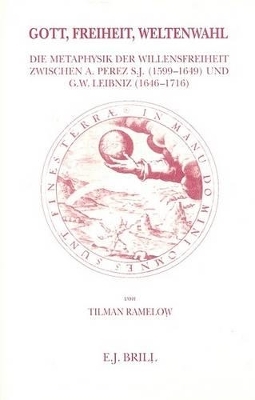
Gott, Freiheit, Weltenwahl
Der Ursprung des Begriffes der besten aller möglichen Welten in der Metaphysik der Willensfreiheit zwischen Antonio Perez S.J. (1599-1649) und G.W. Leibniz (1646-1716)
Seiten
1997
Brill (Verlag)
978-90-04-10641-3 (ISBN)
Brill (Verlag)
978-90-04-10641-3 (ISBN)
This study investigates hitherto unknown sources of Leibniz' thought in late scholasticism. It focusses on the idea of a "best of all possible worlds" and its origins in discussions about possibility, freedom and foreknowledge in the early modern period.
This study investigates the origins of the concept of "the best of all possible worlds". It exemplifies the character of modern metaphysics, which thinks mainly in terms of freedom and possibility. The book contains three parts. The first part tries to reconstruct this concept both historically and systematically; it deals with the concept of possibility beginning with High Scholasticism. The second part investigates the origins of this idea in the Jesuit theory of "scientia media", which is concerned with human freedom and divine foreknowledge. The third part deals with the question, whether there is any necessity to choose the best - a main theme in late scholastic thought of the 17th century.
This investigation of a concept unknown before the time of Leibniz, reveals many new sources and fills a gap in the history of ideas.
This study investigates the origins of the concept of "the best of all possible worlds". It exemplifies the character of modern metaphysics, which thinks mainly in terms of freedom and possibility. The book contains three parts. The first part tries to reconstruct this concept both historically and systematically; it deals with the concept of possibility beginning with High Scholasticism. The second part investigates the origins of this idea in the Jesuit theory of "scientia media", which is concerned with human freedom and divine foreknowledge. The third part deals with the question, whether there is any necessity to choose the best - a main theme in late scholastic thought of the 17th century.
This investigation of a concept unknown before the time of Leibniz, reveals many new sources and fills a gap in the history of ideas.
Tilman Ramelow, Dr.phil. (1995), University of Munich.
| Erscheint lt. Verlag | 1.1.1997 |
|---|---|
| Reihe/Serie | Brill's Studies in Intellectual History ; 72 |
| Verlagsort | Leiden |
| Sprache | deutsch |
| Maße | 155 x 235 mm |
| Gewicht | 1034 g |
| Einbandart | Leinen |
| Themenwelt | Geisteswissenschaften ► Philosophie ► Metaphysik / Ontologie |
| Geisteswissenschaften ► Religion / Theologie | |
| ISBN-10 | 90-04-10641-3 / 9004106413 |
| ISBN-13 | 978-90-04-10641-3 / 9789004106413 |
| Zustand | Neuware |
| Informationen gemäß Produktsicherheitsverordnung (GPSR) | |
| Haben Sie eine Frage zum Produkt? |
Mehr entdecken
aus dem Bereich


aus dem Bereich
eine philosophische Reise
Buch | Softcover (2024)
Goldmann (Verlag)
CHF 21,90


