


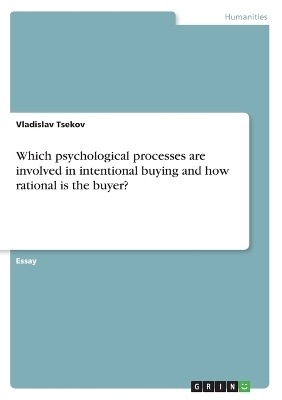
Which psychological processes are involved in intentional buying and how rational is the buyer?
Seiten
2018
|
18001 A. 1. Auflage
GRIN Verlag
9783668827653 (ISBN)
GRIN Verlag
9783668827653 (ISBN)
- Titel nicht im Sortiment
- Artikel merken
Essay from the year 2018 in the subject Psychology - Work, Business, Organisational and Economic Psychology, grade: A, University College London, language: English, abstract: Each day we face numerous decisions that determine the outcome of our life to a great extent. Whether we are rich or poor, happy or sad, good or bad - it all comes down to the decisions we make. It is therefore logical to assume that human beings have evolved to be experts in decision making. For decades, Economists, Psychologists and Philosophers have struggled to answer this question by conceptualizing the way people make decision and by coming up with models that explain judgment and decision making. Over the last few centuries, models of rationality have been constantly changing and evolving. In 1654, Blaise Pascal and Pierre Fermat had a prolonged discussion about human rationale in gambling scenarios, giving birth to the rational choice theory. Its main assumption is that humans take into consideration every available information, cost and benefit associated with a decision and proceed to select the best choice amongst all available alternatives - the one that maximizes Expected Utility. This model, however, is inherently flawed, as it ignores elements such as cognitive biases and mental shortcuts (also known as heuristics) that could lead to deviations from the assumption of perfectly rational decisions. In response to the limitations of the rational choice theory, Herbert Simon proposed the notion of bounded rationality to compensate for flaws in human thinking and to take into consideration environmental constraints when making a decision. Bounded rationality suggests that humans act as satisficers rather than maximizers, aimed at finding a decision that is good enough, taken the amount of information and time that were available for making the decision. This framework applies to any decision making process - including consumer behaviour. Therefore, this essay will argue that consumers are not perfectly rational agents, aimed at maximizing expected utility with each transaction. Rather, humans have inherent limitations to their information processing abilities leading to the development of cognitive biases and heuristics, which help them make decision faster and more efficient. This ability, however, comes at the cost of making suboptimal decision. To illustrate the point and to compare and contrast both models of rationality, we will use a practical example of a car purchase throughout the essay.
| Erscheinungsdatum | 02.12.2018 |
|---|---|
| Sprache | englisch |
| Maße | 148 x 210 mm |
| Gewicht | 44 g |
| Themenwelt | Geisteswissenschaften ► Psychologie ► Allgemeines / Lexika |
| Schlagworte | which |
| ISBN-13 | 9783668827653 / 9783668827653 |
| Zustand | Neuware |
| Informationen gemäß Produktsicherheitsverordnung (GPSR) | |
| Haben Sie eine Frage zum Produkt? |
Mehr entdecken
aus dem Bereich

aus dem Bereich
wie Ängste sich festsetzen und wie sie sich verwandeln lassen
Buch | Softcover (2023)
Herder (Verlag)
CHF 23,90


