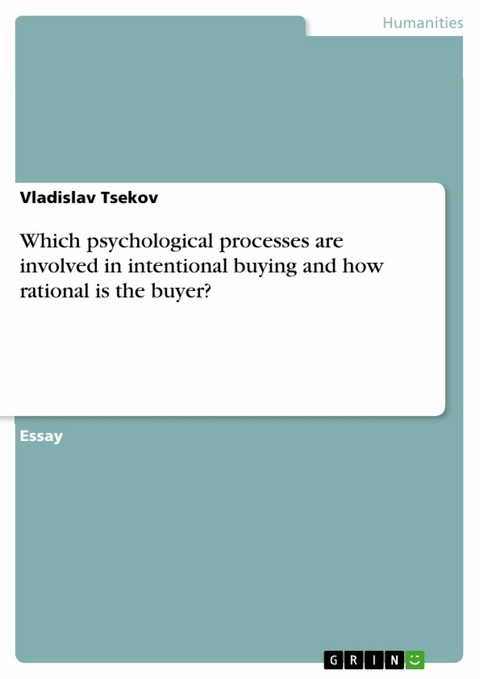
Which psychological processes are involved in intentional buying and how rational is the buyer? (eBook)
20 Seiten
GRIN Verlag
9783668827646 (ISBN)
For decades, Economists, Psychologists and Philosophers have struggled to answer this question by conceptualizing the way people make decision and by coming up with models that explain judgment and decision making. Over the last few centuries, models of rationality have been constantly changing and evolving. In 1654, Blaise Pascal and Pierre Fermat had a prolonged discussion about human rationale in gambling scenarios, giving birth to the rational choice theory. Its main assumption is that humans take into consideration every available information, cost and benefit associated with a decision and proceed to select the best choice amongst all available alternatives - the one that maximizes Expected Utility. This model, however, is inherently flawed, as it ignores elements such as cognitive biases and mental shortcuts (also known as heuristics) that could lead to deviations from the assumption of perfectly rational decisions. In response to the limitations of the rational choice theory, Herbert Simon proposed the notion of bounded rationality to compensate for flaws in human thinking and to take into consideration environmental constraints when making a decision. Bounded rationality suggests that humans act as satisficers rather than maximizers, aimed at finding a decision that is good enough, taken the amount of information and time that were available for making the decision. This framework applies to any decision making process – including consumer behaviour.
Therefore, this essay will argue that consumers are not perfectly rational agents, aimed at maximizing expected utility with each transaction. Rather, humans have inherent limitations to their information processing abilities leading to the development of cognitive biases and heuristics, which help them make decision faster and more efficient. This ability, however, comes at the cost of making suboptimal decision. To illustrate the point and to compare and contrast both models of rationality, we will use a practical example of a car purchase throughout the essay.
| Erscheint lt. Verlag | 2.11.2018 |
|---|---|
| Verlagsort | München |
| Sprache | englisch |
| Themenwelt | Geisteswissenschaften ► Psychologie ► Arbeits- und Organisationspsychologie |
| Schlagworte | which |
| ISBN-13 | 9783668827646 / 9783668827646 |
| Informationen gemäß Produktsicherheitsverordnung (GPSR) | |
| Haben Sie eine Frage zum Produkt? |
 PDF (Ohne DRM)
Digital Rights Management: ohne DRM
Dieses eBook enthält kein DRM oder Kopierschutz. Eine Weitergabe an Dritte ist jedoch rechtlich nicht zulässig, weil Sie beim Kauf nur die Rechte an der persönlichen Nutzung erwerben.
Dateiformat: PDF (Portable Document Format)
Mit einem festen Seitenlayout eignet sich die PDF besonders für Fachbücher mit Spalten, Tabellen und Abbildungen. Eine PDF kann auf fast allen Geräten angezeigt werden, ist aber für kleine Displays (Smartphone, eReader) nur eingeschränkt geeignet.
Systemvoraussetzungen:
PC/Mac: Mit einem PC oder Mac können Sie dieses eBook lesen. Sie benötigen dafür einen PDF-Viewer - z.B. den Adobe Reader oder Adobe Digital Editions.
eReader: Dieses eBook kann mit (fast) allen eBook-Readern gelesen werden. Mit dem amazon-Kindle ist es aber nicht kompatibel.
Smartphone/Tablet: Egal ob Apple oder Android, dieses eBook können Sie lesen. Sie benötigen dafür einen PDF-Viewer - z.B. die kostenlose Adobe Digital Editions-App.
Buying eBooks from abroad
For tax law reasons we can sell eBooks just within Germany and Switzerland. Regrettably we cannot fulfill eBook-orders from other countries.
aus dem Bereich