Century of Segregation (eBook)
278 Seiten
Lexington Books (Verlag)
978-1-4985-6470-0 (ISBN)
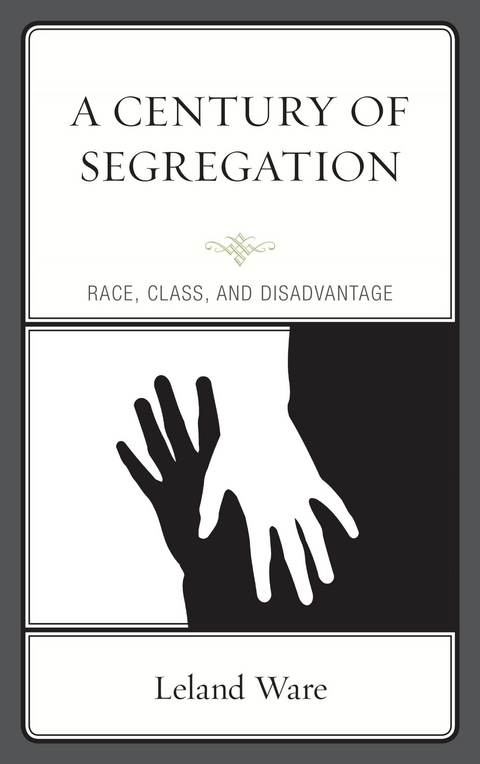
This book explains how race and class intersect in ways that uniquely disadvantage racial minorities. The narrative begins with the 1896 decision in Plessy v. Ferguson. The Supreme Court ruled that separate facilities for blacks were permissible under the Fourteenth Amendment if they were "e;equal"e; to those reserved for whites. One reaction was the establishment of the NAACP to lead the fight for Civil Rights. After more than two decades of lobbying and public education, a long-range, carefully orchestrated, litigation campaign was launched. Segregation would be challenged with lawsuits insisting that black schools be made physically and otherwise equal to white schools. The lawyers calculated that the resulting burden and expense would ultimately cause segregation to collapse under its own weight.A series of successful "e;equalization"e; suits spanning over two decades laid the foundation for the direct challenge in Brown v. Board of Education. That 1954 decision inspired a large-scale, grass roots Civil Rights Movement. A decade of marches, boycotts, and mass protests persuaded Congress to enact the Civil Rights laws of the 1960s.Today, conditions for ethnic minorities are far better than they were a generation ago. However, the story of the nation's black and brown communities is a tale of two cities; one prosperous, educated and affluent adjacent to another suffering from grinding poverty and a lack of opportunities for advancement. For those able to take advantage of the opportunities created by the Civil Rights revolution, the gains have been dramatic. For those left behind in impoverished communities, the obstacles to advancement are more daunting today than they were a generation ago.
Leland Ware is the Louis L. Redding Chair for the Study of Law and Public Policy at the University of Delaware
Chapter 1: Plessy v. Ferguson and the NAACP’s Battle Against SegregationChapter 2: The School Desegregation CampaignChapter 3: Fordice, Black Colleges and the Duty to DesegregateChapter 4: The Curriculum’s Implicit BiasChapter 5: Diversity, Inclusion and Affirmative ActionChapter 6: America’s Apartheid: Residential SegregationChapter 7: The Persistence of Isolated Neighborhoods and Segregated SchoolsChapter 8: Discipline DisparitiesChapter 9: Latino/as and Asians: America’s Changing DemographicsChapter 10: Racial Resentment, Presidential Campaigns and Donald TrumpChapter 11: The Promised Land
| Erscheint lt. Verlag | 18.10.2018 |
|---|---|
| Zusatzinfo | 1 Illustrations including: - 1 Tables. |
| Verlagsort | Lanham |
| Sprache | englisch |
| Themenwelt | Geisteswissenschaften ► Geschichte ► Regional- / Ländergeschichte |
| Sozialwissenschaften ► Politik / Verwaltung ► Staat / Verwaltung | |
| Schlagworte | Brown v. Board of Education • Civil Rights • Civil Rights Laws • judicial branch • NAACP • school desegregation • Segregation • Separate but Equal • Supreme Court • the civil rights movement • The Supreme Court and Civil Rights • Thurgood Marshall |
| ISBN-10 | 1-4985-6470-4 / 1498564704 |
| ISBN-13 | 978-1-4985-6470-0 / 9781498564700 |
| Informationen gemäß Produktsicherheitsverordnung (GPSR) | |
| Haben Sie eine Frage zum Produkt? |
 EPUB (Adobe DRM)
Kopierschutz: Adobe-DRM
Adobe-DRM ist ein Kopierschutz, der das eBook vor Mißbrauch schützen soll. Dabei wird das eBook bereits beim Download auf Ihre persönliche Adobe-ID autorisiert. Lesen können Sie das eBook dann nur auf den Geräten, welche ebenfalls auf Ihre Adobe-ID registriert sind.
Details zum Adobe-DRM
Dateiformat: EPUB (Electronic Publication)
EPUB ist ein offener Standard für eBooks und eignet sich besonders zur Darstellung von Belletristik und Sachbüchern. Der Fließtext wird dynamisch an die Display- und Schriftgröße angepasst. Auch für mobile Lesegeräte ist EPUB daher gut geeignet.
Systemvoraussetzungen:
PC/Mac: Mit einem PC oder Mac können Sie dieses eBook lesen. Sie benötigen eine
eReader: Dieses eBook kann mit (fast) allen eBook-Readern gelesen werden. Mit dem amazon-Kindle ist es aber nicht kompatibel.
Smartphone/Tablet: Egal ob Apple oder Android, dieses eBook können Sie lesen. Sie benötigen eine
Geräteliste und zusätzliche Hinweise
Buying eBooks from abroad
For tax law reasons we can sell eBooks just within Germany and Switzerland. Regrettably we cannot fulfill eBook-orders from other countries.
aus dem Bereich