Psychosis, Trauma and Dissociation (eBook)
John Wiley & Sons (Verlag)
978-1-118-58602-0 (ISBN)
An invaluable sourcebook on the complex relationship between psychosis, trauma, and dissociation, thoroughly revised and updated
This revised and updated second edition of Psychosis, Trauma and Dissociation offers an important resource that takes a wide-ranging and in-depth look at the multifaceted relationship between trauma, dissociation and psychosis. The editors - leaders in their field - have drawn together more than fifty noted experts from around the world, to canvas the relevant literature from historical, conceptual, empirical and clinical perspectives. The result documents the impressive gains made over the past ten years in understanding multiple aspects of the interface between trauma, dissociation and psychosis.
The historical/conceptual section clarifies the meaning of the terms dissociation, trauma and psychosis, proposes dissociation as central to the historical concepts of schizophrenia and borderline personality disorder, and considers unique development perspectives on delusions and the onset of schizophrenia. The empirical section of the text compares and contrasts psychotic and dissociative disorders from a wide range of perspectives, including phenomenology, childhood trauma, and memory and cognitive disturbances, whilst the clinical section focuses on the assessment, differential diagnosis and treatment of these disorders, along with proposals for new and novel hybrid disorders. This important resource:
• Offers extensive updated coverage of the field, from all relevant perspectives
• Brings together in one text contributions from scholars and clinicians working in diverse geographical and theoretical areas
• Helps define and bring cohesion to this new and important field
• Features nine new chapters on: conceptions of trauma, dissociation and psychosis, PTSD with psychotic features, delusions and memory, trauma treatment of psychotic symptoms, and differences between the diagnostic groups on hypnotizability, memory disturbances, brain imaging, auditory verbal hallucinations and psychological testing
Written for clinicians, researchers and academics in the areas of trauma, child abuse, dissociation and psychosis, but relevant for psychiatrists, psychologists and psychotherapists working in any area, the revised second edition of Psychosis, Trauma and Dissociation makes an invaluable contribution to this important evolving field.
The Editors
Andrew Moskowitz, PhD, Professor of Psychology, Dean of Undergraduate Programs, Touro College Berlin, Berlin, Germany.
Martin J. Dorahy, PhD, Professor of Psychology, University of Canterbury, Christchurch, New Zealand.
Ingo Schäfer, MD, MPH, Professor, Department of Psychiatry and Psychotherapy, University Medical Center Hamburg-Eppendorf, University of Hamburg, Hamburg, Germany.
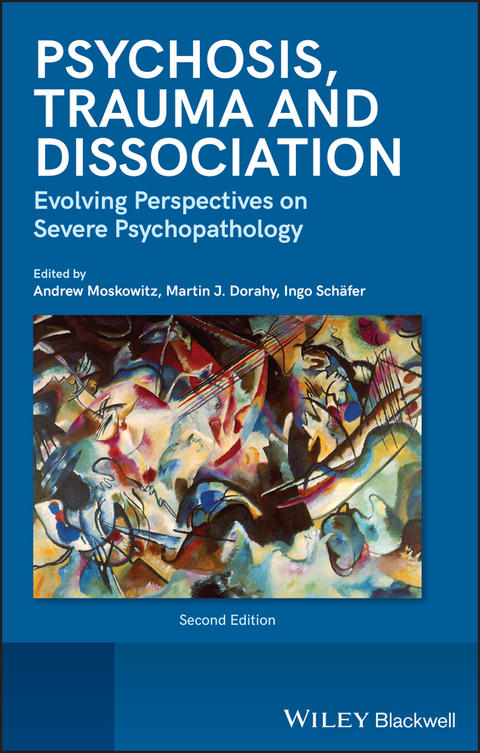
The painting on the front cover, Composition VI, was created by Wassily Kandinsky in 1913. Inspired by the Biblical story of the Great Flood, Kandinsky drew on themes of destruction and rebirth in developing these images.
An invaluable sourcebook on the complex relationship between psychosis, trauma, and dissociation, thoroughly revised and updated This revised and updated second edition of Psychosis, Trauma and Dissociation offers an important resource that takes a wide-ranging and in-depth look at the multifaceted relationship between trauma, dissociation and psychosis. The editors leaders in their field have drawn together more than fifty noted experts from around the world, to canvas the relevant literature from historical, conceptual, empirical and clinical perspectives. The result documents the impressive gains made over the past ten years in understanding multiple aspects of the interface between trauma, dissociation and psychosis. The historical/conceptual section clarifies the meaning of the terms dissociation, trauma and psychosis, proposes dissociation as central to the historical concepts of schizophrenia and borderline personality disorder, and considers unique development perspectives on delusions and the onset of schizophrenia. The empirical section of the text compares and contrasts psychotic and dissociative disorders from a wide range of perspectives, including phenomenology, childhood trauma, and memory and cognitive disturbances, whilst the clinical section focuses on the assessment, differential diagnosis and treatment of these disorders, along with proposals for new and novel hybrid disorders. This important resource: Offers extensive updated coverage of the field, from all relevant perspectives Brings together in one text contributions from scholars and clinicians working in diverse geographical and theoretical areas Helps define and bring cohesion to this new and important field Features nine new chapters on: conceptions of trauma, dissociation and psychosis, PTSD with psychotic features, delusions and memory, trauma treatment of psychotic symptoms, and differences between the diagnostic groups on hypnotizability, memory disturbances, brain imaging, auditory verbal hallucinations and psychological testing Written for clinicians, researchers and academics in the areas of trauma, child abuse, dissociation and psychosis, but relevant for psychiatrists, psychologists and psychotherapists working in any area, the revised second edition of Psychosis, Trauma and Dissociation makes an invaluable contribution to this important evolving field.
The Editors Andrew Moskowitz, PhD, Professor of Psychology, Dean of Undergraduate Programs, Touro College Berlin, Berlin, Germany. Martin J. Dorahy, PhD, Professor of Psychology, University of Canterbury, Christchurch, New Zealand. Ingo Schäfer, MD, MPH, Professor, Department of Psychiatry and Psychotherapy, University Medical Center Hamburg-Eppendorf, University of Hamburg, Hamburg, Germany. The painting on the front cover, Composition VI, was created by Wassily Kandinsky in 1913. Inspired by the Biblical story of the Great Flood, Kandinsky drew on themes of destruction and rebirth in developing these images.
"This volume is highly recommended to clinicians and researchers as an excellent resource of contemporary thinking in understanding some of the many complex ways that individuals respond to traumatic experiences"
- Pamela R. Fuller, Fronteir Psychological Associates
PTD includes outstanding contributions from international experts and provides a comprehensive view of its topics, particularly with respect to conceptual and research issues. The editors have interspersed throughout the book parentheses leading the reader to other related chapters, but a summarizing contribution would have been welcome. That small qualm notwithstanding, PTD is essential reading for anyone wanting to understand how trauma, dissociation, and psychosis both converge and diverge. (Journal of Trauma and Dissociation, July 2020)
This book is a much needed, comprehensive attempt to fill the gap in understanding of the complexities of psychosis, trauma and dissociation. The topic is addressed by world-recognized, highly experienced clinicians and researchers in the field - first historical aspects and where it all began; then research and emerging evidence of the role of trauma in mental illnesses; lastly the clinical experience which informs research. The section on clinical perspectives succeeds in linking trauma with dissociation and psychosis and will appeal not only to like-minded clinicians, to clinicians who are grappling with these concepts, but also to those who have resisted change. The historical section refers to Bleuler's dementia praecox which he first called schizophrenia and described cases with "split mind" in ways that we would now describe as dissociative disorders. I recommend this revised edition - an invaluable resource to all mental health clinicians - psychiatrists, psychologists and psychotherapists alike.
- Joan Haliburn, Australasian Psychiatry, 2019, Vol. 27(6)655-656
Notes on Contributors
Volkmar Aderhold, MD, works at the Institute for Social Psychiatry at the University of Greifswald, Germany. He has worked in psychiatry and psychotherapy for more than 35 years and was for 10 years senior psychiatrist at the Department of Psychiatry and Psychotherapy of the University of Hamburg Hospital in Eppendorf. Dr Aderhold teaches systemic therapy and counseling and has developed special trainings for teaching the Open Dialogue approach to multi‐professional teams, often including experts by experience. He has published important critical papers on antipsychotic medications, including connections to mortality and brain damage, and approaches to minimizing their usage.
Cherie Armour, PhD, is Professor of Psychological Trauma and Mental Health in the School of Psychology, as well as Associate Dean for Research and Impact in the Faculty of Life and Health Sciences, at Ulster University, UK. Her research utilizes large‐scale epidemiological data to examine the prevalence of trauma experiences and psychological disorders. A focus of Professor Armour’s research has been the categorization of Post‐traumatic Stress Disorder in the Diagnostic and Statistical Manual of Mental Disorders, particularly with regard to the validity of PTSD symptom groups and the dissociative PTSD subtype.
Ruth A. Blizard, PhD, is a clinical psychologist practicing in the Binghamton area (New York State, USA) with over 35 years of experience in treating persons with severe trauma, dissociation, and personality disorders. She has published articles integrating psychoanalytic concepts and attachment theory in the treatment of trauma, borderline personality, psychosis, and the spectrum of dissociative disorders. She is on the editorial board of the Journal of Trauma and Dissociation.
Bethany L. Brand, PhD, is the Martha A. Mitten Professor at Towson University (Maryland, USA), where she directs the Clinical Focus program for students planning on entering the mental health field. Dr Brand specializes in the assessment and treatment of trauma‐related disorders and has published more than 90 articles and chapters, mostly in the area of trauma and attachment. She has served on national and international task forces that developed guidelines for the assessment and treatment of trauma‐related disorders. Dr Brand is the Principal Investigator on a series of international treatment studies of individuals with dissociative disorders.
Renn Cannon, BS, holds her Psychology degree from Towson University (Maryland, USA). She is an online education specialist, who focuses on utilizing new and emerging technologies to improve learning outcomes for all students, including those with learning differences or accessibility needs.
Dirk Corstens, drs., is a Dutch physician and psychotherapist, working as a senior consultant psychiatrist in Roermond at METggz, a community mental health centre. He is an expert in the ‘Maastricht approach’ to working with persons who hear voices and in peer‐supported Open Dialogue and has delivered workshops on these topics throughout Europe. Dr Corstens has published extensively on collaborative approaches to talking with, and making sense of, one's voices and is involved in research projects in these areas. He is on the board of ‘Intervoice’, an international online community of hearing voices networks.
Ask Elklit, MPsych, is Professor of Clinical Psychology at the Institute of Psychology at the University of Southern Denmark (Odense, Denmark) and director of the Danish National Centre for Psychotraumatology. He is a licensed psychologist and psychotherapist and has a private practice focusing on personality disorders and severely traumatized clients. Professor Elklit was the co‐founder of the first Danish centre for rape victims and has conducted research on intensive language learning (utilizing Suggestopedia) as a treatment for traumatized refugees. For a decade, he has supervised psychotherapists in several Danish rehabilitation centres for torture victims.
A.D.M.A.C. (Sandra) Escher, MPhil, PhD began her career in journalism before joining the Social Psychiatry department at Maastricht University (Netherlands). Along with Professor Marius Romme and several ‘voice hearers’ (persons who hear voices), she founded the international Hearing Voices Movement and helped to develop the Maastricht approach to working with voice hearers, emphasizing voice hearing as a common human experience. Dr Escher conducted ground‐breaking research on voice hearing in children. With Professor Romme, she has published numerous articles and book chapters and five books, including Making Sense of Voices (2000), Children Hearing Voices (2010), and Psychosis as a Personal Crisis (2011).
Roar Fosse, PhD, is a Senior Research Scientist at the Division of Mental Health and Addiction, Vestre Viken Hospital Trust, Norway. His research interests include psychosocial and biogenetic factors in the aetiology of psychosis; epigenetic and neurobiological mechanisms that link psychosocial stress exposure and the development of severe mental disorders; and evaluating novel treatment models for various mental health difficulties including suicidality, violence, and severe and composite mental disorders.
Harald J. Freyberger, MD, is Professor of Psychiatry, Psychotherapy and Psychosomatic Medicine at the University of Greifswald and Director of the associated Department of Psychiatry and Psychotherapy in Stralsund, Germany. He conducts psychotherapy research, as well as research concerning mental health systems, related to diagnosis and classification, dissociation, and trauma‐related disorders. Professor Freyberger is editor of the German‐language journals Trauma und Gewalt and Psychotherapeut and is a member of the editorial board of the journal Psychotherapy and Psychosomatics.
Cherrie Galletly, MBChB, DPM, FRANZCP, PhD, is Professor of Psychiatry at the University of Adelaide and Ramsay Health Care Mental Health (South Australia, Australia) and Regional Director of Training at the Northern Adelaide Local Health Network. She led the writing of the RANZCP Clinical Practice Guidelines for Schizophrenia and Related Disorders (2016). Professor Galletly has received numerous grants for her research in the areas of schizophrenia, PTSD, and depression, and has published more than 160 papers. She is an Associate Editor of the Australian and New Zealand Journal of Psychiatry.
Jim Geekie, PhD, is a clinical psychologist, currently working in Edinburgh (UK) for NHS Lothian and as a clinical tutor on the University of Edinburgh clinical psychology training programme. Prior to moving back to Scotland, he worked predominately in the area of early intervention for psychosis in New Zealand and England. His publications include Making Sense of Madness (Geekie & Read, 2011) and Experiencing Psychosis (Geekie, Randal, Lampshire, & Read, 2009), both of which focus on the subjective experience of psychosis.
Anabel Gonzalez, MD, PhD, is a psychiatrist and psychotherapist, working at the University Hospital of A Coruña (Spain) where she coordinates the Trauma and Dissociation Program and training in psychotherapy for psychiatry residents. She belongs to the Board of the European Society for Trauma and Dissociation and is Vice President of the EMDR (Eye Movement Desensitization and Reprocessing) Spanish Association. Dr Gonzales leads several ongoing research projects, and has published numerous articles on dissociation, trauma, and EMDR. She has published four books, including EMDR and Dissociation (2012) and I am not myself: Understanding Complex Trauma, Attachment and Dissociation (2018).
Melissa J. Green, PhD, is Associate Professor in the School of Psychiatry at the University of New South Wales (Sydney, Australia). Her research focuses on the development of psychotic and related mental disorders using a combination of techniques from cognitive psychology, neuroscience, genetics, and epidemiology.
Andrew Gumley, PhD, is Professor of Psychological Therapy in the Institute of Health and Wellbeing, University of Glasgow (UK) where he leads the Psychosis Research Group. His research focuses on the cognitive and interpersonal mechanisms of relapse in people with psychosis and the development and evaluation of complex interventions to enhance recovery. He is also a Chartered Clinical Psychologist and is Honorary Consultant Clinical Psychologist in NHS Greater Glasgow & Clyde.
Holly K. Hamilton, PhD, is a clinical research fellow at the San Francisco Veterans Affairs Health Care System and the University of California, San Francisco (USA). Her research focuses on the neural mechanisms of abnormal sensory, perceptual, and cognitive processes in schizophrenia spectrum disorders.
Gerhard Heim, Dr rer. soc., is a Psychotherapist working in Berlin (Germany) and is an expert on the theory and therapeutic approaches of the French physician and philosopher Pierre Janet and his relevance for contemporary approaches to psychotherapy. Since 2004, he has been President of the German Pierre‐Janet‐Gesellschaft (founded 2001). In addition to Pierre Janet, Dr Heim has research interests in, and has published on, the topics of psychopathology and the history of clinical psychology.
Markus Heinimaa, MD, PhD, is a psychiatrist, family therapy trainer, and EMDR (Eye Movement Desensitization and Reprocessing) specialist from Finland. In...
| Erscheint lt. Verlag | 13.11.2018 |
|---|---|
| Sprache | englisch |
| Themenwelt | Geisteswissenschaften ► Psychologie ► Klinische Psychologie |
| Medizin / Pharmazie ► Gesundheitsfachberufe | |
| Medizin / Pharmazie ► Medizinische Fachgebiete ► Psychiatrie / Psychotherapie | |
| Schlagworte | after childhood adversity • attachment perspective • auditory verbal hallucination • Borderline Personality Disorder • childhood delusions • childhood memory • Childhood Trauma • chronic relational trauma disorder • Clinical psychology • cognitive perspectives • defining dissociation • defining psychosis • defining trauma • depersonalization disorder • derealization disorder • Disorganized attachment • Dissociation • dissociation hypothesis • Dissociative disorders • dissociative psychosis • dissociative schizophrenia • dissociative symptoms • ego-fragmentation in schizophrenia • field of psychosis • Hearing Voices • Hypnotizability • hysteria • hysterical psychosis • Klinische Psychologie • Medical Science • Medizin • memory disturbances • mentalization • Phenomenology • Posttraumatic stress disorder • Psychiatrie • Psychiatry • Psychodynamics • Psychologie • Psychology • Psychosis • Psychotherapie u. Beratung • Psychotherapy & Counseling • psychotic disorders • psychotic features • psychotic symptoms • PTSD • Schizophrenia • Schizophrenia spectrum disorders • schizophrenia subtypes • schizotypal personality disorder • structural brain • the double bind • the maastricht approach • threat processing • Trauma • treating dissociative disorders • treating psychotic disorders |
| ISBN-10 | 1-118-58602-6 / 1118586026 |
| ISBN-13 | 978-1-118-58602-0 / 9781118586020 |
| Informationen gemäß Produktsicherheitsverordnung (GPSR) | |
| Haben Sie eine Frage zum Produkt? |
 EPUB (Adobe DRM)
Kopierschutz: Adobe-DRM
Adobe-DRM ist ein Kopierschutz, der das eBook vor Mißbrauch schützen soll. Dabei wird das eBook bereits beim Download auf Ihre persönliche Adobe-ID autorisiert. Lesen können Sie das eBook dann nur auf den Geräten, welche ebenfalls auf Ihre Adobe-ID registriert sind.
Details zum Adobe-DRM
Dateiformat: EPUB (Electronic Publication)
EPUB ist ein offener Standard für eBooks und eignet sich besonders zur Darstellung von Belletristik und Sachbüchern. Der Fließtext wird dynamisch an die Display- und Schriftgröße angepasst. Auch für mobile Lesegeräte ist EPUB daher gut geeignet.
Systemvoraussetzungen:
PC/Mac: Mit einem PC oder Mac können Sie dieses eBook lesen. Sie benötigen eine
eReader: Dieses eBook kann mit (fast) allen eBook-Readern gelesen werden. Mit dem amazon-Kindle ist es aber nicht kompatibel.
Smartphone/Tablet: Egal ob Apple oder Android, dieses eBook können Sie lesen. Sie benötigen eine
Geräteliste und zusätzliche Hinweise
Buying eBooks from abroad
For tax law reasons we can sell eBooks just within Germany and Switzerland. Regrettably we cannot fulfill eBook-orders from other countries.
aus dem Bereich