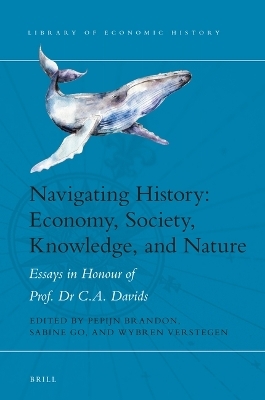
Navigating History: Economy, Society, Knowledge, and Nature
Brill (Verlag)
978-90-04-38155-1 (ISBN)
Contributors are: Ulbe Bosma, Pepijn Brandon, Jaap Bruijn, Petra van Dam, Victor Enthoven, Sabine Go, Marjolein ’t Hart, Raoul De Kerf, Jan Lucassen, Karin Lurvink, Joel Mokyr, Marijn Molema, Bert de Munck, Pál Nyiri, Harm Pieters, Matthias van Rossum, Joost Schokkenbroek, Jeroen Touwen, Wybren Verstegen, and Jan Luiten van Zanden.
Pepijn Brandon is Assistant Professor in Social and Economic History at VU Amsterdam and Senior Researcher at the International Institute of Social History. He obtained his PhD from the University of Amsterdam in 2013. His research focuses on connections between capitalist development, war, and slavery. He is author of War, capital, and the Dutch state (1588-1795) (Leiden/Boston: Brill, 2015), and a member of the editorial committee of the International Review of Social History. Sabine Go is Assistant Professor of Accounting at the School of Business and Economics of VU Amsterdam. She is particularly interested in the emergence and development of economic institutions during early modern and modern times in the Low Countries. Her current research focuses on contract enforcement and governance issues. She collaborates as Senior Visiting Fellow in an ERC Consolidator Grant Project on General Average, Transaction Costs and Risk Management during the First Globalization. Wybren Verstegen is Assistant Professor in Economic and Social History at VU Amsterdam. He teaches Global History, the History of the United States and the US South. His dissertation about nobility and society in the revolutionary era in Veluwe-district (in the east of the Netherlands) was published in 1989. He has written many scientific and newspaper articles concerning environmental history and sustainability. Recently he published the book Vrije wandeling. Het parlement, de fiscus en de bescherming van het particuliere Nederlandse natuurschoon tussen 1924-1995 (Groningen: Historia Agriculturae, 2017) as well as several articles about nature protection on estates in the Netherlands in the twentieth century.
Preface
Pepijn Brandon, Sabine Go, and Wybren Verstegen
List of Illustrations
List of Contributors
Introduction: Davids and Goliath: How Books Helped to Combat Historians’ Adversaries
Marjolein Hart’t and Jan Lucassen
Section 1: Resources of Knowledge, Cultures of Learning
1 Religion, Culture and the Great Enrichment
Joel Mokyr
2 Wandering about the Learning Market: Early Modern Apprenticeship in Antwerp Gold- and Silversmith Ateliers
Bert De Munck and Raoul De Kerf
3 Educating World Citizens: The Rise of International Education in the Twenty-first Century
Pál Nyiri
Section 2: Institutions for a Global Economy
4 A Changing Landscape: Institutions and Institutional Change in the Dutch Economy
Jeroen Touwen
5 Social Partnership in the Northern Netherlands (1985-?)
Marijn Molema
Section 3: Chasing Whales, Crossing Oceans
5 Zaanse Jonas: Zaan Whaling and Shipbuilding in the Seventeenth Century
Victor Enthoven
7 Keeping Risk at Bay: Risk Management and Insurance in Eighteenth-century Dutch Whaling
Sabine Go and Jaap Bruijn
8 Figuring Out Global and Local Relations: Cantonese Face-makers and their Sitters in the 18th Century
Joost C.A. Schokkenbroek
Section 4: Chains of Profit, Chains of Labour
9 Chasing the Delfland: Slave Revolts, Enslavement, and (Private) voc Networks in Early Modern Asia
Matthias van Rossum
10 “With the Power of Language and the Force of Reason”: An Amsterdam Banker’s Fight for Slave Owners’ Compensation
Pepijn Brandon and Karin Lurvink
11 Up and Down the Chain: Sugar Refiners’ Responses to Changing Food Regimes
Ulbe Bosma
Section 5: Humans and their Natural Environment
12 Enlightened Ideas in Commemoration Books of the 1825 Zuiderzee Flood in the Netherlands
Petra J.E.M. van Dam and Harm Pieters
13 Secret and Stillborn: A Dutch Fiscal Bill from 1947 to Protect Both Nature and Monuments on Dutch Estates
Wybren Verstegen
14 Birds in Texel in 1910 and the Shifting Baseline Syndrome
Jan Luiten van Zanden
List of Publications of Karel Davids 1973–2017
List of Doctoral Theses Supervised by Karel Davids (1997-May 2018)
Index of Names and Geographic Locations
| Erscheinungsdatum | 09.11.2018 |
|---|---|
| Reihe/Serie | Library of Economic History ; 11 |
| Verlagsort | Leiden |
| Sprache | englisch |
| Maße | 155 x 235 mm |
| Gewicht | 714 g |
| Themenwelt | Geisteswissenschaften ► Geschichte ► Allgemeine Geschichte |
| Geschichte ► Teilgebiete der Geschichte ► Wirtschaftsgeschichte | |
| ISBN-10 | 90-04-38155-4 / 9004381554 |
| ISBN-13 | 978-90-04-38155-1 / 9789004381551 |
| Zustand | Neuware |
| Informationen gemäß Produktsicherheitsverordnung (GPSR) | |
| Haben Sie eine Frage zum Produkt? |
aus dem Bereich