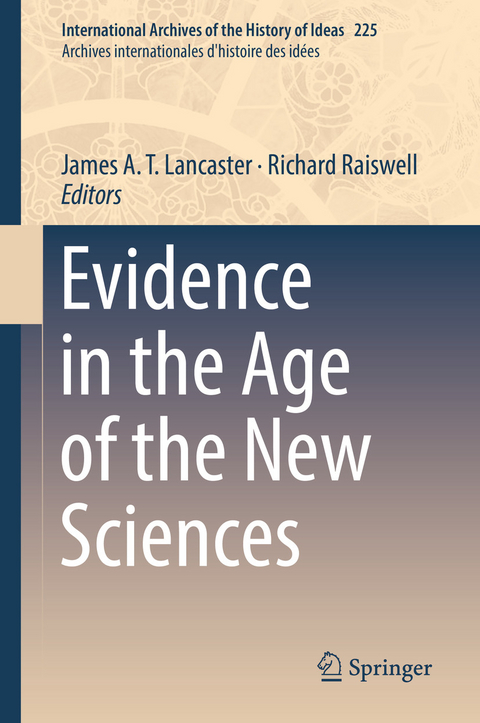
Evidence in the Age of the New Sciences (eBook)
XVIII, 309 Seiten
Springer International Publishing (Verlag)
9783319918693 (ISBN)
The motto of the Royal Society-Nullius in verba-was intended to highlight the members' rejection of received knowledge and the new place they afforded direct empirical evidence in their quest for genuine, useful knowledge about the world. But while many studies have raised questions about the construction, reception and authentication of knowledge, Evidence in the Age of the New Sciences is the first to examine the problem of evidence at this pivotal moment in European intellectual history. What constituted evidence-and for whom? Where might it be found? How should it be collected and organized? What is the relationship between evidence and proof? These are crucial questions, for what constitutes evidence determines how people interrogate the world and the kind of arguments they make about it.
In this important new collection, Lancaster and Raiswell have assembled twelve studies that capture aspects of the debate over evidence in a variety of intellectual contexts. From law and theology to geography, medicine and experimental philosophy, the chapters highlight the great diversity of approaches to evidence-gathering that existed side by side in the sixteenth and seventeenth centuries. In this way, the volume makes an important addition to the literature on early science and knowledge formation, and will be of particular interest to scholars and advanced students in these fields.
James A. T. Lancaster is an intellectual historian who received his PhD from the Warburg Institute in the University of London. He is currently a UQ Research Fellow at the Institute for Advanced Studies in the Humanities (IASH) and Affiliate Academic in the School of Historical and Philosophical Inquiry (HAPI) at the University of Queensland. Previously, he was a Visiting Lecturer and Teaching Fellow in the Department of History at Royal Holloway, University of London. As a member of the Editorial Board of the Oxford Francis Bacon critical edition, he has published articles and book chapters on the philosophical and religious thought of Francis Bacon. His recent publications include a co-edited special issue of Intellectual History Review on early modern anticlericalism: 'Priestcraft. Early Modern Variations on the Theme of Sacerdotal Imposture'.
Richard Raiswell is Associate Professor of History at the University of Prince Edward Island, a Fellow at the Centre for Reformation and Renaissance Studies (Toronto), a member of the Executive Committee of Scientiae: Disciplines of Knowing in the Early Modern World, and a founding editor of the journal Preternature (Penn State). His research is concerned with questions about the construction and assimilation of knowledge in the late medieval and early modern periods, especially responses to the new empiricism in the fields of demonology and geography. Recent work includes Knowing Demons, Knowing Spirits (forthcoming with Michelle Brock and David Winter), 'Edward Terry and the Calvinist Geography of India,' in Études anglaises and The Devil in Society in Premodern Europe (with Peter Dendle). He is currently working on a primary source reader on medieval demonology for the University of Toronto's Readings in Medieval Civilizations and Cultures series.
James A. T. Lancaster is an intellectual historian who received his PhD from the Warburg Institute in the University of London. He is currently a UQ Research Fellow at the Institute for Advanced Studies in the Humanities (IASH) and Affiliate Academic in the School of Historical and Philosophical Inquiry (HAPI) at the University of Queensland. Previously, he was a Visiting Lecturer and Teaching Fellow in the Department of History at Royal Holloway, University of London. As a member of the Editorial Board of the Oxford Francis Bacon critical edition, he has published articles and book chapters on the philosophical and religious thought of Francis Bacon. His recent publications include a co-edited special issue of Intellectual History Review on early modern anticlericalism: “Priestcraft. Early Modern Variations on the Theme of Sacerdotal Imposture”.Richard Raiswell is Associate Professor of History at the University of Prince Edward Island, a Fellow at the Centre for Reformation and Renaissance Studies (Toronto), a member of the Executive Committee of Scientiae: Disciplines of Knowing in the Early Modern World, and a founding editor of the journal Preternature (Penn State). His research is concerned with questions about the construction and assimilation of knowledge in the late medieval and early modern periods, especially responses to the new empiricism in the fields of demonology and geography. Recent work includes Knowing Demons, Knowing Spirits (forthcoming with Michelle Brock and David Winter), “Edward Terry and the Calvinist Geography of India,” in Études anglaises and The Devil in Society in Premodern Europe (with Peter Dendle). He is currently working on a primary source reader on medieval demonology for the University of Toronto’s Readings in Medieval Civilizations and Cultures series.
Chapter 1: Evidence and the Disciplines of Knowing in Early Modern Europe (James A.T. Lancaster).- Part I: Evidence & Method.- Chapter 2: Legal Proof and Probability in Early Modern England (Lisa Klotz).- Chapter 3: Seeking Intellectual Evidence in the Sciences: The Role of Botany in Descartes’ Therapeutics (Fabrizio Baldassarri).- Chapter 4: Towards Descartes’ Scientific Method of Doubt: a posteriori Evidence and The Rhetoric of Les Météores (Patrick Brissey).- Part II: Instruments of Evidence & Observation.- Chapter 5: Locke, Pyrard, and Coconuts: Travel Literature as Natural History (Patrick J. Connolly).- Chapter 6: The Visibility of the Romana Ecclesia: Cesare Baronio and the Disclosure of the Invisible (Filip Malesevic).- Chapter 7: From the divine monochord to the weather-glass: Changing perspectives in Robert Fludd’s philosophy (Luca Guariento).- Chapter 8: Magical and Mechanical Evidence: The Late-Renaissance Automata of Francesco I de’ Medici (Lily Filson).- Part III: Assessing & Assimilating Evidence in its Contexts.- Chapter 9: Searching for Mt. Carmel in the New World: Fray Antonio Vázquez de Espinosa and Confessional Geography (Ran Segev).- Chapter 10: Hutchinsonianism, Newtonian Science, and the Question of Evidence in a Fragmenting World (Robert L. Knetsch).- Chapter 11: Diet and Hygiene between Ethics and Medicine: The Reception of Alvise Cornaro’s La Vita Sobria in Early XVII Century England (Federico Bellini).- Chapter 12: Prognostic birds and vulgar errors. Popular naturalism in early modern England, 1550-1800 (Jennifer Mori).
| Erscheint lt. Verlag | 24.10.2018 |
|---|---|
| Reihe/Serie | International Archives of the History of Ideas Archives internationales d'histoire des idées | International Archives of the History of Ideas Archives internationales d'histoire des idées |
| Zusatzinfo | XVIII, 309 p. 36 illus. |
| Verlagsort | Cham |
| Sprache | englisch |
| Themenwelt | Geisteswissenschaften ► Geschichte ► Regional- / Ländergeschichte |
| Geisteswissenschaften ► Philosophie ► Allgemeines / Lexika | |
| Schlagworte | Automata of Francesco I de’ Medici • Confessional Geography • Descartes’ Scientific Method of Doubt • Descartes’ Therapeutics • Early Modern Conceptions of Proof • Early Modern Conceptions of Truth • Early Modern Information Revolution • Early Modern Natural Philosophy • Early Modern Science • Evidence in Early Modern Europe • Hutchinsonianism • Instruments of Evidence and Observation • Intellectual Evidence • Legal Proof and Probability • Magical and Mechanical Evidence • Newtonian Science • Robert Fludd’s philosophy • Social History of Knowledge • Social History of the Scientific Revolution • The Reception of Alvise Cornaro’s La Vita Sobria |
| ISBN-13 | 9783319918693 / 9783319918693 |
| Informationen gemäß Produktsicherheitsverordnung (GPSR) | |
| Haben Sie eine Frage zum Produkt? |
 PDF (Wasserzeichen)
DRM: Digitales Wasserzeichen
Dieses eBook enthält ein digitales Wasserzeichen und ist damit für Sie personalisiert. Bei einer missbräuchlichen Weitergabe des eBooks an Dritte ist eine Rückverfolgung an die Quelle möglich.
Dateiformat: PDF (Portable Document Format)
Mit einem festen Seitenlayout eignet sich die PDF besonders für Fachbücher mit Spalten, Tabellen und Abbildungen. Eine PDF kann auf fast allen Geräten angezeigt werden, ist aber für kleine Displays (Smartphone, eReader) nur eingeschränkt geeignet.
Systemvoraussetzungen:
PC/Mac: Mit einem PC oder Mac können Sie dieses eBook lesen. Sie benötigen dafür einen PDF-Viewer - z.B. den Adobe Reader oder Adobe Digital Editions.
eReader: Dieses eBook kann mit (fast) allen eBook-Readern gelesen werden. Mit dem amazon-Kindle ist es aber nicht kompatibel.
Smartphone/Tablet: Egal ob Apple oder Android, dieses eBook können Sie lesen. Sie benötigen dafür einen PDF-Viewer - z.B. die kostenlose Adobe Digital Editions-App.
Buying eBooks from abroad
For tax law reasons we can sell eBooks just within Germany and Switzerland. Regrettably we cannot fulfill eBook-orders from other countries.
aus dem Bereich