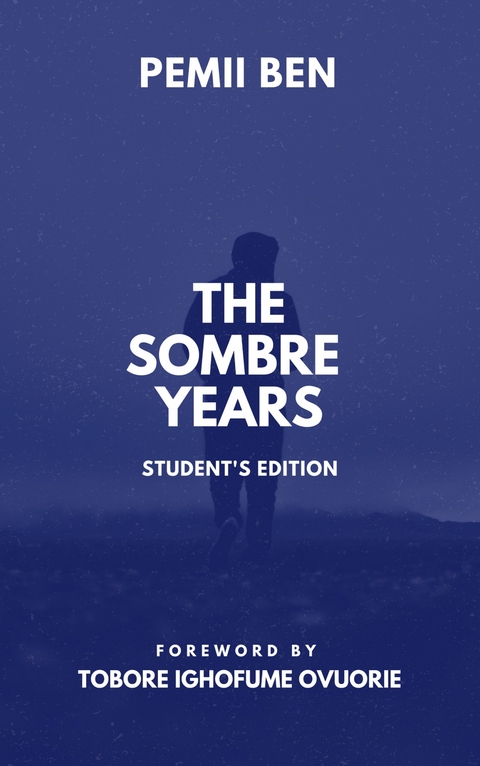
The Sombre Years (eBook)
54 Seiten
Publiseer Publishing (Verlag)
978-0-00-009631-9 (ISBN)
The Somber Years is a corpus celebrating the launch of the forceps of investigative Journalism into one of the world's most ailing social vices-commercial sex. While some advocates give the impression that sex workers have every right to denigrate themselves by staying in the trade, the book, on the contrary offers profound hope, offering the way out to a better and healthier living for those in the trade. The book recognizes that, as human beings, sex workers are undeniably entitled to their fundamental human rights.
It however rejects the situation where women and girls are turned into moneymaking tools. In the course of doing this investigation, I had one-on-one chats with lots of sex workers in Nigeria and in the West African sub-region. One thing is pronounced from the interviews: 90% of these women and girls hate the thing they do-commercial sex and truly seek better alternatives. These better alternatives are honestly hard to come by. The good news however, is, this book brings that long-expected alternative.
The thematic presentation of the fruits of succinct investigation hides nothing about the solutions to this modern slavery. This becomes necessary following the fact that advocates of the legalization of sex work refuse themselves, to become sex workers, and they also will not allow their children or loved ones to practice the trade. So, who are they legalizing illegality for?
I was busy watching my favourite cartoon network when she walked briskly into my room, like the old time British soldiers. I stared at her eyes steadily but could not find any cause for alarm. Suddenly, mum came and grasped my tender arms, drew me close to herself and told me to pay close attention to what she had to say. “Ito,” she began:
“Around the world today, there is a human rights crisis of sexual abuse of millions of women, children, and thousands of men in prostitution and other forms of sexual exploitation. There are regions of the world where prostitution has gone from being almost non-existent to a hundred million dollar moneymaking industry. I am going to talk about prostitution and sex trafficking.... I don’t believe you can talk about one without the other. They are inextricably linked. Those who favour legalized prostitution have led several years’ campaign to delink them–to convince us that trafficking has nothing to do with prostitution. That is false. As countries and activists who favour legalization have tried to separate prostitution and trafficking, most of the global attention has focused on trafficking. We should be clear that we have to talk about both prostitution and trafficking together. Sex trafficking is the process that delivers victims into prostitution. It includes the recruitment, harboring, movement, and methods by which victims are compelled to stay in prostitution, whether by violence, coercion, threat, debt, or cultural manipulation. Prostitution and sex trafficking are based on a balance between the supply of available victims and the demand for victims to provide the sex acts. Victims are recruited from marginalized, poor, and vulnerable populations. These potential victims may be from the same city or country as the exploiters, or they may be trafficked from other countries or continents. They may be women and girls who are poor, uneducated, and naïve, and therefore easy to control, or they may be educated, middle-class girls who have been sexually abused until their bodily integrity and identities are destroyed and they no longer know how to resist abuse and exploitation. They may also be greed-infested girls/women who, driven by the insatiable quest for luxury, plunge into the trade. Even though, this sect accounts for less than 10% of the total number in sex trade. Another category is those unemployed graduates (and even some of the employed ones with menial earnings) who, unable to source for adequate sustenance, resort to the sex trade.
“Hmm!” I heaved. What a long discourse! But in all this, I still could not figure out what mum was aiming at telling me. But the boredom that regained good control of me during her talk did not even bother her. What could be her motivation, I pondered. Mum however, took another straight gaze into eyes and said “my daughter, listen, I have to bore you a little more just for your own good. I was not lucky to get these free tutorials you get now. If I did, perhaps, I would have been better off.” I still could not understand the crux of the matter.
This time, she took me into her bedroom for the first time in a long time and continued:
Human trafficking happens in nearly every corner of the world. Trafficking in persons is modern-day slavery, involving victims who are forced, defrauded or coerced into labor or sexual exploitation. Annually, people - mostly women and children - are trafficked across national borders. This does not count the millions trafficked within their own countries. People are trapped into trafficking by many means. In some cases, physical force is used. In other cases, false promises are made regarding job opportunities or marriages in foreign countries to entrap victims. Human trafficking is a clandestine operation, and its victims are hidden and afraid to come forward.
At this juncture, I was unable to hide my disgust with the talks I could not understand. “Mum!” I managed to scream, “what are you saying?” She paused, took a deeper breath and drew closer to me on the couch and whispered into my ears: “my daughter, you have not heard anything yet!
I pondered on my mum’s scary narrative for several days, not knowing exactly what to think. However, I did ask her about how the odd trade she described starts. She simply told me that the answer to my question was a discussion for another day.
I did not have the patience to wait for whenever my mum would possibly be ready to tell me how the bad business starts, so I kept asking whoever I thought could have the answers to satiate my curiosity. So, one fateful day, I asked one of the lady Nelly, our Mathematics teacher in school if she had ever heard about prostitution. The teacher was taken aback and she almost gave me a knock on the head which she later converted to a slap on my back.
That was not the kind of response I had expected. “Could it be that mum was telling me the wrong thing?” I wondered in my tender heart. The hot slap I got because I asked my teacher about prostitution got me inhibited and so I could not ask another teacher.
A golden opportunity came when Dr. Doreen Ajekuko visited our school from a group that was introduced to us as Society Against Prostitution and Child Labour in Nigeria, SAPCLN. The tall, robust and beautiful woman walked into each of the classrooms and I saw a lot of kindness in her eyes. We had to end our classes early to enable the woman address the school.
The moment she started her speech, so many things came to my mind: “should I ask her the same question that made my teacher slap me or should I simply keep quiet and listen” I asked myself rhetorically. I listened attentively to the woman’s speech, though I understood only little. Perhaps the older students understood everything. My mind was doubly fixed on asking her my question.
At the end of her presentation, she asked if anyone had any question at all. The answer she got was sullen silence. But I kept looking at her in the eyes. “My little girl,” she said to me, “you look curious and worried, do you have any question for me?” she finally asked me. I had to look at my teacher who gave me a slap the other day to get approval but the Dr. Doreen Ajekuko kept persuading me to feel free to ask the question. “Auntie, how does prostitution start and are good girls sometimes the victims?” I finally let go of the question. To my greatest surprise, the question that fetched me a slap from my teacher earned me applause from the SAPCLN woman: “very good question,” she replied. But I could hear a loud murmur from my teachers, especially the one who gave me a slap the other day when I asked her the question.
I still remember vividly that her answer to my question generated a fresh presentation that lasted several hours. Her presentation, though long but meaningful, is recalled below:
Prostitution and trafficking begin with the demand for victims to be used in prostitution. It begins when men go in search of sex that can be purchased. In countries where prostitution is illegal, it begins when pimps place orders with their criminal networks for women and children. In countries where prostitution is legal, it begins when brothels place job adverts with government employment agencies, that is, in countries where such adverts are allowed. In places where buying sex acts is popular and profitable, pimps cannot recruit enough local women to fill up the brothels, so they have to bring in victims from other places.
Over the past decade, the most popular proposed solutions to sex trafficking and “out-of-control” prostitution is legalization of prostitution. Prostitution has been legalized with the expectation that it would bring positive outcomes in Australia, the Netherlands, Germany, and recently, in New Zealand. Although legalization has resulted in big legal profits for a few, the other benefits have not materialized. Organized crime groups continue to traffic women and children and run illegal prostitution operations alongside the legal businesses. In Victoria, Australia, legalization of brothels was supposed to eliminate street prostitution. It did not. In fact, there are many more women on the streets than before legalization. There have been calls for legalizing street prostitution in order to control it.
Legalization does not reduce prostitution or trafficking; in fact, both activities increase because men can legally buy sex acts and pimps and brothel keepers can legally sell and profit from them. Cities develop reputations as sex tourist destinations.
German lawmakers thought they were going to get hundreds of millions of Euros in tax revenue when they legalized prostitution and brothels. But keeping with the criminal nature of prostitution, the newly redefined “business owners” and “freelance staff” in brothels will not pay their taxes. Germany suffered a budget deficit, and the Federal Audit Office estimates that the government has lost over two billion Euros a year in unpaid tax revenue from the sex industry. Recently, lawmakers started to look for ways to increase collection of taxes from prostitutes. This has put the government into the traditional role of pimps coercing prostitutes to give them more money.
This predatory behavior of the government sharply contrasts to the promised benefits of legalization in Germany, such as government benefits and rights for women. Legalization was supposed to enable women to get health insurance and retirement benefits, and...
| Erscheint lt. Verlag | 18.8.2018 |
|---|---|
| Sprache | englisch |
| Themenwelt | Geisteswissenschaften ► Geschichte ► Regional- / Ländergeschichte |
| ISBN-10 | 0-00-009631-8 / 0000096318 |
| ISBN-13 | 978-0-00-009631-9 / 9780000096319 |
| Informationen gemäß Produktsicherheitsverordnung (GPSR) | |
| Haben Sie eine Frage zum Produkt? |
 EPUB (Adobe DRM)
Größe: 408 KB
Kopierschutz: Adobe-DRM
Adobe-DRM ist ein Kopierschutz, der das eBook vor Mißbrauch schützen soll. Dabei wird das eBook bereits beim Download auf Ihre persönliche Adobe-ID autorisiert. Lesen können Sie das eBook dann nur auf den Geräten, welche ebenfalls auf Ihre Adobe-ID registriert sind.
Details zum Adobe-DRM
Dateiformat: EPUB (Electronic Publication)
EPUB ist ein offener Standard für eBooks und eignet sich besonders zur Darstellung von Belletristik und Sachbüchern. Der Fließtext wird dynamisch an die Display- und Schriftgröße angepasst. Auch für mobile Lesegeräte ist EPUB daher gut geeignet.
Systemvoraussetzungen:
PC/Mac: Mit einem PC oder Mac können Sie dieses eBook lesen. Sie benötigen eine
eReader: Dieses eBook kann mit (fast) allen eBook-Readern gelesen werden. Mit dem amazon-Kindle ist es aber nicht kompatibel.
Smartphone/Tablet: Egal ob Apple oder Android, dieses eBook können Sie lesen. Sie benötigen eine
Geräteliste und zusätzliche Hinweise
Buying eBooks from abroad
For tax law reasons we can sell eBooks just within Germany and Switzerland. Regrettably we cannot fulfill eBook-orders from other countries.
aus dem Bereich