


Extremities
Painting Empire in Post-revolutionary France
Seiten
2002
Yale University Press (Verlag)
978-0-300-08887-8 (ISBN)
Yale University Press (Verlag)
978-0-300-08887-8 (ISBN)
- Titel ist leider vergriffen;
keine Neuauflage - Artikel merken
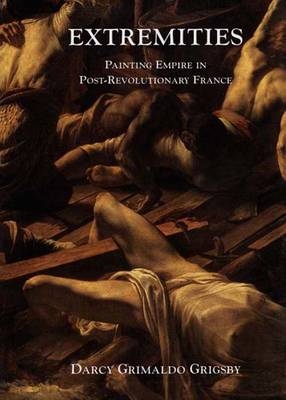
Following the French Revolution, four artists - Girodet, Gros, Gericault and Delacroix - painted works expressing violent events and issues in faraway lands. This study of six of these paintings shows how their disturbing depictions chart the history of France's empire and colonial politics.
In the decades following the French Revolution, four artists -Girodet, Gros, Gericault and Delacroix - painted works in their Parisian studios that vividly expressed violent events and issues in faraway, colonial lands. This examination of six of these paintings argues that their disturbing, erotic depictions of slavery, revolt, plague, decapitation, cannibalism, massacre and abduction chart the history of France's empire and colonial politics. Darcy Grimaldo Grigsby shows that these paintings about occurrences in the West Indies, Syria, Egypt, Senegal and Ottoman Empire Greece are preoccupied not with mastery and control but with loss, degradation and failure, and she explains how such representations of crises in the colonies were able to answer the artists' longings as well as the needs of the government and the opposition parties at home. Empire made painters devoted to the representation of liberty and the new French nation confront liberty's antithesis: slavery. It also forced them to contend with cultural and racial difference.
Young male artists responded, says Grigsby, by translating distant crises into images of challenges to the self, making history painting the site where geographic extremities and bodily extremities articulated one another.
In the decades following the French Revolution, four artists -Girodet, Gros, Gericault and Delacroix - painted works in their Parisian studios that vividly expressed violent events and issues in faraway, colonial lands. This examination of six of these paintings argues that their disturbing, erotic depictions of slavery, revolt, plague, decapitation, cannibalism, massacre and abduction chart the history of France's empire and colonial politics. Darcy Grimaldo Grigsby shows that these paintings about occurrences in the West Indies, Syria, Egypt, Senegal and Ottoman Empire Greece are preoccupied not with mastery and control but with loss, degradation and failure, and she explains how such representations of crises in the colonies were able to answer the artists' longings as well as the needs of the government and the opposition parties at home. Empire made painters devoted to the representation of liberty and the new French nation confront liberty's antithesis: slavery. It also forced them to contend with cultural and racial difference.
Young male artists responded, says Grigsby, by translating distant crises into images of challenges to the self, making history painting the site where geographic extremities and bodily extremities articulated one another.
Darcy Grimaldo Grigsby is associate professor of the history of art at the University of California, Berkeley.
| Erscheint lt. Verlag | 11.5.2002 |
|---|---|
| Zusatzinfo | 80 colour pl 140 illustrations |
| Sprache | englisch |
| Maße | 195 x 275 mm |
| Gewicht | 1770 g |
| Themenwelt | Kunst / Musik / Theater ► Kunstgeschichte / Kunststile |
| Kunst / Musik / Theater ► Malerei / Plastik | |
| Geschichte ► Teilgebiete der Geschichte ► Wirtschaftsgeschichte | |
| ISBN-10 | 0-300-08887-6 / 0300088876 |
| ISBN-13 | 978-0-300-08887-8 / 9780300088878 |
| Zustand | Neuware |
| Informationen gemäß Produktsicherheitsverordnung (GPSR) | |
| Haben Sie eine Frage zum Produkt? |
Mehr entdecken
aus dem Bereich


aus dem Bereich
wie Tech-Konzerne und Großmächte die Welt unter sich aufteilen
Buch | Hardcover (2025)
C.H.Beck (Verlag)
CHF 39,20
Aufstieg und Fall der Deutschland AG
Buch | Hardcover (2025)
Suhrkamp (Verlag)
CHF 41,95


