


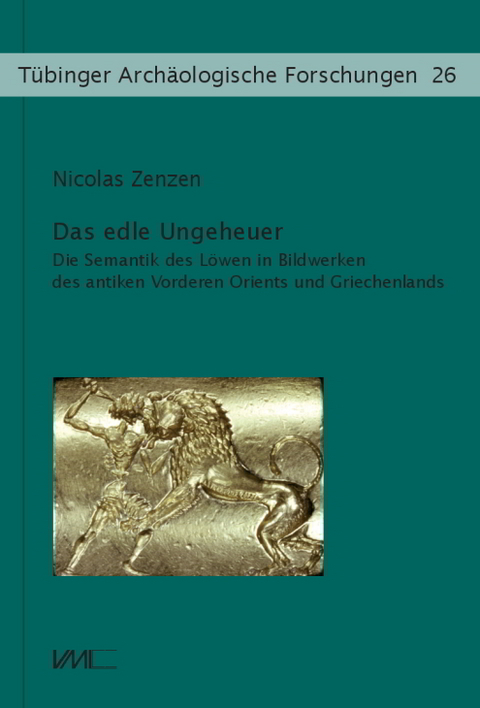
Das edle Ungeheuer
Die Semantik des Löwen in Bildwerken des antiken Vorderen Orients und Griechenlands
Seiten
2018
|
1., Aufl.
VML Vlg Marie Leidorf (Verlag)
978-3-89646-917-5 (ISBN)
VML Vlg Marie Leidorf (Verlag)
978-3-89646-917-5 (ISBN)
Lions used to be very common in the ancient Near East and were and still are fascinating animals to humans, whose charisma of superior imperturbability made an impressive appearance of fascinating elegance and who, at the same time, posed a serious threat to human body and life. The representations of lions considered here span some 3,000 years of cultural history from Italy to the River Oxus [Amu Darya] and yet comprise only a very limited spectrum of motifs and meanings reflected by the five chapters of the book [predator, lion hunt, subjugators of lions, guardian, sign of strength and majestic dignity]. All lion images have in common that they define the position of man in the world. The lion is the symbol of the threatening unpredictability of wild nature in contrast to the order of culture that inspires a feeling of security. When overcome by humans, the lion demonstrates man’s dominant position in the world. At the same time it can be a metaphor for the qualities of outstanding humans. Last but not least, the lion functions as a guardian marking certain spheres, in which defined human rules apply, and warns against any violation of these. Der früher im vorderasiatischen Raum weit verbreitete Löwe war und ist ein für den Menschen sehr eindrucksvolles Tier, dessen Ausstrahlung überlegener Ruhe eine imposante Erscheinung von faszinierender Eleganz abgibt und das zugleich für Leib und Leben des Menschen eine ernste Gefahr darstellt. Die hier betrachteten Löwendarstellungen decken rund 3.000 Jahre Kulturgeschichte zwischen Italien und Oxus ab und enthalten doch nur ein sehr überschaubares Spektrum an Motiven und Bedeutungen, die sich in den fünf Kapiteln des Bandes widerspiegeln [Raubtier, Löwenjagd, Löwenbezwinger, Wächter, Zeichen von Stärke und Hoheit]. Allen Löwenbildern ist gemein, dass sie die Position des Menschen in der Welt definieren. Der Löwe ist Sinnbild für die bedrohliche Unberechenbarkeit der wilden Natur im Gegensatz zur Sicherheit vermittelnden Ordnung der Kultur. Indem er dem Menschen unterliegt, präsentiert er dessen dominierende Position in der Welt. Zugleich kann er Metapher für die Qualitäten herausragender Menschen sein. Schließlich markiert der Löwe als Wächter Bereiche, in denen bestimmte menschliche Regeln gelten und warnt vor der Verletzung derselben.
Lions used to be very common in the ancient Near East and were and still are fascinating animals to humans, whose charisma of superior imperturbability made an impressive appearance of fascinating elegance and who, at the same time, posed a serious threat to human body and life. The representations of lions considered here span some 3,000 years of cultural history from Italy to the River Oxus [Amu Darya] and yet comprise only a very limited spectrum of motifs and meanings reflected by the five chapters of the book [predator, lion hunt, subjugators of lions, guardian, sign of strength and majestic dignity]. All lion images have in common that they define the position of man in the world. The lion is the symbol of the threatening unpredictability of wild nature in contrast to the order of culture that inspires a feeling of security. When overcome by humans, the lion demonstrates man’s dominant position in the world. At the same time it can be a metaphor for the qualities of outstanding humans. Last but not least, the lion functions as a guardian marking certain spheres, in which defined human rules apply, and warns against any violation of these.
Lions used to be very common in the ancient Near East and were and still are fascinating animals to humans, whose charisma of superior imperturbability made an impressive appearance of fascinating elegance and who, at the same time, posed a serious threat to human body and life. The representations of lions considered here span some 3,000 years of cultural history from Italy to the River Oxus [Amu Darya] and yet comprise only a very limited spectrum of motifs and meanings reflected by the five chapters of the book [predator, lion hunt, subjugators of lions, guardian, sign of strength and majestic dignity]. All lion images have in common that they define the position of man in the world. The lion is the symbol of the threatening unpredictability of wild nature in contrast to the order of culture that inspires a feeling of security. When overcome by humans, the lion demonstrates man’s dominant position in the world. At the same time it can be a metaphor for the qualities of outstanding humans. Last but not least, the lion functions as a guardian marking certain spheres, in which defined human rules apply, and warns against any violation of these.
| Erscheinungsdatum | 18.08.2018 |
|---|---|
| Reihe/Serie | Tübinger Archäologische Forschungen ; 26 |
| Verlagsort | Rahden |
| Sprache | deutsch |
| Maße | 210 x 297 mm |
| Gewicht | 2030 g |
| Einbandart | gebunden |
| Themenwelt | Geisteswissenschaften ► Archäologie |
| Geschichte ► Allgemeine Geschichte ► Altertum / Antike | |
| Schlagworte | Jagd • König • Löwe • Raubtier • Ritual • Tier |
| ISBN-10 | 3-89646-917-7 / 3896469177 |
| ISBN-13 | 978-3-89646-917-5 / 9783896469175 |
| Zustand | Neuware |
| Informationen gemäß Produktsicherheitsverordnung (GPSR) | |
| Haben Sie eine Frage zum Produkt? |
Mehr entdecken
aus dem Bereich


aus dem Bereich
ohne den ganzen langweiligen Kram
Buch | Hardcover (2025)
C.H.Beck (Verlag)
CHF 36,40
von den Anfängen bis zum Untergang
Buch | Hardcover (2025)
Alfred Kröner Verlag
CHF 48,95
von den Anfängen bis zur Gegenwart
Buch | Softcover (2025)
C.H.Beck (Verlag)
CHF 16,80


