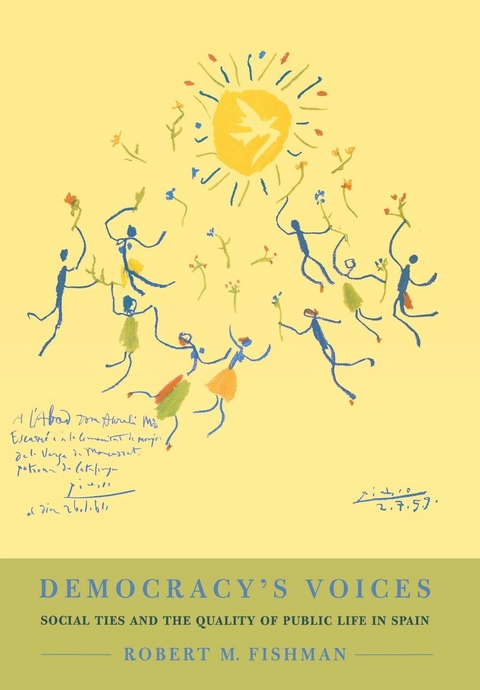
Democracy's Voices (eBook)
208 Seiten
Cornell University Press (Verlag)
978-1-5017-2717-7 (ISBN)
Building on one of sociology's core ideas—that social ties can shape collective outcomes—Democracy's Voices shows that connections across class boundaries can remake public rhetoric and thus the quality of democratic life. Robert M. Fishman takes up a...
Building on one of sociology's core ideas—that social ties can shape collective outcomes—Democracy's Voices shows that connections across class boundaries can remake public rhetoric and thus the quality of democratic life. Robert M. Fishman takes up a question of enduring significance to people concerned with the quality of democratic public life, focusing on why political rhetoric proves engaging and broadly relevant, or disengaging and narrow. The answer to that question, he argues, is to be found not only in the deeds of prominent politicians and the nature of official institutions but also in the existence and the character of social connections among ordinary citizens. Fishman's book, based on long-term fieldwork and systematic survey research in Spain, identifies the special contribution to democratic quality made by conversations between intellectuals and workers.
Fishman focuses on what he calls the "discursive horizons" of local leaders and communities: the actual location of the problems and proposed remedies articulated in political rhetorics. Democracy's Voices shows how the subcultural context of social ties may accentuate or diminish their power to reshape rhetorics. Fishman argues that conversations are able to remake public rhetorics whereas ties that take the form of brokerage lack that ability. The book also offers a general critique of social capital theory and argues that the full ability of social ties to shape collective outcomes can only be observed when one distinguishes in useful ways among types of ties.
Building on one of sociology's core ideas—that social ties can shape collective outcomes—Democracy's Voices shows that connections across class boundaries can remake public rhetoric and thus the quality of democratic life. Robert M. Fishman takes up a question of enduring significance to people concerned with the quality of democratic public life, focusing on why political rhetoric proves engaging and broadly relevant, or disengaging and narrow. The answer to that question, he argues, is to be found not only in the deeds of prominent politicians and the nature of official institutions but also in the existence and the character of social connections among ordinary citizens. Fishman's book, based on long-term fieldwork and systematic survey research in Spain, identifies the special contribution to democratic quality made by conversations between intellectuals and workers. Fishman focuses on what he calls the "discursive horizons" of local leaders and communities: the actual location of the problems and proposed remedies articulated in political rhetorics. Democracy's Voices shows how the subcultural context of social ties may accentuate or diminish their power to reshape rhetorics. Fishman argues that conversations are able to remake public rhetorics whereas ties that take the form of brokerage lack that ability. The book also offers a general critique of social capital theory and argues that the full ability of social ties to shape collective outcomes can only be observed when one distinguishes in useful ways among types of ties.
Robert M. Fishman is Professor of Sociology and Fellow of the Kellogg and Nanovic Institutes, University of Notre Dame. He is the author of Working Class Organization and the Return to Democracy in Spain, also from Cornell.
| Erscheint lt. Verlag | 5.7.2018 |
|---|---|
| Verlagsort | Ithaca |
| Sprache | englisch |
| Maße | 150 x 150 mm |
| Themenwelt | Geisteswissenschaften ► Geschichte ► Regional- / Ländergeschichte |
| Sozialwissenschaften ► Ethnologie ► Volkskunde | |
| Sozialwissenschaften ► Pädagogik | |
| Sozialwissenschaften ► Soziologie ► Makrosoziologie | |
| ISBN-10 | 1-5017-2717-6 / 1501727176 |
| ISBN-13 | 978-1-5017-2717-7 / 9781501727177 |
| Informationen gemäß Produktsicherheitsverordnung (GPSR) | |
| Haben Sie eine Frage zum Produkt? |
 PDF (Adobe DRM)
Kopierschutz: Adobe-DRM
Adobe-DRM ist ein Kopierschutz, der das eBook vor Mißbrauch schützen soll. Dabei wird das eBook bereits beim Download auf Ihre persönliche Adobe-ID autorisiert. Lesen können Sie das eBook dann nur auf den Geräten, welche ebenfalls auf Ihre Adobe-ID registriert sind.
Details zum Adobe-DRM
Dateiformat: PDF (Portable Document Format)
Mit einem festen Seitenlayout eignet sich die PDF besonders für Fachbücher mit Spalten, Tabellen und Abbildungen. Eine PDF kann auf fast allen Geräten angezeigt werden, ist aber für kleine Displays (Smartphone, eReader) nur eingeschränkt geeignet.
Systemvoraussetzungen:
PC/Mac: Mit einem PC oder Mac können Sie dieses eBook lesen. Sie benötigen eine
eReader: Dieses eBook kann mit (fast) allen eBook-Readern gelesen werden. Mit dem amazon-Kindle ist es aber nicht kompatibel.
Smartphone/Tablet: Egal ob Apple oder Android, dieses eBook können Sie lesen. Sie benötigen eine
Geräteliste und zusätzliche Hinweise
Buying eBooks from abroad
For tax law reasons we can sell eBooks just within Germany and Switzerland. Regrettably we cannot fulfill eBook-orders from other countries.
aus dem Bereich