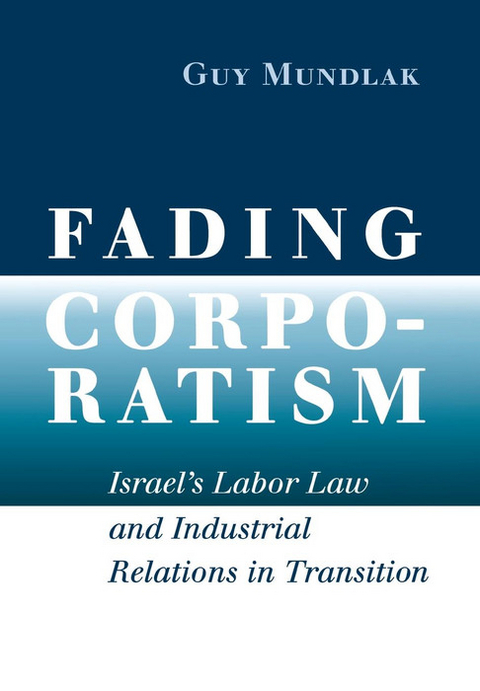
Fading Corporatism (eBook)
296 Seiten
Ilr Press (Verlag)
978-0-8014-6173-6 (ISBN)
Since the 1980s, industrial relations and labor law in Israel have rapidly changed from a European style of corporatism to a model of pluralism familiar to North America. The country's legal and industrial relations systems have become more...
Since the 1980s, industrial relations and labor law in Israel have rapidly changed from a European style of corporatism to a model of pluralism familiar to North America. The country's legal and industrial relations systems have become more decentralized, yet more intensively regulated; they are no longer centrally managed, but they do not fit the neoliberal model of a free market. In recent years, a dynamic system for voicing interests has evolved, granting more leeway to individuals, identity-based representation, and a flourishing civil society, but restraining effective collective representation.
In Fading Corporatism, Guy Mundlak explains the changing nature of labor law and industrial relations in Israel and the seemingly paradoxical outcomes of transformation as played out in numerous spheres, including the law governing the recognition of trade unions and strikes; the emergence of a human rights regime; and the regulation of temporary work agencies, Palestinian workers from the occupied territories, and migrant workers.
Placing the example of Israel in a conceptual framework that draws on the literature of corporatism, Mundlak offers a theoretical coupling of legal studies and industrial relations that will interest scholars and practitioners in both fields. Surveying legal developments from 1920 to the present, Fading Corporatism will also appeal to readers interested in the political, economic, and legal history of Israel. At the same time, Mundlak emphasizes the comparative implications of the Israeli case study. His account is particularly instructive for countries in which traditionally corporatist industrial and legal systems are experiencing similar pressures, such as the Netherlands, Austria, and Germany.
Since the 1980s, industrial relations and labor law in Israel have rapidly changed from a European style of corporatism to a model of pluralism familiar to North America. The country's legal and industrial relations systems have become more decentralized, yet more intensively regulated; they are no longer centrally managed, but they do not fit the neoliberal model of a free market. In recent years, a dynamic system for voicing interests has evolved, granting more leeway to individuals, identity-based representation, and a flourishing civil society, but restraining effective collective representation.
In Fading Corporatism, Guy Mundlak explains the changing nature of labor law and industrial relations in Israel and the seemingly paradoxical outcomes of transformation as played out in numerous spheres, including the law governing the recognition of trade unions and strikes; the emergence of a human rights regime; and the regulation of temporary work agencies, Palestinian workers from the occupied territories, and migrant workers. Placing the example of Israel in a conceptual framework that draws on the literature of corporatism, Mundlak offers a theoretical coupling of legal studies and industrial relations that will interest scholars and practitioners in both fields.
Surveying legal developments from 1920 to the present, Fading Corporatism will also appeal to readers interested in the political, economic, and legal history of Israel. At the same time, Mundlak emphasizes the comparative implications of the Israeli case study. His account is particularly instructive for countries in which traditionally corporatist industrial and legal systems are experiencing similar pressures, such as the Netherlands, Austria, and Germany.
Guy Mundlak is Professor of Law and Labor Studies at Tel-Aviv University.
| Erscheint lt. Verlag | 5.7.2018 |
|---|---|
| Verlagsort | Ithaca |
| Sprache | englisch |
| Maße | 160 x 160 mm |
| Gewicht | 28 g |
| Themenwelt | Geisteswissenschaften ► Geschichte ► Regional- / Ländergeschichte |
| Recht / Steuern ► Arbeits- / Sozialrecht ► Arbeitsrecht | |
| Recht / Steuern ► EU / Internationales Recht | |
| Wirtschaft ► Volkswirtschaftslehre ► Makroökonomie | |
| ISBN-10 | 0-8014-6173-1 / 0801461731 |
| ISBN-13 | 978-0-8014-6173-6 / 9780801461736 |
| Informationen gemäß Produktsicherheitsverordnung (GPSR) | |
| Haben Sie eine Frage zum Produkt? |
 PDF (Adobe DRM)
Kopierschutz: Adobe-DRM
Adobe-DRM ist ein Kopierschutz, der das eBook vor Mißbrauch schützen soll. Dabei wird das eBook bereits beim Download auf Ihre persönliche Adobe-ID autorisiert. Lesen können Sie das eBook dann nur auf den Geräten, welche ebenfalls auf Ihre Adobe-ID registriert sind.
Details zum Adobe-DRM
Dateiformat: PDF (Portable Document Format)
Mit einem festen Seitenlayout eignet sich die PDF besonders für Fachbücher mit Spalten, Tabellen und Abbildungen. Eine PDF kann auf fast allen Geräten angezeigt werden, ist aber für kleine Displays (Smartphone, eReader) nur eingeschränkt geeignet.
Systemvoraussetzungen:
PC/Mac: Mit einem PC oder Mac können Sie dieses eBook lesen. Sie benötigen eine
eReader: Dieses eBook kann mit (fast) allen eBook-Readern gelesen werden. Mit dem amazon-Kindle ist es aber nicht kompatibel.
Smartphone/Tablet: Egal ob Apple oder Android, dieses eBook können Sie lesen. Sie benötigen eine
Geräteliste und zusätzliche Hinweise
Buying eBooks from abroad
For tax law reasons we can sell eBooks just within Germany and Switzerland. Regrettably we cannot fulfill eBook-orders from other countries.
aus dem Bereich