


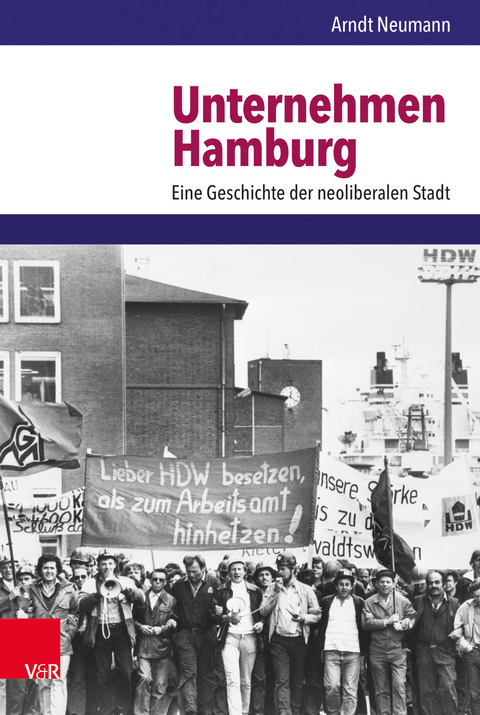
Unternehmen Hamburg
Eine Geschichte der neoliberalen Stadt
Seiten
2018
Vandenhoeck & Ruprecht (Verlag)
978-3-525-35594-7 (ISBN)
Vandenhoeck & Ruprecht (Verlag)
978-3-525-35594-7 (ISBN)
Studie über den Wandel der räumlichen Ordnung der Arbeitswelt in Hamburg
Did the spatial order of the working world change fundamentally in European cities since the 1970s? To answer this question Arndt Neumann turns to a case study about the port city Hamburg. He argues that due to a cumulative structural break the fordist city was replaced by the neoliberal city. Until the 1970s industry and urbanity were closely linked. Steel mills and shipyards shaped the city centres. In addition, modernist town planning was oriented towards industrial mass productions. Since then the industrial sector lost its importance, from the decline of heavy industries to the rise of postmodern architecture. At the same time the creative industry and the financial market gained influence. To grasp the entire complexity of this transformation Arndt Neumann investigates different working worlds in different urban space: the industrial labour in the port area, the office work in the city, the house work in the suburbs and the sequencing activities in the urban neighbourhoods. In particular he focusses on the manifold cross connections between labour history and urban history.
Did the spatial order of the working world change fundamentally in European cities since the 1970s? To answer this question Arndt Neumann turns to a case study about the port city Hamburg. He argues that due to a cumulative structural break the fordist city was replaced by the neoliberal city. Until the 1970s industry and urbanity were closely linked. Steel mills and shipyards shaped the city centres. In addition, modernist town planning was oriented towards industrial mass productions. Since then the industrial sector lost its importance, from the decline of heavy industries to the rise of postmodern architecture. At the same time the creative industry and the financial market gained influence. To grasp the entire complexity of this transformation Arndt Neumann investigates different working worlds in different urban space: the industrial labour in the port area, the office work in the city, the house work in the suburbs and the sequencing activities in the urban neighbourhoods. In particular he focusses on the manifold cross connections between labour history and urban history.
Dr. Arndt Neumann ist wissenschaftlicher Mitarbeiter des Historischen Instituts der FernUniversität in Hagen.
Dr. Anselm Doering-Manteuffel ist Professor für Neuere Geschichte und Direktor des Seminars für Zeitgeschichte der Universität Tübingen.
Dr. Lutz Raphael ist Professor für Neuere und Neueste Geschichte an der Universität Trier.
| Erscheinungsdatum | 18.09.2018 |
|---|---|
| Reihe/Serie | Nach dem Boom |
| Mitarbeit |
Herausgeber (Serie): Anselm Doering-Manteuffel, Lutz Raphael |
| Zusatzinfo | mit 112 z.T. farb. Abb. |
| Verlagsort | Göttingen |
| Sprache | deutsch |
| Maße | 160 x 237 mm |
| Gewicht | 967 g |
| Themenwelt | Geschichte ► Allgemeine Geschichte ► Zeitgeschichte |
| Schlagworte | Arbeit • Arbeitswelt • Deutschland/Zeitgeschichte • Geschichte /Zeitgeschichte • Großstadt • Hamburg • Hamburg /Wirtschaft, Volkswirtschaft • Raumordnung • Stadtgeschichte |
| ISBN-10 | 3-525-35594-7 / 3525355947 |
| ISBN-13 | 978-3-525-35594-7 / 9783525355947 |
| Zustand | Neuware |
| Informationen gemäß Produktsicherheitsverordnung (GPSR) | |
| Haben Sie eine Frage zum Produkt? |
Mehr entdecken
aus dem Bereich
aus dem Bereich
die großen Jahre der Soziologie 1949-1969
Buch | Hardcover (2025)
Klett-Cotta (Verlag)
CHF 39,20
eine Deutschlandreise im Jahr 1958
Buch | Hardcover (2024)
C.H.Beck (Verlag)
CHF 29,90


