


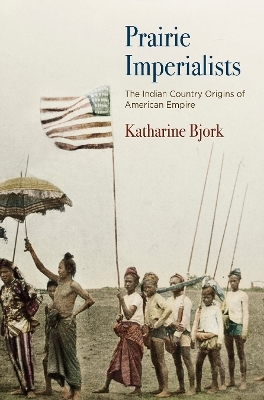
Prairie Imperialists
The Indian Country Origins of American Empire
Seiten
2019
University of Pennsylvania Press (Verlag)
978-0-8122-5100-5 (ISBN)
University of Pennsylvania Press (Verlag)
978-0-8122-5100-5 (ISBN)
The Spanish-American War marked the emergence of the United States as an imperial power. It was when the United States first landed troops overseas and established governments of occupation in the Philippines, Cuba, and other formerly Spanish colonies. But such actions to extend U.S. sovereignty abroad, argues Katharine Bjork, had a precedent in earlier relations with Native nations at home. In Prairie Imperialists, Bjork traces the arc of American expansion by showing how the Army's conquests of what its soldiers called "Indian Country" generated a repertoire of actions and understandings that structured encounters with the racial others of America's new island territories following the War of 1898.
Prairie Imperialists follows the colonial careers of three Army officers from the domestic frontier to overseas posts in Cuba and the Philippines. The men profiled-Hugh Lenox Scott, Robert Lee Bullard, and John J. Pershing-internalized ways of behaving in Indian Country that shaped their approach to later colonial appointments abroad. Scott's ethnographic knowledge and experience with Native Americans were valorized as an asset for colonial service; Bullard and Pershing, who had commanded African American troops, were regarded as particularly suited for roles in the pacification and administration of colonial peoples overseas. After returning to the mainland, these three men played prominent roles in the "Punitive Expedition" President Woodrow Wilson sent across the southern border in 1916, during which Mexico figured as the next iteration of "Indian Country."
With rich biographical detail and ambitious historical scope, Prairie Imperialists makes fundamental connections between American colonialism and the racial dimensions of domestic political and social life-during peacetime and while at war. Ultimately, Bjork contends, the concept of "Indian Country" has served as the guiding force of American imperial expansion and nation building for the past two and a half centuries and endures to this day.
Prairie Imperialists follows the colonial careers of three Army officers from the domestic frontier to overseas posts in Cuba and the Philippines. The men profiled-Hugh Lenox Scott, Robert Lee Bullard, and John J. Pershing-internalized ways of behaving in Indian Country that shaped their approach to later colonial appointments abroad. Scott's ethnographic knowledge and experience with Native Americans were valorized as an asset for colonial service; Bullard and Pershing, who had commanded African American troops, were regarded as particularly suited for roles in the pacification and administration of colonial peoples overseas. After returning to the mainland, these three men played prominent roles in the "Punitive Expedition" President Woodrow Wilson sent across the southern border in 1916, during which Mexico figured as the next iteration of "Indian Country."
With rich biographical detail and ambitious historical scope, Prairie Imperialists makes fundamental connections between American colonialism and the racial dimensions of domestic political and social life-during peacetime and while at war. Ultimately, Bjork contends, the concept of "Indian Country" has served as the guiding force of American imperial expansion and nation building for the past two and a half centuries and endures to this day.
Katharine Bjork is Professor of History at Hamline University and author of In the Circle of Dance: Notes of an Outsider in Nepal.
Introduction. Gray Wolves for GuÁnica
PART I. INDIAN COUNTRY
Chapter 1. Coming to Indian Country
Chapter 2. Scouting
Chapter 3. Right Kind of White Men
Chapter 4. Prairie Imperialists
PART II. INDIAN COUNTRY ABROAD
Chapter 5. Spoil of the Spaniard
Chapter 6. The Buckskin Mantle
Chapter 7. Sultan of Sulu
PART III. THE LAST INDIAN WAR
Chapter 8. Spy Mission to Mexico: Lieutenant Colonel Robert Lee Bullard, 1911
Chapter 9. Washington and the Border: Brigadier General Hugh Lenox Scott, 1911-1916
Chapter 10. The Punitive Expedition: Brigadier General John J. Pershing, 1916
Notes
Bibliography
Index
Acknowledgments
| Erscheinungsdatum | 18.12.2018 |
|---|---|
| Reihe/Serie | America in the Nineteenth Century |
| Zusatzinfo | 18 illus. |
| Verlagsort | Pennsylvania |
| Sprache | englisch |
| Maße | 152 x 229 mm |
| Themenwelt | Sachbuch/Ratgeber ► Geschichte / Politik ► Allgemeines / Lexika |
| Geisteswissenschaften ► Geschichte ► Regional- / Ländergeschichte | |
| Geschichte ► Teilgebiete der Geschichte ► Wirtschaftsgeschichte | |
| ISBN-10 | 0-8122-5100-8 / 0812251008 |
| ISBN-13 | 978-0-8122-5100-5 / 9780812251005 |
| Zustand | Neuware |
| Informationen gemäß Produktsicherheitsverordnung (GPSR) | |
| Haben Sie eine Frage zum Produkt? |
Mehr entdecken
aus dem Bereich

aus dem Bereich
wie Tech-Konzerne und Großmächte die Welt unter sich aufteilen
Buch | Hardcover (2025)
C.H.Beck (Verlag)
CHF 39,20


