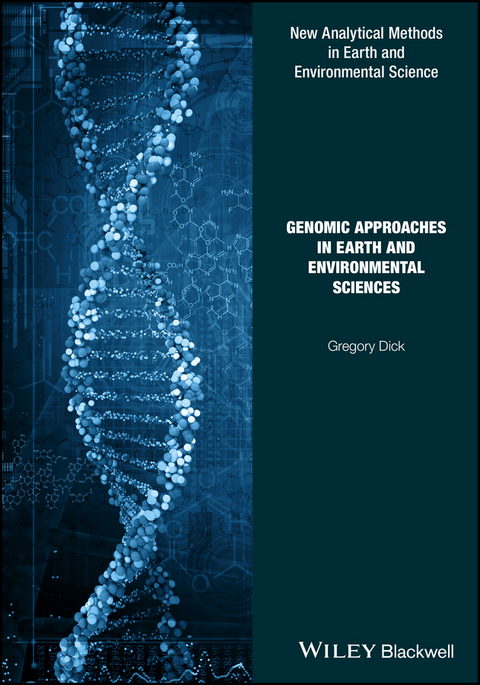
Genomic Approaches in Earth and Environmental Sciences (eBook)
John Wiley & Sons (Verlag)
978-1-118-70826-2 (ISBN)
The first comprehensive synthesis of genomic techniques in earth sciences
The past 15 years have witnessed an explosion of DNA sequencing technologies that provide unprecedented insights into biology. Although this technological revolution has been driven by the biomedical sciences, it also offers extraordinary opportunities in the earth and environmental sciences. In particular, the application of 'omics' methods (genomics, transcriptomics, proteomics) directly to environmental samples offers exciting new vistas of complex microbial communities and their roles in environmental and geochemical processes. This unique book fills the gap where there exists a lack of resources and infrastructure to educate and train geoscientists about the opportunities, approaches, and analytical methods available in the application of omic technologies to problems in the geosciences.
Genomic Approaches in Earth and Environmental Sciences begins by covering the role of microorganisms in earth and environmental processes. It then goes on to discuss how omics approaches provide new windows into geobiological processes. It delves into the DNA sequencing revolution and the impact that genomics has made on the geosciences. The book then discusses the methods used in the field, beginning with an overview of current technologies. After that it offers in-depth coverage of single cell genomics, metagenomics, metatranscriptomics, metaproteomics, and functional approaches, before finishing up with an outlook on the future of the field.
- The very first synthesis of an important new family of techniques
- Shows strengths and limitations (both practical and theoretical) of the techniques
- Deals with both theoretical and laboratory basics
- Shows use of techniques in a variety of applications, including various aspects of environmental science, geobiology, and evolution
Genomic Approaches in Earth and Environmental Sciences is a welcome addition to the library of all earth and environmental scientists and students working within a wide range of subdisciplines.
Gregory J. Dick, is Associate Professor of Earth and Environmental Sciences at the University of Michigan.
The first comprehensive synthesis of genomic techniques in earth sciences The past 15 years have witnessed an explosion of DNA sequencing technologies that provide unprecedented insights into biology. Although this technological revolution has been driven by the biomedical sciences, it also offers extraordinary opportunities in the earth and environmental sciences. In particular, the application of "e;omics"e; methods (genomics, transcriptomics, proteomics) directly to environmental samples offers exciting new vistas of complex microbial communities and their roles in environmental and geochemical processes. This unique book fills the gap where there exists a lack of resources and infrastructure to educate and train geoscientists about the opportunities, approaches, and analytical methods available in the application of omic technologies to problems in the geosciences. Genomic Approaches in Earth and Environmental Sciences begins by covering the role of microorganisms in earth and environmental processes. It then goes on to discuss how omics approaches provide new windows into geobiological processes. It delves into the DNA sequencing revolution and the impact that genomics has made on the geosciences. The book then discusses the methods used in the field, beginning with an overview of current technologies. After that it offers in-depth coverage of single cell genomics, metagenomics, metatranscriptomics, metaproteomics, and functional approaches, before finishing up with an outlook on the future of the field. The very first synthesis of an important new family of techniques Shows strengths and limitations (both practical and theoretical) of the techniques Deals with both theoretical and laboratory basics Shows use of techniques in a variety of applications, including various aspects of environmental science, geobiology, and evolution Genomic Approaches in Earth and Environmental Sciences is a welcome addition to the library of all earth and environmental scientists and students working within a wide range of subdisciplines.
Gregory J. Dick, is Associate Professor of Earth and Environmental Sciences at the University of Michigan.
Chapter 1
Introduction
1.1 Exploring the Microbial World
Microorganisms shaped the geochemical evolution of our planet throughout its history, and they continue to play a key role in the modern world. In deep time they oxygenated Earth’s atmosphere and set the stage for life as we know it. Today, microbes mediate global biogeochemical cycles, influence the speciation and fate of pollutants, and modulate climate change through production and consumption of greenhouse gases. The field of geomicrobiology and microbial geochemistry (GMG), which studies the interplay between microbes and the Earth system, has roots in the 19th century (Druschel & Kappler 2015; Druschel et al. 2014). However, only recently has the breadth of microbial geomicrobiological processes and extent to which they shape geological, geochemical, and environmental processes become clear. Many methods and concepts central to GMG are also relevant to environmental engineering (e.g., drinking water and wastewater treatment) and medicine (e.g., human microbiome), including the omics approaches that are the focus of this book.
How to study this microbial world? Inherent challenges abound; microorganisms are small. Their cellular morphology is typically not informative of their phylogeny, physiology, or role in biogeochemical or ecological processes. Microbes often live in highly diverse microbial communities where it is hard to decipher the activities of different microorganisms or to trace specific microbial processes. Traditional microbiological approaches revolve around the cultivation of bacteria and archaea, which enables powerful laboratory‐based methods of dissecting microbial physiology, biochemistry, and genetics as they relate to geochemical processes (Newman et al. 2012). Yet most microorganisms in nature are resistant to cultivation owing to symbiotic lifestyles or unknown nutritional requirements (Staley & Konopka 1985). Further, it can be impractical to grow pure cultures due to the extremely slow growth of many microorganisms, which in the environment is perhaps more akin to stationary phase than to growing cultures (Roy et al. 2012). Comprehensive culturing is also impractical because of the stunning complexity of natural microbial communities (thousands of species). Finally, the results from pure cultures may not be representative of in situ processes (Madsen 2005).
Traditional geochemical methods of measuring process rates and products and using biological poisons or inhibitors of specific microbial enzymes offer critical quantitative data and some mechanistic insights (Madsen 2005; Oremland et al. 2005). However, these approaches provide little information with regard to the identity or nature of the microorganisms that underpin processes of interest. Exciting advances in microscopy and spectroscopy that provide opportunities to link microorganisms to biogeochemical processes are described and reviewed elsewhere (Behrens et al. 2012; Newman et al. 2012; Wagner 2009).
Recent advances in DNA sequencing technologies open up entirely new avenues to study geomicrobiology by circumventing the cultivation step and providing extensive information on microorganisms as they exist in natural settings. This data comes from the sequence of macromolecules (Box 1.1) that constitute microbial cells (Fig. 1.1). This book focuses on DNA, RNA, and protein, and also touches on lipids and the pool of small molecules within a cell (metabolites). The collection of genes that encode an organism is known as the genome. Genes are transcribed as messenger RNAs, or transcripts, the total pool of which is called the transcriptome. Transcripts are then translated into protein, which actually performs the structural and biochemical functions of the cell. The total protein content of a cell is known as the proteome. The total content of small molecules within a cell is referred to as the metabolome. These small molecules include metabolites, the substrates, intermediates, and products of biochemical reactions catalyzed by enzymes. The study of the whole collection of each of these molecules in a pure culture is referred to as genomics, transcriptomics, proteomics, and metabolomics. When such information is derived from a whole community of microorganisms, we say “community genomics” or “metagenomics“ (or metatranscriptomics, metaproteomics). Collectively, these approaches, whether applied to a single organism or a community of organisms, are referred to in shorthand as “omics.”
Figure 1.1 Generalized structure of a bacterial or archaeal cell. Inset details translation and protein synthesis..
Source: Druschel and Kappler (2015), p. 390, Fig. 1. Reproduced with permission from the Mineralogical Society of America
Box 1.1 Definitions of key macromolecules studied by omics approaches
Deoxyribonucleic acid (DNA): DNA consists of four nucleotide bases – guanine (G), adenine (A), thymine (T), and cytosine (C) – that are joined together in a sequence to form genes.
Gene: a unit of genetic information encoding protein, tRNA, or ribosomal RNA. Genes are about 1000 bases long, on average.
Genome: the genome is the collection of all genetic information in an organism, including the genes as well as elements between genes that are involved in regulating gene expression. Microbial genomes range in size from approximately 400 000 to 10 million bases and from 400 to 10 000 genes.
Ribonucleic acid (RNA): There are several major forms of RNA, including messenger RNA (mRNA), transfer RNA (tRNA), and ribosomal rRNA (rRNA). mRNA is an intermediate between DNA and protein (see Fig. 1.1); rRNA is a structural and catalytic component of ribosomes, the machinery that translates mRNA into protein. tRNA are small molecules that recognize the three‐base code of mRNA and translate it into amino acids during protein synthesis.
Protein: proteins are polymers (long chains) of amino acids. The two main roles of proteins are (1) to provide structure or scaffolding, e.g., in cell wall or protein synthesis; (2) to catalyze biochemical reactions in the cell, including those required for energy metabolism, biosynthesis of macromolecules, transport of elements into and out of the cell, and generation of biogenic minerals (“biomineralization”). Proteins can also “sense” the environment and transduce signals that elicit cellular responses.
Lipids: hydrocarbons, often with polar head groups, that are the primary constituents of cell membranes. In some cases, specific lipids are diagnostic of specific microbial groups or metabolisms. Unlike other biological macromolecules, lipids may be preserved in sediments over geological time (millions to billions of years), so they have great value in potentially providing information on ancient ecosystems. Like other macromolecules, the synthesis of lipids is conducted by proteins that are encoded by genes. Hence, the “lipidome” can theoretically be predicted from the genome.
Carbohydrates: macromoleucles consisting of carbon, hydrogen. Carbohydrates decorate the cell surface and are an important interface between the cells and their environment. Because they are often negatively charged, they can play important roles in binding cations and influencing biomineralization.
Whereas genomes encode all the proteins that could possibly be made in a given cell, a genome does not give any information about which proteins and RNA are actually being produced at any given time, or about the quantities in which they are produced. Transcriptomics and proteomics provide this information. DNA, RNA, and protein have different lifetimes based on the stability of the molecules and the biochemical mechanisms that degrade them. Thus these molecules provide information at different time scales (Fig. 1.2). Genomes also provide a “molecular fossil record” of how genes and organisms have evolved over the billions of years of life on Earth (David & Alm 2011; Macalady and Banfield 2003; Zerkle et al. 2005).
Figure 1.2 Macromolecules that serve as the basis for the three main omics approaches..
Source: Dick and Lam (2015), p. 404, Fig. 1, with permission from the Mineralogical Society of America
1.2 The DNA Sequencing Revolution: Historical Perspectives
The “meta‐omics” revolution has its roots in the pioneering work of Carl Woese and colleagues, who sequenced microbial rRNA genes in order to uncover their phylogenetic relationships (Woese & Fox 1977). This work recognized that, because rRNA genes serve critical functions, they are present in every organism and are highly conserved at the sequence level. Thus, they hold invaluable information about the evolutionary relationships of microorganisms. Through painstaking labor, the sequence of rRNA genes from a wide range of organisms was deciphered, leading to an astonishing discovery: methane‐producing microorganisms previously assumed to be bacteria were actually a new and completely separate domain of life – the archaea (Sapp & Fox 2013). This transformed our understanding of the tree of life by revealing that it is composed of three domains: bacteria, archaea, and eukarya (Woese & Fox 1977). The advent of rRNA gene sequencing also provided a practical and objective tool for classifying microorganisms, a task which had been...
| Erscheint lt. Verlag | 15.3.2018 |
|---|---|
| Reihe/Serie | Analytical Methods in Earth and Environmental Science |
| Analytical Methods in Earth and Environmental Science | Analytical Methods in Earth and Environmental Science |
| Sprache | englisch |
| Themenwelt | Geisteswissenschaften ► Archäologie |
| Geschichte ► Allgemeine Geschichte ► Vor- und Frühgeschichte | |
| Naturwissenschaften ► Geowissenschaften ► Mineralogie / Paläontologie | |
| Technik | |
| Schlagworte | bioinformatic approaches to metagenomics • earth science • earth sciences • Environmental Science • future of genomics • Genom • Genomic applications • genomics • genomics and earth science • genomics and environmental science • genomic techniques in earth sciences • geomicrobiology • Geowissenschaften • guide to genomic approaches • guide to genomics • <i>Genomic Approaches in Earth and Environmental Sciences</i></p> • <p>geobiology • metagenomics in environmental science • metaproteomicsin environmental science • metatranscriptomics in earth science • molecular geomicrobiology • molecular methods to geobiology • Omics • omics methods • Paläontologie, Paläobiologie u. Geobiologie • paleobiology • paleontology • Paleontology, Paleobiology & Geobiology • Proteomics • single cell genomics in earth science • Transcriptomics • Umweltwissenschaften • understanding geobiology • understanding geoscience |
| ISBN-10 | 1-118-70826-1 / 1118708261 |
| ISBN-13 | 978-1-118-70826-2 / 9781118708262 |
| Informationen gemäß Produktsicherheitsverordnung (GPSR) | |
| Haben Sie eine Frage zum Produkt? |
 EPUB (Adobe DRM)
Kopierschutz: Adobe-DRM
Adobe-DRM ist ein Kopierschutz, der das eBook vor Mißbrauch schützen soll. Dabei wird das eBook bereits beim Download auf Ihre persönliche Adobe-ID autorisiert. Lesen können Sie das eBook dann nur auf den Geräten, welche ebenfalls auf Ihre Adobe-ID registriert sind.
Details zum Adobe-DRM
Dateiformat: EPUB (Electronic Publication)
EPUB ist ein offener Standard für eBooks und eignet sich besonders zur Darstellung von Belletristik und Sachbüchern. Der Fließtext wird dynamisch an die Display- und Schriftgröße angepasst. Auch für mobile Lesegeräte ist EPUB daher gut geeignet.
Systemvoraussetzungen:
PC/Mac: Mit einem PC oder Mac können Sie dieses eBook lesen. Sie benötigen eine
eReader: Dieses eBook kann mit (fast) allen eBook-Readern gelesen werden. Mit dem amazon-Kindle ist es aber nicht kompatibel.
Smartphone/Tablet: Egal ob Apple oder Android, dieses eBook können Sie lesen. Sie benötigen eine
Geräteliste und zusätzliche Hinweise
Buying eBooks from abroad
For tax law reasons we can sell eBooks just within Germany and Switzerland. Regrettably we cannot fulfill eBook-orders from other countries.
aus dem Bereich