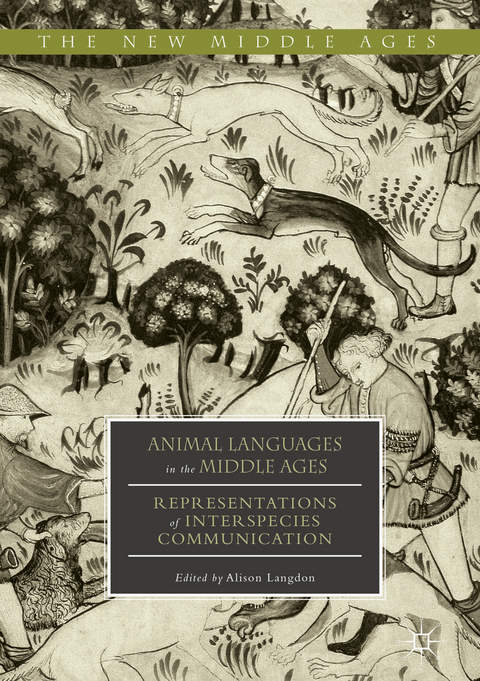
Animal Languages in the Middle Ages (eBook)
XV, 272 Seiten
Springer International Publishing (Verlag)
978-3-319-71897-2 (ISBN)
The essays in this interdisciplinary volume explore language, broadly construed, as part of the continued interrogation of the boundaries of human and nonhuman animals in the Middle Ages. Uniting a diverse set of emerging and established scholars, Animal Languages questions the assumed medieval distinction between humans and other animals. The chapters point to the wealth of non-human communicative and discursive forms through which animals function both as vehicles for human meaning and as agents of their own, demonstrating the significance of human and non-human interaction in medieval texts, particularly for engaging with the Other. The book ultimately considers the ramifications of deconstructing the medieval anthropocentric view of language for the broader question of human singularity.
Alison Langdon is Associate Professor of English at Western Kentucky University, USA. She is the editor of Postscript to the Middle Ages: Teaching Medieval Studies through Umberto Eco's The Name of the Rose (2009) and has published articles on the women troubadours, Chaucer and his contemporaries, and canines in medieval literature. Her current projects center on the liminality of human/animal identity in the medieval imagination.
Alison Langdon is Associate Professor of English at Western Kentucky University, USA. She is the editor of Postscript to the Middle Ages: Teaching Medieval Studies through Umberto Eco’s The Name of the Rose (2009) and has published articles on the women troubadours, Chaucer and his contemporaries, and canines in medieval literature. Her current projects center on the liminality of human/animal identity in the medieval imagination.
1 IntroductionPart I Communicating Through Animals2 Becoming-Birds: The Destabilizing Use of Gendered Animal Imagery in Ancrene Wisse3 As faucon comen out of muwe”: Female Agency and the Language of Falconry4 Saints and Holy Beasts: Pious Animals in Early-Medieval Insular Saints’ Vitae5 The Speech of Strangers: The Tale of the Andalusi PhoenixPart II Recovering Animal Languages6 Bark Like a Man: Performance, Identity, and Boundary in Old English Animal Voice Catalogues7 In Briddes Wise: Chaucer’s Avian Poetics8 Understanding Hawk-Latin: Animal Language and Universal Rhetoric9 "Dites le mei, si ferez bien": Fallen Language and Animal Communication in Marie de France's BisclavretPart III Embodied Language and Interspecies Dependence10 On Equine Language: Jordanus Rufus and Thirteenth-Century Communicative Horsemanship11 No Hoof, No Horse: Hoof Care, Veterinary Medicine and Cross-Species Communication in Late Medieval England12 Medieval Dog Whisperers: The Poetics of Rehabilitation13 Embodied Emotion as Animal Language in Le Chevalier au Lion.
| Erscheint lt. Verlag | 13.2.2018 |
|---|---|
| Reihe/Serie | The New Middle Ages | The New Middle Ages |
| Zusatzinfo | XV, 272 p. 10 illus. |
| Verlagsort | Cham |
| Sprache | englisch |
| Themenwelt | Geisteswissenschaften ► Geschichte ► Regional- / Ländergeschichte |
| Geisteswissenschaften ► Sprach- / Literaturwissenschaft ► Literaturwissenschaft | |
| Schlagworte | Ancrene Wisse • Andalusi Phoenix • animals as metaphor in medieval text • "becoming-animal" • birds in Chaucer • Chrétien de Troyes’ Cligès • Critical Animal Studies • falconry and gender • Guillaume au Faucon • Hybridity • interspecies communication • Le Chevalier au Lion • Marie de France's Bisclavret • medieval anthropocentrism • medieval falconry • medieval texts • medieval veterinary medicine • performative gender and animals • Troilus and Criseyde • vitae |
| ISBN-10 | 3-319-71897-5 / 3319718975 |
| ISBN-13 | 978-3-319-71897-2 / 9783319718972 |
| Informationen gemäß Produktsicherheitsverordnung (GPSR) | |
| Haben Sie eine Frage zum Produkt? |
 PDF (Wasserzeichen)
DRM: Digitales Wasserzeichen
Dieses eBook enthält ein digitales Wasserzeichen und ist damit für Sie personalisiert. Bei einer missbräuchlichen Weitergabe des eBooks an Dritte ist eine Rückverfolgung an die Quelle möglich.
Dateiformat: PDF (Portable Document Format)
Mit einem festen Seitenlayout eignet sich die PDF besonders für Fachbücher mit Spalten, Tabellen und Abbildungen. Eine PDF kann auf fast allen Geräten angezeigt werden, ist aber für kleine Displays (Smartphone, eReader) nur eingeschränkt geeignet.
Systemvoraussetzungen:
PC/Mac: Mit einem PC oder Mac können Sie dieses eBook lesen. Sie benötigen dafür einen PDF-Viewer - z.B. den Adobe Reader oder Adobe Digital Editions.
eReader: Dieses eBook kann mit (fast) allen eBook-Readern gelesen werden. Mit dem amazon-Kindle ist es aber nicht kompatibel.
Smartphone/Tablet: Egal ob Apple oder Android, dieses eBook können Sie lesen. Sie benötigen dafür einen PDF-Viewer - z.B. die kostenlose Adobe Digital Editions-App.
Buying eBooks from abroad
For tax law reasons we can sell eBooks just within Germany and Switzerland. Regrettably we cannot fulfill eBook-orders from other countries.
aus dem Bereich