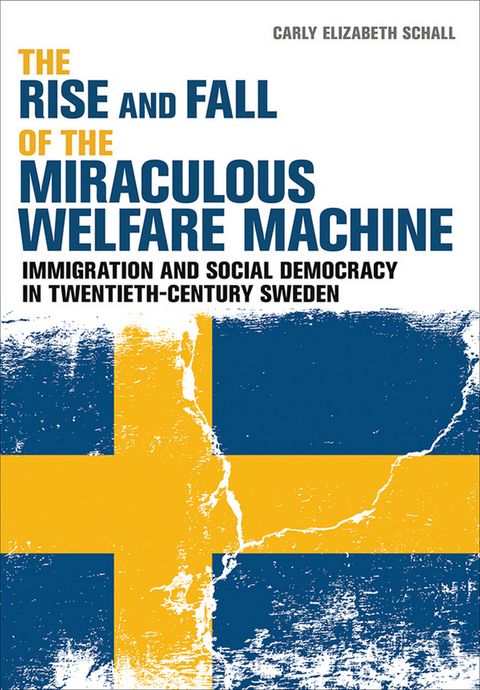
The Rise and Fall of the Miraculous Welfare Machine (eBook)
258 Seiten
Ilr Press (Verlag)
978-1-5017-0408-6 (ISBN)
In this book Carly Elizabeth Schall acknowledges the important role of ethnic homogeneity in Sweden's thriving welfare state, but she argues that it mattered primarily because political elites—especially social democrats—made it matter.
Sweden is well known for the success of its welfare state. Many believe that success was made possible in part by the country's ethnic homogeneity and that the increased diversity of Sweden’s population is putting its welfare state at risk. Few, however, have suggested convincing mechanisms for explaining the precise relationship between relative ethnic homogeneity/heterogeneity and the welfare state. In this book Carly Elizabeth Schall acknowledges the important role of ethnic homogeneity in Sweden’s thriving welfare state, but she argues that it mattered primarily because political elites—especially social democrats—made it matter.Schall shows that diversity and the welfare state are related but that diversity does not undermine the welfare state in a straightforward way. Tracing the development of the Swedish welfare state from the late 1920s until the present day, she focuses on five historical periods of crisis. She argues that the story of Swedish national identity is a story of elite-driven hegemony-building and that the linking of social democracy and national identity colored the integration of immigrants in important ways. Social democracy could have withstood the challenge posed by immigration, but the faltering of social democratic hegemony opened a door for anti-immigrant sentiment. In her deft analysis of the relationship between immigration and the welfare state in Sweden, Schall makes a compelling argument that has relevance for immigration policy in the United States and elsewhere.
Sweden is well known for the success of its welfare state. Many believe that success was made possible in part by the country's ethnic homogeneity and that the increased diversity of Sweden's population is putting its welfare state at risk. Few, however, have suggested convincing mechanisms for explaining the precise relationship between relative ethnic homogeneity/heterogeneity and the welfare state. In this book Carly Elizabeth Schall acknowledges the important role of ethnic homogeneity in Sweden's thriving welfare state, but she argues that it mattered primarily because political elites— especially social democrats—made it matter.
Schall shows that diversity and the welfare state are related but that diversity does not undermine the welfare state in a straightforward way. Tracing the development of the Swedish welfare state from the late 1920s until the present day, she focuses on five historical periods of crisis. She argues that the story of Swedish national identity is a story of elite-driven hegemony-building and that the linking of social democracy and national identity colored the integration of immigrants in important ways. Social democracy could have withstood the challenge posed by immigration, but the faltering of social democratic hegemony opened a door for anti-immigrant sentiment. In her deft analysis of the relationship between immigration and the welfare state in Sweden, Schall makes a compelling argument that has relevance for immigration policy in the United States and elsewhere.
Carly Elizabeth Schall is Assistant Professor of Sociology at Indiana University–Purdue University Indianapolis.
Introduction PART I. HOMOGENEITY IN THE PEOPLE'S HOME
Chapter 1. 1928–1932: Ethnic Nation and Social Democratic Consolidation
Chapter 2. 1945–1950: Making the "People’s Home" Interlude 1. A Swedish Welfare State, a Welfare State for Swedes PART II. HETEROGENEITY IN THE PEOPLE’S HOME
Chapter 3. 1968–1975: Security, Equality, and Choice: Expanding the People’s Home
Chapter 4. 1991–1995: People’s Home No Longer? The Breakdown of the Miraculous Welfare Machine Interlude 2. Is There Room for Difference in Social Democracy? Chapter 5. The End of Social Democracy Hegemony Conclusions: Who Belongs in the Swedish People’s Home?
| Erscheint lt. Verlag | 14.6.2016 |
|---|---|
| Zusatzinfo | 4 tables, 2 charts |
| Verlagsort | Ithaca |
| Sprache | englisch |
| Maße | 150 x 150 mm |
| Gewicht | 28 g |
| Themenwelt | Geisteswissenschaften ► Geschichte ► Regional- / Ländergeschichte |
| Sozialwissenschaften ► Pädagogik ► Sozialpädagogik | |
| Sozialwissenschaften ► Politik / Verwaltung ► Staat / Verwaltung | |
| Sozialwissenschaften ► Soziologie | |
| Schlagworte | Swedish, social democracy, ethnic homogeneity, welfare, national identity |
| ISBN-10 | 1-5017-0408-7 / 1501704087 |
| ISBN-13 | 978-1-5017-0408-6 / 9781501704086 |
| Informationen gemäß Produktsicherheitsverordnung (GPSR) | |
| Haben Sie eine Frage zum Produkt? |
 EPUB (Adobe DRM)
Kopierschutz: Adobe-DRM
Adobe-DRM ist ein Kopierschutz, der das eBook vor Mißbrauch schützen soll. Dabei wird das eBook bereits beim Download auf Ihre persönliche Adobe-ID autorisiert. Lesen können Sie das eBook dann nur auf den Geräten, welche ebenfalls auf Ihre Adobe-ID registriert sind.
Details zum Adobe-DRM
Dateiformat: EPUB (Electronic Publication)
EPUB ist ein offener Standard für eBooks und eignet sich besonders zur Darstellung von Belletristik und Sachbüchern. Der Fließtext wird dynamisch an die Display- und Schriftgröße angepasst. Auch für mobile Lesegeräte ist EPUB daher gut geeignet.
Systemvoraussetzungen:
PC/Mac: Mit einem PC oder Mac können Sie dieses eBook lesen. Sie benötigen eine
eReader: Dieses eBook kann mit (fast) allen eBook-Readern gelesen werden. Mit dem amazon-Kindle ist es aber nicht kompatibel.
Smartphone/Tablet: Egal ob Apple oder Android, dieses eBook können Sie lesen. Sie benötigen eine
Geräteliste und zusätzliche Hinweise
Buying eBooks from abroad
For tax law reasons we can sell eBooks just within Germany and Switzerland. Regrettably we cannot fulfill eBook-orders from other countries.
aus dem Bereich