


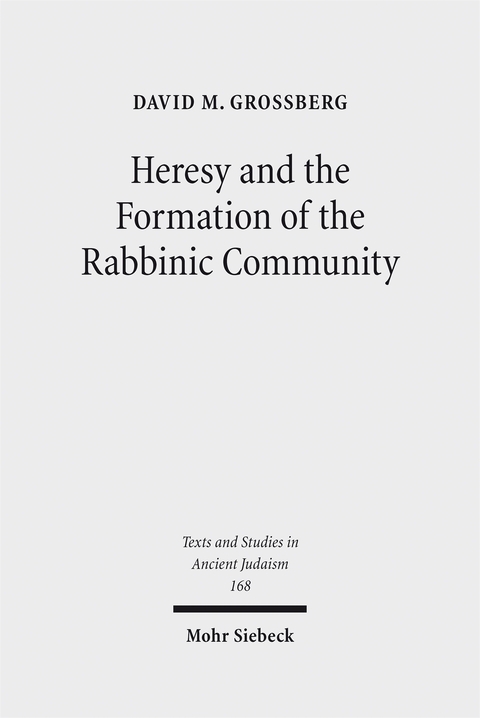
Heresy and the Formation of the Rabbinic Community
Seiten
Zwischen dem 1. und dem 6. Jahrhundert n.Chr. systematisierte eine Gruppe von Weisen, die in der Wissenschaft als die rabbinische Gemeinde bezeichnet wird, ihr Konzept des Judentums in Werken wie der Mishna und dem Talmud. David M. Grossberg bietet einen neuen Zugang die Entstehung dieser Gemeinde zu denken.
Between the first and sixth centuries C.E., a group of sages that scholars refer to as the rabbinic community systematized their ideas about Judaism in works such as the Mishnah and the Talmud. David M. Grossberg offers a new approach to thinking about this community's formation. Rather than seeking an occasion of origin, he examines the gradual development of the idea of an authorized rabbinic collective. The classical rabbinic texts imagine a diverse setting of Sadducees, Pharisees, sinners, and sectarians interacting in complex and changing ways with pious sages, teachers, and judges. Yet this representation aligns only vaguely with the social reality in which these ancient sages actually lived and operated. The author contends that these texts' primary aim was not to describe real rabbinic opponents but to create and enforce boundaries between piety and impiety and between legitimate and illegitimate teachings. In this way, the emerging rabbinic movement set standards of inclusion and exclusion in the community of righteous Israel and established the bounds of the community aspiring to lead them, the rabbinic community itself.
Between the first and sixth centuries C.E., a group of sages that scholars refer to as the rabbinic community systematized their ideas about Judaism in works such as the Mishnah and the Talmud. David M. Grossberg offers a new approach to thinking about this community's formation. Rather than seeking an occasion of origin, he examines the gradual development of the idea of an authorized rabbinic collective. The classical rabbinic texts imagine a diverse setting of Sadducees, Pharisees, sinners, and sectarians interacting in complex and changing ways with pious sages, teachers, and judges. Yet this representation aligns only vaguely with the social reality in which these ancient sages actually lived and operated. The author contends that these texts' primary aim was not to describe real rabbinic opponents but to create and enforce boundaries between piety and impiety and between legitimate and illegitimate teachings. In this way, the emerging rabbinic movement set standards of inclusion and exclusion in the community of righteous Israel and established the bounds of the community aspiring to lead them, the rabbinic community itself.
Born 1965; PhD from Princeton University; currently Visiting Scholar, Cornell University, Ithaca.
| Erscheinungsdatum | 23.06.2017 |
|---|---|
| Reihe/Serie | Texts and Studies in Ancient Judaism |
| Verlagsort | Tübingen |
| Sprache | englisch |
| Maße | 162 x 240 mm |
| Gewicht | 573 g |
| Themenwelt | Geisteswissenschaften ► Religion / Theologie ► Judentum |
| Geisteswissenschaften ► Sprach- / Literaturwissenschaft ► Literaturwissenschaft | |
| Schlagworte | Ancient • Ancient Judaism • Antiquity • Christianity • Early • Early Christianity • Judaism • Judentum • Late • Late Antiquity • Literature • Rabbiner • rabbinic • rabbinic literature • Rabbinische Literatur • Religious • Religious Studies • Studies |
| ISBN-10 | 3-16-155147-8 / 3161551478 |
| ISBN-13 | 978-3-16-155147-5 / 9783161551475 |
| Zustand | Neuware |
| Informationen gemäß Produktsicherheitsverordnung (GPSR) | |
| Haben Sie eine Frage zum Produkt? |
Mehr entdecken
aus dem Bereich

aus dem Bereich


