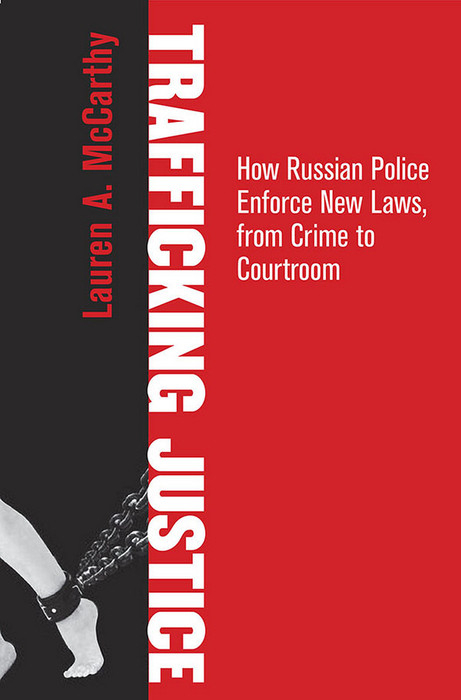
Trafficking Justice (eBook)
304 Seiten
Cornell University Press (Verlag)
978-1-5017-0137-5 (ISBN)
In response to a growing human trafficking problem and domestic and international pressure, human trafficking and the use of slave labor were first criminalized in Russia in 2003. In Trafficking Justice, Lauren A. McCarthy explains why Russian police, prosecutors, and judges have largely ignored this new weapon in their legal arsenal, despite the fact that the law was intended to make it easier to pursue trafficking cases.Using a combination of interview data, participant observation, and an original dataset of more than 5,500 Russian news media articles on human trafficking cases, McCarthy explores how trafficking cases make their way through the criminal justice system, covering multiple forms of the crime-sexual, labor, and child trafficking-over the period 2003-2013. She argues that to understand how law enforcement agencies have dealt with trafficking, it is critical to understand how their 'institutional machinery'-the incentives, culture, and structure of their organizations-channels decision-making on human trafficking cases toward a familiar set of routines and practices and away from using the new law. As a result, law enforcement often chooses to charge and prosecute traffickers with related crimes, such as kidnapping or recruitment into prostitution, rather than under the 2003 trafficking law because these other charges are more familiar and easier to bring to a successful resolution. In other words, after ten years of practice, Russian law enforcement has settled on a policy of prosecuting traffickers, not trafficking.
McCarthyLauren A.:
Lauren A. McCarthy is Assistant Professor of Political Science and Legal Studies at the University of Massachusetts Amherst.
In response to a growing human trafficking problem and domestic and international pressure, human trafficking and the use of slave labor were first criminalized in Russia in 2003. In Trafficking Justice, Lauren A. McCarthy explains why Russian police, prosecutors, and judges have largely ignored this new weapon in their legal arsenal, despite the fact that the law was intended to make it easier to pursue trafficking cases. Using a combination of interview data, participant observation, and an original dataset of more than 5,500 Russian news media articles on human trafficking cases, McCarthy explores how trafficking cases make their way through the criminal justice system, covering multiple forms of the crime-sexual, labor, and child trafficking-over the period 2003-2013. She argues that to understand how law enforcement agencies have dealt with trafficking, it is critical to understand how their institutional machinery-the incentives, culture, and structure of their organizations-channels decision-making on human trafficking cases toward a familiar set of routines and practices and away from using the new law. As a result, law enforcement often chooses to charge and prosecute traffickers with related crimes, such as kidnapping or recruitment into prostitution, rather than under the 2003 trafficking law because these other charges are more familiar and easier to bring to a successful resolution. In other words, after ten years of practice, Russian law enforcement has settled on a policy of prosecuting traffickers, not trafficking.
| Sprache | englisch |
|---|---|
| Themenwelt | Geisteswissenschaften ► Geschichte ► Regional- / Ländergeschichte |
| Recht / Steuern ► EU / Internationales Recht | |
| Recht / Steuern ► Strafrecht ► Kriminologie | |
| Sozialwissenschaften ► Politik / Verwaltung | |
| Sozialwissenschaften ► Soziologie | |
| ISBN-10 | 1-5017-0137-1 / 1501701371 |
| ISBN-13 | 978-1-5017-0137-5 / 9781501701375 |
| Informationen gemäß Produktsicherheitsverordnung (GPSR) | |
| Haben Sie eine Frage zum Produkt? |
 PDF (Adobe DRM)
Kopierschutz: Adobe-DRM
Adobe-DRM ist ein Kopierschutz, der das eBook vor Mißbrauch schützen soll. Dabei wird das eBook bereits beim Download auf Ihre persönliche Adobe-ID autorisiert. Lesen können Sie das eBook dann nur auf den Geräten, welche ebenfalls auf Ihre Adobe-ID registriert sind.
Details zum Adobe-DRM
Dateiformat: PDF (Portable Document Format)
Mit einem festen Seitenlayout eignet sich die PDF besonders für Fachbücher mit Spalten, Tabellen und Abbildungen. Eine PDF kann auf fast allen Geräten angezeigt werden, ist aber für kleine Displays (Smartphone, eReader) nur eingeschränkt geeignet.
Systemvoraussetzungen:
PC/Mac: Mit einem PC oder Mac können Sie dieses eBook lesen. Sie benötigen eine
eReader: Dieses eBook kann mit (fast) allen eBook-Readern gelesen werden. Mit dem amazon-Kindle ist es aber nicht kompatibel.
Smartphone/Tablet: Egal ob Apple oder Android, dieses eBook können Sie lesen. Sie benötigen eine
Geräteliste und zusätzliche Hinweise
Buying eBooks from abroad
For tax law reasons we can sell eBooks just within Germany and Switzerland. Regrettably we cannot fulfill eBook-orders from other countries.
aus dem Bereich