Zum Hauptinhalt springen
Nicht aus der Schweiz? Besuchen Sie lehmanns.de
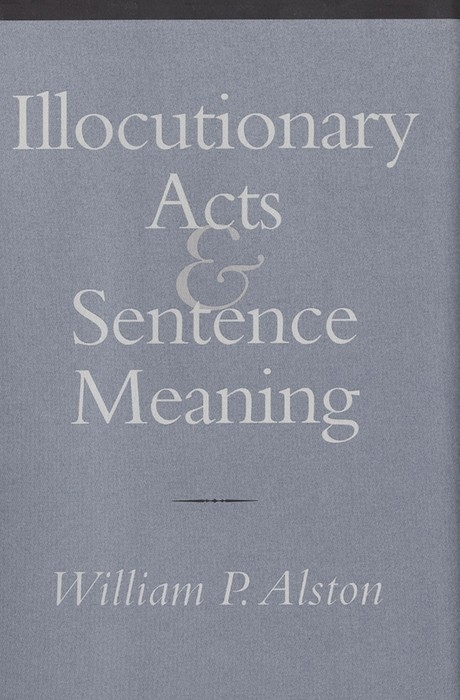
Illocutionary Acts and Sentence Meaning -  William P. Alston

Illocutionary Acts and Sentence Meaning (eBook)

eBook Download: PDF
2000 | 1. Auflage
352 Seiten
Cornell University Press (Verlag)
978-1-5017-0042-2 (ISBN)
Systemvoraussetzungen
183,72 inkl. MwSt
(CHF 179,45)
Der eBook-Verkauf erfolgt durch die Lehmanns Media GmbH (Berlin) zum Preis in Euro inkl. MwSt.
  • Download sofort lieferbar
  • Zahlungsarten anzeigen
What is it for a sentence to have a certain meaning? This is the question that William P. Alston, one of America's most distinguished and prolific analytic philosophers, addresses in this major contribution to the philosophy of language. His answer focuses on the given sentence's potential to play the role that its speaker had in mind-what he terms the usability of the sentence to perform the illocutionary act intended by its speaker. Alston defines an illocutionary act as an act of saying something with a certain content. He develops his account of what it is to perform such acts in terms of taking responsibility, in uttering a sentence, for the existence of certain conditions. In requesting someone to open a window, for example, the speaker takes responsibility for its being the case that the window is closed and that the speaker has an interest in its being opened. In Illocutionary Acts and Sentence Meaning, Alston expands upon this concept, creating a framework of five categories of illocutionary act and going on to argue that sentence meaning is fundamentally a matter of illocutionary act potential; that is, for a sentence to have a particular meaning is for it to be usable to perform illocutionary acts of a certain type. In providing detailed and explicit patterns of analysis for the whole range of illocutionary acts, Alston makes a unique contribution to the field of philosophy of language-one that is likely to generate debate for years to come.
PDFPDF (Adobe DRM)

Kopierschutz: Adobe-DRM
Adobe-DRM ist ein Kopierschutz, der das eBook vor Mißbrauch schützen soll. Dabei wird das eBook bereits beim Download auf Ihre persönliche Adobe-ID autorisiert. Lesen können Sie das eBook dann nur auf den Geräten, welche ebenfalls auf Ihre Adobe-ID registriert sind.
Details zum Adobe-DRM

Dateiformat: PDF (Portable Document Format)
Mit einem festen Seiten­layout eignet sich die PDF besonders für Fach­bücher mit Spalten, Tabellen und Abbild­ungen. Eine PDF kann auf fast allen Geräten ange­zeigt werden, ist aber für kleine Displays (Smart­phone, eReader) nur einge­schränkt geeignet.

Systemvoraussetzungen:
PC/Mac: Mit einem PC oder Mac können Sie dieses eBook lesen. Sie benötigen eine Adobe-ID und die Software Adobe Digital Editions (kostenlos). Von der Benutzung der OverDrive Media Console raten wir Ihnen ab. Erfahrungsgemäß treten hier gehäuft Probleme mit dem Adobe DRM auf.
eReader: Dieses eBook kann mit (fast) allen eBook-Readern gelesen werden. Mit dem amazon-Kindle ist es aber nicht kompatibel.
Smartphone/Tablet: Egal ob Apple oder Android, dieses eBook können Sie lesen. Sie benötigen eine Adobe-ID sowie eine kostenlose App.
Geräteliste und zusätzliche Hinweise

Buying eBooks from abroad
For tax law reasons we can sell eBooks just within Germany and Switzerland. Regrettably we cannot fulfill eBook-orders from other countries.

Mehr entdecken
aus dem Bereich
100 Fragmente des Glücks | Vom Autor der Bestseller »Glück«, …

von Wilhelm Schmid

eBook Download (2025)
Insel Verlag
CHF 11,70
Privatbriefe als Quellen des Französischen im 17. Jahrhundert

von Katharina Fezer

eBook Download (2025)
Walter de Gruyter GmbH & Co.KG (Verlag)
CHF 68,30