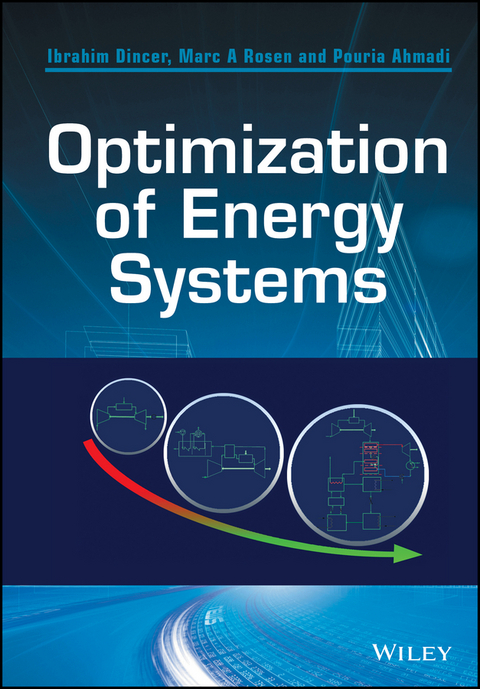
Optimization of Energy Systems (eBook)
John Wiley & Sons (Verlag)
978-1-118-89450-7 (ISBN)
An essential resource for optimizing energy systems to enhance design capability, performance and sustainability
Optimization of Energy Systems comprehensively describes the thermodynamic modelling, analysis and optimization of numerous types of energy systems in various applications. It provides a new understanding of the system and the process of defining proper objective functions for determination of the most suitable design parameters for achieving enhanced efficiency, cost effectiveness and sustainability.
Beginning with a general summary of thermodynamics, optimization techniques and optimization methods for thermal components, the book goes on to describe how to determine the most appropriate design parameters for more complex energy systems using various optimization methods. The results of each chapter provide potential tools for design, analysis, performance improvement, and greenhouse gas emissions reduction.
Key features:
- Comprehensive coverage of the modelling, analysis and optimization of many energy systems for a variety of applications.
- Examples, practical applications and case studies to put theory into practice.
- Study problems at the end of each chapter that foster critical thinking and skill development.
- Written in an easy-to-follow style, starting with simple systems and moving to advanced energy systems and their complexities.
A unique resource for understanding cutting-edge research in the thermodynamic analysis and optimization of a wide range of energy systems, Optimization of Energy Systems is suitable for graduate and senior undergraduate students, researchers, engineers, practitioners, and scientists in the area of energy systems.
IBRAHIM DINCER is a tenured full professor of Mechanical Engineering in the Faculty of Engineering and Applied Science at UOIT. He is Vice President for Strategy in International Association for Hydrogen Energy (IAHE) and Vice-President for World Society of Sustainable Energy Technologies (WSSET). Renowned for his pioneering works in the area of sustainable energy technologies he has authored and co-authored numerous books and book chapters, more than a thousand refereed journal and conference papers, and many technical reports. He has chaired many national and international conferences, symposia, workshops and technical meetings. He has delivered more than 300 keynote and invited lectures. He is an active member of various international scientific organizations and societies, and serves as editor-in-chief, associate editor, regional editor, and editorial board member on various prestigious international journals. He is a recipient of several research, teaching and service awards, including the Premier's research excellence award in Ontario, Canada, in 2004.
MARC A. ROSEN is a professor of Mechanical Engineering at the University of Ontario Institute of Technology in Oshawa, Canada, where he served as founding Dean of Engineering and Applied Science. Dr. Rosen is an active teacher and researcher in thermodynamics, energy technology, sustainable energy and the environmental impact of energy and industrial systems. He is a registered Professional Engineer in Ontario, and has served in many professional capacities, including being founding Editor-in-Chief of several journals, and a Director of Oshawa Power and Utilities Corporation. A Past-President of the Engineering Institute of Canada and the Canadian Society for Mechanical Engineering, Dr. Rosen received an Award of Excellence in Research and Technology Development from the Ontario Ministry of Environment and Energy, and is a Fellow of the Engineering Institute of Canada, the American Society of Mechanical Engineers, the Canadian Society for Mechanical Engineering, the Canadian Academy of Engineering and the International Energy Foundation.
POURIA AHMADI is a postdoctoral fellow in the Fuel Cell Research group at Simon Fraser University (SFU). He earned his PhD in 2013 in mechanical engineering at the Clean Energy Research Lab at University of Ontario Institute of Technology, Canada. There, he worked on the design, analysis and optimization of advanced integrated energy systems for enhanced sustainability. Prior to joining SFU, he was a postdoctoral fellow at Ryerson University in Toronto, Ontario, where he worked on integrated renewable energy technologies for a net zero energy community in London, Ontario, Canada. He also worked as a research assistant and PhD student at the advanced heat transfer lab at Sharif University of Technology, Tehran, Iran. He has 65 publications in both high ranked and peer-reviewed journals and international conference proceedings.
An essential resource for optimizing energy systems to enhance design capability, performance and sustainability Optimization of Energy Systems comprehensively describes the thermodynamic modelling, analysis and optimization of numerous types of energy systems in various applications. It provides a new understanding of the system and the process of defining proper objective functions for determination of the most suitable design parameters for achieving enhanced efficiency, cost effectiveness and sustainability. Beginning with a general summary of thermodynamics, optimization techniques and optimization methods for thermal components, the book goes on to describe how to determine the most appropriate design parameters for more complex energy systems using various optimization methods. The results of each chapter provide potential tools for design, analysis, performance improvement, and greenhouse gas emissions reduction. Key features: Comprehensive coverage of the modelling, analysis and optimization of many energy systems for a variety of applications. Examples, practical applications and case studies to put theory into practice. Study problems at the end of each chapter that foster critical thinking and skill development. Written in an easy-to-follow style, starting with simple systems and moving to advanced energy systems and their complexities. A unique resource for understanding cutting-edge research in the thermodynamic analysis and optimization of a wide range of energy systems, Optimization of Energy Systems is suitable for graduate and senior undergraduate students, researchers, engineers, practitioners, and scientists in the area of energy systems.
IBRAHIM DINCER is a tenured full professor of Mechanical Engineering in the Faculty of Engineering and Applied Science at UOIT. He is Vice President for Strategy in International Association for Hydrogen Energy (IAHE) and Vice-President for World Society of Sustainable Energy Technologies (WSSET). Renowned for his pioneering works in the area of sustainable energy technologies he has authored and co-authored numerous books and book chapters, more than a thousand refereed journal and conference papers, and many technical reports. He has chaired many national and international conferences, symposia, workshops and technical meetings. He has delivered more than 300 keynote and invited lectures. He is an active member of various international scientific organizations and societies, and serves as editor-in-chief, associate editor, regional editor, and editorial board member on various prestigious international journals. He is a recipient of several research, teaching and service awards, including the Premier's research excellence award in Ontario, Canada, in 2004. MARC A. ROSEN is a professor of Mechanical Engineering at the University of Ontario Institute of Technology in Oshawa, Canada, where he served as founding Dean of Engineering and Applied Science. Dr. Rosen is an active teacher and researcher in thermodynamics, energy technology, sustainable energy and the environmental impact of energy and industrial systems. He is a registered Professional Engineer in Ontario, and has served in many professional capacities, including being founding Editor-in-Chief of several journals, and a Director of Oshawa Power and Utilities Corporation. A Past-President of the Engineering Institute of Canada and the Canadian Society for Mechanical Engineering, Dr. Rosen received an Award of Excellence in Research and Technology Development from the Ontario Ministry of Environment and Energy, and is a Fellow of the Engineering Institute of Canada, the American Society of Mechanical Engineers, the Canadian Society for Mechanical Engineering, the Canadian Academy of Engineering and the International Energy Foundation. POURIA AHMADI is a postdoctoral fellow in the Fuel Cell Research group at Simon Fraser University (SFU). He earned his PhD in 2013 in mechanical engineering at the Clean Energy Research Lab at University of Ontario Institute of Technology, Canada. There, he worked on the design, analysis and optimization of advanced integrated energy systems for enhanced sustainability. Prior to joining SFU, he was a postdoctoral fellow at Ryerson University in Toronto, Ontario, where he worked on integrated renewable energy technologies for a net zero energy community in London, Ontario, Canada. He also worked as a research assistant and PhD student at the advanced heat transfer lab at Sharif University of Technology, Tehran, Iran. He has 65 publications in both high ranked and peer-reviewed journals and international conference proceedings.
Cover 1
Title Page 5
Copyright 6
Contents 7
Acknowledgements 15
Preface 17
Chapter 1 Thermodynamic Fundamentals 19
1.1 Introduction 19
1.2 Thermodynamics 19
1.3 The First Law of Thermodynamics 20
1.3.1 Thermodynamic System 21
1.3.2 Process 21
1.3.3 Cycle 21
1.3.4 Heat 22
1.3.5 Work 22
1.3.6 Thermodynamic Property 22
1.3.6.1 Specific Internal Energy 22
1.3.6.2 Specific Enthalpy 23
1.3.6.3 Specific Entropy 23
1.3.7 Thermodynamic Tables 23
1.3.8 Engineering Equation Solver (EES) 24
1.4 The Second Law of Thermodynamics 30
1.5 Reversibility and Irreversibility 32
1.6 Exergy 32
1.6.1 Exergy Associated with Kinetic and Potential Energy 33
1.6.2 Physical Exergy 34
1.6.3 Chemical Exergy 34
1.6.3.1 Standard Chemical Exergy 34
1.6.3.2 Chemical Exergy of Gas Mixtures 35
1.6.3.3 Chemical Exergy of Humid Air 35
1.6.3.4 Chemical Exergy of Liquid Water and Ice 36
1.6.3.5 Chemical Exergy for Absorption Chillers 39
1.6.4 Exergy Balance Equation 41
1.6.5 Exergy Efficiency 42
1.6.6 Procedure for Energy and Exergy Analyses 42
1.7 Concluding Remarks 45
References 45
Study Questions/Problems 46
Chapter 2 Modeling and Optimization 51
2.1 Introduction 51
2.2 Modeling 52
2.2.1 Air compressors 54
2.2.2 Gas Turbines 55
2.2.3 Pumps 56
2.2.4 Closed Heat Exchanger 57
2.2.5 Combustion Chamber (CC) 58
2.2.6 Ejector 59
2.2.7 Flat Plate Solar Collector 61
2.2.8 Solar Photovoltaic Thermal (PV/T) System 62
2.2.9 Solar Photovoltaic Panel 62
2.3 Optimization 65
2.3.1 System Boundaries 66
2.3.2 Objective Functions and System Criteria 66
2.3.3 Decision Variables 66
2.3.4 Constraints 66
2.3.5 Optimization Methods 67
2.3.5.1 Classical Optimization 67
2.3.5.2 Numerical Optimization Methods 67
2.3.5.3 Evolutionary Algorithms 68
2.4 Multi-objective Optimization 69
2.4.1 Sample Applications of Multi-objective Optimization 70
2.4.1.1 Economics 70
2.4.1.2 Finance 71
2.4.1.3 Engineering 71
2.4.2 Illustrative Example: Air Compressor Optimization 71
2.4.2.1 Thermodynamic and Economic Modeling and Analysis 71
2.4.2.2 Decision Variables 73
2.4.2.3 Constraints 74
2.4.2.4 Multi-objective Optimization 74
2.4.3 llustrative Example: Steam Turbine 76
2.4.3.1 Decision Variables 77
2.4.3.2 Constraints 77
2.4.3.3 Multi-objective Optimization 78
2.5 Concluding Remarks 79
References 81
Study Questions/Problems 81
Chapter 3 Modeling and Optimization of Thermal Components 83
3.1 Introduction 83
3.2 Air Compressor 84
3.3 Steam Turbine 85
3.4 Pump 86
3.4.1 Modeling and Simulation of a Pump 87
3.4.2 Decision variables 87
3.4.3 Constraints 87
3.4.4 Multi-objective Optimization of a Pump 88
3.5 Combustion Chamber 91
3.5.1 Modeling and Analysis of a Combustion Chamber 91
3.5.1.1 Total Cost Rate 93
3.5.2 Decision Variables 93
3.5.3 Constraints 93
3.5.4 Multi-objective Optimization 94
3.6 Flat Plate Solar Collector 96
3.6.1 Modeling and Analysis of Collector 96
3.6.2 Decision Variables and Input Data 97
3.6.3 Constraints 97
3.6.4 Multi-objective Optimization 99
3.7 Ejector 99
3.7.1 Modeling and Analysis of an Ejector 101
3.7.2 Decision Variables and Constraints 103
3.7.3 Objective Functions and Optimization 103
3.8 Concluding Remarks 107
References 107
Study Questions/Problems 108
Chapter 4 Modeling and Optimization of Heat Exchangers 110
4.1 Introduction 110
4.2 Types of Heat Exchangers 111
4.3 Modeling and Optimization of Shell and Tube Heat Exchangers 114
4.3.1 Modeling and Simulation 114
4.3.2 Optimization 117
4.3.2.1 Definition of Objective Functions 117
4.3.2.2 Decision Variables 117
4.3.3 Case Study 118
4.3.4 Model Verification 118
4.3.5 Optimization Results 119
4.3.6 Sensitivity Analysis Results 121
4.4 Modeling and Optimization of Cross Flow Plate Fin Heat Exchangers 121
4.4.1 Modeling and Simulation 123
4.4.2 Optimization 125
4.4.2.1 Decision Variables 126
4.4.3 Case Study 126
4.4.4 Model Verification 126
4.4.5 Optimization Results 127
4.4.6 Sensitivity Analysis Results 130
4.5 Modeling and Optimization of Heat Recovery Steam Generators 136
4.5.1 Modeling and Simulation 136
4.5.2 Optimization 139
4.5.2.1 Decision Variables 139
4.5.3 Case Study 139
4.5.4 Modeling Verification 140
4.5.5 Optimization Results 140
4.5.6 Sensitivity Analysis Results 146
4.6 Concluding Remarks 147
References 148
Study Questions/Problems 149
Chapter 5 Modeling and Optimization of Refrigeration Systems 151
5.1 Introduction 151
5.2 Vapor Compression Refrigeration Cycle 152
5.2.1 Thermodynamic Analysis 153
5.2.2 Exergy Analysis 156
5.2.3 Optimization 162
5.2.3.1 Decision Variables 163
5.2.3.2 Optimization Results 164
5.3 Cascade Refrigeration Systems 168
5.4 Absorption Chiller 177
5.4.1 Thermodynamic Analysis 179
5.4.2 Exergy Analysis 180
5.4.3 Exergoeconomic Analysis 184
5.4.4 Results and Discussion 184
5.4.4.1 Optimization 192
5.4.4.2 Optimization Results 193
5.5 Concluding Remarks 196
References 196
Study Questions/Problems 197
Chapter 6 Modeling and Optimization of Heat Pump Systems 201
6.1 Introduction 201
6.2 Air/Water Heat Pump System 202
6.3 System Exergy Analysis 204
6.4 Energy and Exergy Results 206
6.5 Optimization 211
6.6 Concluding Remarks 214
Reference 216
Study Questions/Problems 216
Chapter 7 Modeling and Optimization of Fuel Cell Systems 217
7.1 Introduction 217
7.2 Thermodynamics of Fuel Cells 218
7.2.1 Gibbs Function 218
7.2.2 Reversible Cell Potential 219
7.3 PEM Fuel Cell Modeling 221
7.3.1 Exergy and Exergoeconomic Analyses 222
7.3.2 Multi-objective Optimization of a PEM Fuel Cell System 223
7.4 SOFC Modeling 230
7.4.1 Mathematical Model 230
7.4.2 Cost Analysis 233
7.4.3 Optimization 234
7.5 Concluding Remarks 237
References 237
Study Questions/Problems 237
Chapter 8 Modeling and Optimization of Renewable Energy Based Systems 239
8.1 Introduction 239
8.2 Ocean Thermal Energy Conversion (OTEC) 240
8.2.1 Thermodynamic Modeling of OTEC 240
8.2.1.1 Flat Plate Solar Collector 241
8.2.1.2 Organic Rankine Cycle (ORC) 242
8.2.1.3 PEM Electrolyzer 243
8.2.2 Thermochemical Modeling of a PEM Electrolyzer 244
8.2.3 Exergy Analysis 245
8.2.4 Efficiencies 246
8.2.4.1 Exergy Efficiency 246
8.2.5 Exergoeconomic Analysis 246
8.2.5.1 Flat Plate Solar Collector in OTEC Cycle 246
8.2.5.2 OTEC Cycle 247
8.2.6 Results and Discussion 247
8.2.6.1 Modeling Validation and Simulation Code Results 247
8.2.6.2 Exergy Analysis Results 250
8.2.7 Multi-objective Optimization 255
8.2.7.1 Objectives 256
8.2.7.2 Decision Variables 256
8.2.8 Optimization Results 256
8.3 Solar Based Energy System 259
8.3.1 Thermodynamic Analysis 262
8.3.2 Exergoeconomic Analysis 264
8.3.3 Results and Discussion 264
8.3.3.1 Exergoeconomic Results 266
8.3.4 Sensitivity Analysis 268
8.3.5 Optimization 271
8.3.6 Optimization Results 272
8.4 Hybrid Wind-Photovoltaic-Battery System 274
8.4.1 Modeling 274
8.4.1.1 Photovoltaic (PV) Panel 274
8.4.1.2 Wind Turbine (WT) 280
8.4.1.3 Battery 280
8.4.2 Objective Function, Design Parameters, and Constraints 280
8.4.3 Real Parameter Genetic Algorithm 281
8.4.4 Case Study 282
8.4.5 Results and Discussion 283
8.5 Concluding Remarks 286
References 288
Study Questions/Problems 291
Chapter 9 Modeling and Optimization of Power Plants 293
9.1 Introduction 293
9.2 Steam Power Plants 294
9.2.1 Modeling and Analysis 296
9.2.2 Objective Functions, Design Parameters, and Constraints 299
9.3 Gas Turbine Power Plants 301
9.3.1 Thermodynamic Modeling 302
9.3.1.1 Air Compressor 303
9.3.1.2 Air Preheater (AP) 304
9.3.1.3 Combustion Chamber (CC) 304
9.3.1.4 Gas Turbine 304
9.3.2 Exergy and Exergoeconomic Analyses 305
9.3.3 Environmental Impact Assessment 307
9.3.4 Optimization 308
9.3.4.1 Definition of Objective Functions 308
9.3.4.2 Decision Variables 309
9.3.4.3 Model Validation 309
9.3.5 Results and Discussion 310
9.3.6 Sensitivity Analysis 312
9.3.7 Summary 314
9.4 Combined Cycle Power Plants 315
9.4.1 Thermodynamic Modeling 316
9.4.1.1 Duct Burner 316
9.4.1.2 Heat Recovery Steam Generator (HRSG) 316
9.4.1.3 Steam Turbine (ST) 318
9.4.1.4 Condenser 318
9.4.1.5 Pump 318
9.4.2 Exergy Analysis 318
9.4.3 Optimization 319
9.4.3.1 Definition of Objectives 319
9.4.3.2 Decision Variables 320
9.4.3.3 Constraints 320
9.4.4 Results and Discussion 321
9.5 Concluding Remarks 330
References 331
Study Questions/Problems 332
Chapter 10 Modeling and Optimization of Cogeneration and Trigeneration Systems 335
10.1 Introduction 335
10.2 Gas Turbine Based CHP System 339
10.2.1 Thermodynamic Modeling and Analyses 340
10.2.1.1 Air Preheater 340
10.2.1.2 Heat Recovery Steam Generator (HRSG) 341
10.2.2 Optimization 343
10.2.2.1 Single Objective Optimization 343
10.2.2.2 Multi-objective Optimization 349
10.2.2.3 Optimization Results 351
10.3 Internal Combustion Engine (ICE) Cogeneration Systems 360
10.3.1 Selection of Working Fluids 361
10.3.2 Thermodynamic Modeling and Analysis 362
10.3.2.1 Internal Combustion Engine 363
10.3.2.2 Organic Rankine Cycle 364
10.3.2.3 Ejector Refrigeration Cycle (ERC) 364
10.3.3 Exergy Analysis 366
10.3.4 Optimization 366
10.3.4.1 Decision Variables 368
10.3.4.2 Multi-objective optimization 368
10.4 Micro Gas Turbine Trigeneration System 380
10.4.1 Thermodynamic Modeling 380
10.4.1.1 Topping Cycle (Brayton Cycle) 380
10.4.1.2 Bottoming Cycle 380
10.4.1.3 Absorption Chiller 383
10.4.1.4 Domestic Water Heater 383
10.4.2 Exergy Analysis 383
10.4.3 Optimization 384
10.4.3.1 Definition of Objectives 384
10.4.3.2 Decision Variables 385
10.4.3.3 Evolutionary Algorithm: Genetic Algorithm 386
10.4.4 Optimization Results 386
10.4.5 Sensitivity Analysis 390
10.5 Biomass Based Trigeneration System 399
10.5.1 Thermodynamic Modeling 400
10.5.1.1 Gasifier 400
10.5.1.2 Multi-effect Desalination Unit 401
10.5.2 Exergy Analysis 404
10.5.3 Optimization 405
10.5.3.1 Decision Variables 408
10.5.4 Optimization Results 408
10.6 Concluding Remarks 410
References 411
Study Questions/Problems 414
Chapter 11 Modeling and Optimization of Multigeneration Energy Systems 416
11.1 Introduction 416
11.2 Multigeneration System Based On Gas Turbine Prime Mover 419
11.2.1 Thermodynamic Modeling 421
11.2.1.1 Brayton Cycle 421
11.2.1.2 Bottoming Cycle 422
11.2.1.3 Absorption Chiller 424
11.2.1.4 Domestic Hot Water Heater 424
11.2.1.5 Organic Rankine Cycle 424
11.2.1.6 Heat Recovery Vapor Generator (HRVG) 426
11.2.2 Exergy Analysis 430
11.2.2.1 Exergy Efficiency 431
11.2.3 Economic Analysis 431
11.2.3.1 Brayton Cycle 431
11.2.3.2 Steam Cycle 432
11.2.3.3 ORC Cycle 433
11.2.3.4 Absorption Chiller 434
11.2.3.5 PEM Electrolyzer 435
11.2.3.6 Domestic Hot Water (DHW) Heater 435
11.2.3.7 Capital recovery factor (CRF) 435
11.2.4 Multi-objective Optimization 435
11.2.4.1 Definition of Objectives 435
11.2.4.2 Decision Variables 436
11.2.5 Optimization Results 436
11.3 Biomass Based Multigeneration Energy System 440
11.3.1 Thermodynamic Analysis 442
11.3.1.1 Biomass Combustion 442
11.3.1.2 ORC Cycle 443
11.3.1.3 Domestic Water Heater 444
11.3.1.4 Double-effect Absorption Chiller 444
11.3.1.5 Reverse Osmosis (RO) Desalination Unit 446
11.3.2 Exergy Analysis of the System 448
11.3.3 Economic Analysis of the System 449
11.3.3.1 Biomass Combustor and Evaporator 449
11.3.3.2 Heating Process Unit 450
11.3.3.3 Reverse Osmosis (RO) Desalination Unit 450
11.3.4 Multi-objective Optimization 450
11.3.4.1 Definition of Objectives 450
11.3.4.2 Decision Variables 451
11.3.5 Optimization Results 451
11.4 Concluding Remarks 461
References 461
Study Questions/Problems 462
Index 465
EULA 472
| Erscheint lt. Verlag | 3.5.2017 |
|---|---|
| Sprache | englisch |
| Themenwelt | Geisteswissenschaften ► Geschichte |
| Technik ► Bauwesen | |
| Technik ► Elektrotechnik / Energietechnik | |
| Technik ► Maschinenbau | |
| Schlagworte | Cost • design and analysis • Efficiency • Energie • Energy • Energy systems • Environmental impact • exergy • Maschinenbau • Maschinenbau - Entwurf • mechanical engineering • Mechanical Engineering - Design • Optimization • Performance Assessment • sustainability • thermodynamics • Thermodynamik |
| ISBN-10 | 1-118-89450-2 / 1118894502 |
| ISBN-13 | 978-1-118-89450-7 / 9781118894507 |
| Informationen gemäß Produktsicherheitsverordnung (GPSR) | |
| Haben Sie eine Frage zum Produkt? |
 PDF (Adobe DRM)
Kopierschutz: Adobe-DRM
Adobe-DRM ist ein Kopierschutz, der das eBook vor Mißbrauch schützen soll. Dabei wird das eBook bereits beim Download auf Ihre persönliche Adobe-ID autorisiert. Lesen können Sie das eBook dann nur auf den Geräten, welche ebenfalls auf Ihre Adobe-ID registriert sind.
Details zum Adobe-DRM
Dateiformat: PDF (Portable Document Format)
Mit einem festen Seitenlayout eignet sich die PDF besonders für Fachbücher mit Spalten, Tabellen und Abbildungen. Eine PDF kann auf fast allen Geräten angezeigt werden, ist aber für kleine Displays (Smartphone, eReader) nur eingeschränkt geeignet.
Systemvoraussetzungen:
PC/Mac: Mit einem PC oder Mac können Sie dieses eBook lesen. Sie benötigen eine
eReader: Dieses eBook kann mit (fast) allen eBook-Readern gelesen werden. Mit dem amazon-Kindle ist es aber nicht kompatibel.
Smartphone/Tablet: Egal ob Apple oder Android, dieses eBook können Sie lesen. Sie benötigen eine
Geräteliste und zusätzliche Hinweise
Buying eBooks from abroad
For tax law reasons we can sell eBooks just within Germany and Switzerland. Regrettably we cannot fulfill eBook-orders from other countries.
aus dem Bereich