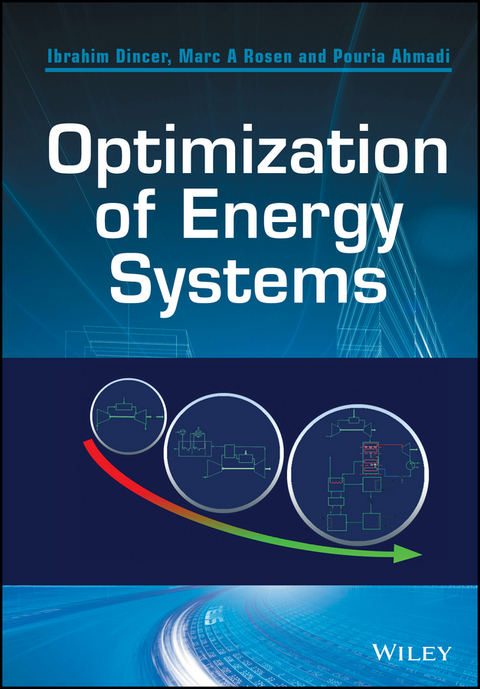
Optimization of Energy Systems (eBook)
John Wiley & Sons (Verlag)
978-1-118-89449-1 (ISBN)
An essential resource for optimizing energy systems to enhance design capability, performance and sustainability
Optimization of Energy Systems comprehensively describes the thermodynamic modelling, analysis and optimization of numerous types of energy systems in various applications. It provides a new understanding of the system and the process of defining proper objective functions for determination of the most suitable design parameters for achieving enhanced efficiency, cost effectiveness and sustainability.
Beginning with a general summary of thermodynamics, optimization techniques and optimization methods for thermal components, the book goes on to describe how to determine the most appropriate design parameters for more complex energy systems using various optimization methods. The results of each chapter provide potential tools for design, analysis, performance improvement, and greenhouse gas emissions reduction.
Key features:
- Comprehensive coverage of the modelling, analysis and optimization of many energy systems for a variety of applications.
- Examples, practical applications and case studies to put theory into practice.
- Study problems at the end of each chapter that foster critical thinking and skill development.
- Written in an easy-to-follow style, starting with simple systems and moving to advanced energy systems and their complexities.
A unique resource for understanding cutting-edge research in the thermodynamic analysis and optimization of a wide range of energy systems, Optimization of Energy Systems is suitable for graduate and senior undergraduate students, researchers, engineers, practitioners, and scientists in the area of energy systems.
IBRAHIM DINCER is a tenured full professor of Mechanical Engineering in the Faculty of Engineering and Applied Science at UOIT. He is Vice President for Strategy in International Association for Hydrogen Energy (IAHE) and Vice-President for World Society of Sustainable Energy Technologies (WSSET). Renowned for his pioneering works in the area of sustainable energy technologies he has authored and co-authored numerous books and book chapters, more than a thousand refereed journal and conference papers, and many technical reports. He has chaired many national and international conferences, symposia, workshops and technical meetings. He has delivered more than 300 keynote and invited lectures. He is an active member of various international scientific organizations and societies, and serves as editor-in-chief, associate editor, regional editor, and editorial board member on various prestigious international journals. He is a recipient of several research, teaching and service awards, including the Premier's research excellence award in Ontario, Canada, in 2004.
MARC A. ROSEN is a professor of Mechanical Engineering at the University of Ontario Institute of Technology in Oshawa, Canada, where he served as founding Dean of Engineering and Applied Science. Dr. Rosen is an active teacher and researcher in thermodynamics, energy technology, sustainable energy and the environmental impact of energy and industrial systems. He is a registered Professional Engineer in Ontario, and has served in many professional capacities, including being founding Editor-in-Chief of several journals, and a Director of Oshawa Power and Utilities Corporation. A Past-President of the Engineering Institute of Canada and the Canadian Society for Mechanical Engineering, Dr. Rosen received an Award of Excellence in Research and Technology Development from the Ontario Ministry of Environment and Energy, and is a Fellow of the Engineering Institute of Canada, the American Society of Mechanical Engineers, the Canadian Society for Mechanical Engineering, the Canadian Academy of Engineering and the International Energy Foundation.
POURIA AHMADI is a postdoctoral fellow in the Fuel Cell Research group at Simon Fraser University (SFU). He earned his PhD in 2013 in mechanical engineering at the Clean Energy Research Lab at University of Ontario Institute of Technology, Canada. There, he worked on the design, analysis and optimization of advanced integrated energy systems for enhanced sustainability. Prior to joining SFU, he was a postdoctoral fellow at Ryerson University in Toronto, Ontario, where he worked on integrated renewable energy technologies for a net zero energy community in London, Ontario, Canada. He also worked as a research assistant and PhD student at the advanced heat transfer lab at Sharif University of Technology, Tehran, Iran. He has 65 publications in both high ranked and peer-reviewed journals and international conference proceedings.
An essential resource for optimizing energy systems to enhance design capability, performance and sustainability Optimization of Energy Systems comprehensively describes the thermodynamic modelling, analysis and optimization of numerous types of energy systems in various applications. It provides a new understanding of the system and the process of defining proper objective functions for determination of the most suitable design parameters for achieving enhanced efficiency, cost effectiveness and sustainability. Beginning with a general summary of thermodynamics, optimization techniques and optimization methods for thermal components, the book goes on to describe how to determine the most appropriate design parameters for more complex energy systems using various optimization methods. The results of each chapter provide potential tools for design, analysis, performance improvement, and greenhouse gas emissions reduction. Key features: Comprehensive coverage of the modelling, analysis and optimization of many energy systems for a variety of applications. Examples, practical applications and case studies to put theory into practice. Study problems at the end of each chapter that foster critical thinking and skill development. Written in an easy-to-follow style, starting with simple systems and moving to advanced energy systems and their complexities. A unique resource for understanding cutting-edge research in the thermodynamic analysis and optimization of a wide range of energy systems, Optimization of Energy Systems is suitable for graduate and senior undergraduate students, researchers, engineers, practitioners, and scientists in the area of energy systems.
IBRAHIM DINCER is a tenured full professor of Mechanical Engineering in the Faculty of Engineering and Applied Science at UOIT. He is Vice President for Strategy in International Association for Hydrogen Energy (IAHE) and Vice-President for World Society of Sustainable Energy Technologies (WSSET). Renowned for his pioneering works in the area of sustainable energy technologies he has authored and co-authored numerous books and book chapters, more than a thousand refereed journal and conference papers, and many technical reports. He has chaired many national and international conferences, symposia, workshops and technical meetings. He has delivered more than 300 keynote and invited lectures. He is an active member of various international scientific organizations and societies, and serves as editor-in-chief, associate editor, regional editor, and editorial board member on various prestigious international journals. He is a recipient of several research, teaching and service awards, including the Premier's research excellence award in Ontario, Canada, in 2004. MARC A. ROSEN is a professor of Mechanical Engineering at the University of Ontario Institute of Technology in Oshawa, Canada, where he served as founding Dean of Engineering and Applied Science. Dr. Rosen is an active teacher and researcher in thermodynamics, energy technology, sustainable energy and the environmental impact of energy and industrial systems. He is a registered Professional Engineer in Ontario, and has served in many professional capacities, including being founding Editor-in-Chief of several journals, and a Director of Oshawa Power and Utilities Corporation. A Past-President of the Engineering Institute of Canada and the Canadian Society for Mechanical Engineering, Dr. Rosen received an Award of Excellence in Research and Technology Development from the Ontario Ministry of Environment and Energy, and is a Fellow of the Engineering Institute of Canada, the American Society of Mechanical Engineers, the Canadian Society for Mechanical Engineering, the Canadian Academy of Engineering and the International Energy Foundation. POURIA AHMADI is a postdoctoral fellow in the Fuel Cell Research group at Simon Fraser University (SFU). He earned his PhD in 2013 in mechanical engineering at the Clean Energy Research Lab at University of Ontario Institute of Technology, Canada. There, he worked on the design, analysis and optimization of advanced integrated energy systems for enhanced sustainability. Prior to joining SFU, he was a postdoctoral fellow at Ryerson University in Toronto, Ontario, where he worked on integrated renewable energy technologies for a net zero energy community in London, Ontario, Canada. He also worked as a research assistant and PhD student at the advanced heat transfer lab at Sharif University of Technology, Tehran, Iran. He has 65 publications in both high ranked and peer-reviewed journals and international conference proceedings.
Acknowledgements xiii
Preface xv
1 Thermodynamic Fundamentals 1
1.1 Introduction 1
1.2 Thermodynamics 1
1.3 The First Law ofThermodynamics 2
1.4 The Second Law of Thermodynamics 12
1.5 Reversibility and Irreversibility 14
1.6 Exergy 14
2 Modeling and Optimization 33
2.1 Introduction 33
2.2 Modeling 34
2.3 Optimization 47
2.4 Multi-objective Optimization 51
3 Modeling and Optimization of Thermal Components 65
3.1 Introduction 65
3.2 Air Compressor 66
3.3 Steam Turbine 67
3.4 Pump 68
3.5 Combustion Chamber 73
3.6 Flat Plate Solar Collector 78
3.7 Ejector 81
4 Modeling and Optimization of Heat Exchangers 92
4.1 Introduction 92
4.2 Types of Heat Exchangers 93
4.3 Modeling and Optimization of Shell and Tube Heat Exchangers 96
4.4 Modeling and Optimization of Cross Flow Plate Fin Heat Exchangers 103
4.5 Modeling and Optimization of Heat Recovery Steam Generators 118
5 Modeling and Optimization of Refrigeration Systems 133
5.1 Introduction 133
5.2 Vapor Compression Refrigeration Cycle 134
5.3 Cascade Refrigeration Systems 150
5.4 Absorption Chiller 159
6 Modeling and Optimization of Heat Pump Systems 183
6.1 Introduction 183
6.2 Air/Water Heat Pump System 184
6.3 System Exergy Analysis 186
6.4 Energy and Exergy Results 188
6.5 Optimization 193
7 Modeling and Optimization of Fuel Cell Systems 199
7.1 Introduction 199
7.2 Thermodynamics of Fuel Cells 200
7.3 PEM Fuel Cell Modeling 203
7.4 SOFC Modeling 212
8 Modeling and Optimization of Renewable Energy Based Systems 221
8.1 Introduction 221
8.2 Ocean Thermal Energy Conversion (OTEC) 222
8.3 Solar Based Energy System 241
8.4 HybridWind-Photovoltaic-Battery System 256
9 Modeling and Optimization of Power Plants 275
9.1 Introduction 275
9.2 Steam Power Plants 276
9.3 Gas Turbine Power Plants 283
9.4 Combined Cycle Power Plants 297
10 Modeling and Optimization of Cogeneration and Trigeneration Systems 317
10.1 Introduction 317
10.2 Gas Turbine Based CHP System 321
10.3 Internal Combustion Engine (ICE) Cogeneration Systems 342
10.4 Micro Gas Turbine Trigeneration System 362
10.5 Biomass Based Trigeneration System 381
11 Modeling and Optimization of Multigeneration Energy Systems 398
11.1 Introduction 398
11.2 Multigeneration System Based On Gas Turbine Prime Mover 401
11.3 Biomass Based Multigeneration Energy System 422
Index 447
Chapter 1
Thermodynamic Fundamentals
1.1 Introduction
Energy plays a critical role in driving almost all practical processes and is essential to sustain life. Energy exists in several forms, for example, light, heat, and electricity. Energy systems are widespread and used in diverse industries such as power generation, petrochemical processing, refrigeration, hydrogen production, chemical processing, and manufacturing. Interest is growing in producing superior energy products at minimal cost, while satisfying concerns regarding environmental impact, safety, and other issues. It is no longer adequate to develop a system that simply performs a desired task. For various reasons, it is often important to optimize processes so that a chosen quantity, known as the objective function, is maximized or minimized. For example, the output, profit, productivity, product quality, and so on, may be maximized, or the cost per item, financial investment, energy input, and so on, may be minimized. The success and growth of industries today is strongly based on their ability to optimize designs and systems.
When an engineer undertakes the analysis of an energy system and/or its application, she or he should deal with several basic factors first. These depend on the type of the problem being studied, and often involve such disciplines as thermodynamics, fluid mechanics, and heat transfer. Consequently, it is helpful to introduce several fundamental definitions and concepts before moving on to detailed energy systems applications, especially for readers who lack a background in thermodynamics, fluid mechanics, or heat transfer.
This chapter provides such a review, and is intended to give novice and practicing energy systems engineers a strong understanding of fundamentals, including physical phenomena, basic laws and principles, and governing relations, as well as a solid grounding in practical aspects. This introductory chapter covers relevant fundamentals involved in the optimization of energy systems. We begin the chapter with a summary of fundamental definitions and physical quantities, with their units, dimensions, and interrelations. We then consider introductory aspects of thermodynamics, with a particular focus on energy, exergy, and heat transfer.
1.2 Thermodynamics
Energy is needed for almost every activity. In simple terms, energy is usually thought of as the ability to carry out useful tasks like producing work and heating. Energy is contained in the fuel we use, the food we eat, and the places we live. Energy enables such outcomes as transportation, fresh water, and thermal comfort in buildings.
Energy use has drawbacks too. It can be dangerous if not used cautiously and often leads to pollution and environmental damage.
Energy can be converted from one form to another, but cannot be created or destroyed. Work and heat are two categories of energy in transit. Thermodynamics plays a key role in the analysis of processes, systems, and devices in which energy transfers and transformations occur. The implications of thermodynamics are far reaching and applications span the range of human enterprise. Nature allows the conversion of work completely into heat, but not the reverse. Additionally, converting heat into work requires a device, which is often complex (e.g., an engine).
Although energy can be transformed into different forms, the principle of conservation of energy states that the total energy of a system can only change if energy is transferred into or out of the system. This implies that it is impossible to create or destroy energy. The total energy of a system can this be calculated by adding all forms of energy in the system. Examples of energy transfer and transformation include generating or making use of electric energy, performing chemical reactions and lifting an object. Lifting against gravity performs work on the object and stores gravitational potential energy; if the object falls, gravity does work on the object, which transforms its potential energy into kinetic energy associated with its speed.
The name “thermodynamics” stems from the Greek words therme (heat) and dynamis (power), which is descriptive of efforts to convert heat into power [1]. The discipline of thermodynamics is based primarily on two fundamental natural laws, known as the first and second laws. The first law of thermodynamics is simply an expression of the conservation of energy principle. It states that energy, as a thermodynamic quantity, is neither created nor destroyed during a process. The second law of thermodynamics states that energy has quality as well as quantity, and that processes naturally occur in the direction of decreasing quality of energy [2].
1.3 The First Law of Thermodynamics
The first law of thermodynamics (FLT) embodies the principle of energy conservation, which states that, although energy can change form, it can be neither created nor destroyed. The FLT defines internal energy as a state function and provides a formal statement of the conservation of energy [2]. However, the first law provides no information about the direction in which processes can spontaneously occur, that is, reversibility aspects of thermodynamic processes. For example, the FLT cannot indicate how cells can perform work while existing in an isothermal environment. The FLT provides no information about the inability of any thermodynamic process to convert heat fully into mechanical work, or any insight into why mixtures cannot spontaneously separate or unmix themselves. A principle to explain these phenomena and to characterize the availability of energy is required. Such a principle is embodied in the second law of thermodynamics (SLT), which we explain later in this chapter.
A simple example of energy conversion is the process in which a body that has some potential energy at some elevation falls, and part of the potential energy is converted into kinetic energy. Experimental data show that the decrease in potential energy is equal to the increase in kinetic energy if air resistance is negligible. This simple example demonstrates the conservation of energy principle. In order to analyze energy systems, we need to use energy balance equations, which express the balance of the energy entering and leaving a system and the energy change in the system. That is, the net change in the total energy of the system during a process is equal to the difference between the total energy entering and the total energy leaving the system during that process, or
This relation can also be written as
The energy E may include internal energy U, kinetic energy (KE) and potential energy (PE) terms as follows:
For a change of state from state 1 to state 2 with a constant gravitational acceleration (g), Equation 1.2 can be used to show the following:
where denotes the fixed amount of mass in the system, the velocity, and the elevation. In order to apply the FLT to an energy system, we need to know some further concepts, which are described in the following sections.
1.3.1 Thermodynamic System
A thermodynamic system is a region or device or combination of devices that contains a certain quantity of matter. It is important to carefully define the system under consideration during an analysis and its boundaries. Three important types of systems can be defined:
- Closed system. Such a system is defined as one across the boundaries of which no material crosses. It therefore contains a fixed quantity of matter. Sometimes this is also called a control mass.
- Open system. This is defined as a system in which material (mass) is allowed to cross the boundaries. The term open system is sometimes referred to as a control volume.
- Isolated system. This is a closed system that is independent and unaffected by the surroundings. No mass, heat, or work crosses its boundary.
1.3.2 Process
A process is a physical or chemical change in the properties of matter or the conversion of energy from one form to another. In some processes, one property remains constant. The prefix “iso” is employed to describe such as process, for example isothermal (constant temperature), isobaric (constant pressure), and isochoric (constant volume).
1.3.3 Cycle
A cycle is a series of thermodynamic processes in which the end point conditions or properties of the matter are identical to the initial conditions.
1.3.4 Heat
Heat is the thermal form of energy, and heat transfer takes place when a temperature difference exists within a medium or between different media. The definitive experiment that showed heat to be a form of energy, convertible into other forms, was carried out by Scottish physicist James Joule. Heat transfer always requires a difference in temperature, and higher temperature differences provide higher heat transfer rates. The units for heat are joules or kilojoules in the International System (SI) and the foot pound force or British thermal unit (Btu) in the English system. In terms of sign conventions in thermodynamic calculations, a common one states that heat transfer to a system is considered positive, while heat transfer from a system is negative. If there is no heat transfer involved in a process, it is called adiabatic.
1.3.5 Work
Work is the energy that is transferred by a difference in pressure or force of any kind, and is subdivided into shaft work and flow work. Shaft work is the mechanical energy used to drive a mechanism...
| Erscheint lt. Verlag | 3.5.2017 |
|---|---|
| Sprache | englisch |
| Themenwelt | Geisteswissenschaften ► Geschichte |
| Technik ► Bauwesen | |
| Technik ► Elektrotechnik / Energietechnik | |
| Technik ► Maschinenbau | |
| Schlagworte | Cost • design and analysis • Efficiency • Energie • Energy • Energy systems • Environmental impact • exergy • Maschinenbau • Maschinenbau - Entwurf • mechanical engineering • Mechanical Engineering - Design • Optimization • Performance Assessment • sustainability • thermodynamics • Thermodynamik |
| ISBN-10 | 1-118-89449-9 / 1118894499 |
| ISBN-13 | 978-1-118-89449-1 / 9781118894491 |
| Informationen gemäß Produktsicherheitsverordnung (GPSR) | |
| Haben Sie eine Frage zum Produkt? |
 EPUB (Adobe DRM)
Kopierschutz: Adobe-DRM
Adobe-DRM ist ein Kopierschutz, der das eBook vor Mißbrauch schützen soll. Dabei wird das eBook bereits beim Download auf Ihre persönliche Adobe-ID autorisiert. Lesen können Sie das eBook dann nur auf den Geräten, welche ebenfalls auf Ihre Adobe-ID registriert sind.
Details zum Adobe-DRM
Dateiformat: EPUB (Electronic Publication)
EPUB ist ein offener Standard für eBooks und eignet sich besonders zur Darstellung von Belletristik und Sachbüchern. Der Fließtext wird dynamisch an die Display- und Schriftgröße angepasst. Auch für mobile Lesegeräte ist EPUB daher gut geeignet.
Systemvoraussetzungen:
PC/Mac: Mit einem PC oder Mac können Sie dieses eBook lesen. Sie benötigen eine
eReader: Dieses eBook kann mit (fast) allen eBook-Readern gelesen werden. Mit dem amazon-Kindle ist es aber nicht kompatibel.
Smartphone/Tablet: Egal ob Apple oder Android, dieses eBook können Sie lesen. Sie benötigen eine
Geräteliste und zusätzliche Hinweise
Buying eBooks from abroad
For tax law reasons we can sell eBooks just within Germany and Switzerland. Regrettably we cannot fulfill eBook-orders from other countries.
aus dem Bereich