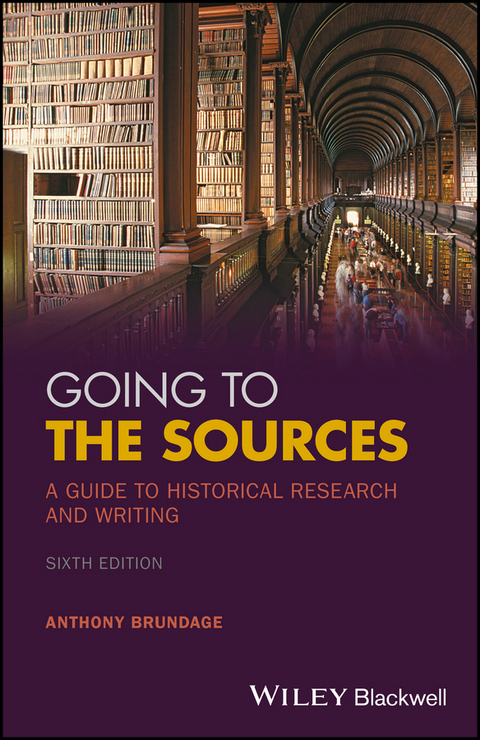
Going to the Sources (eBook)
John Wiley & Sons (Verlag)
978-1-119-26283-1 (ISBN)
It's been almost 30 years since the first edition of Going to the Sources: A Guide to Historical Research and Writing was first published. Newly revised and updated, the sixth edition of this bestselling guide helps students at all levels meet the challenge of writing their first (or their first 'real') research paper.
Presenting various schools of thought, this useful tool explores the dynamic, nature, and professional history of research papers, and shows readers how to identify, find, and evaluate both primary and secondary sources for their own writing assignments.
This new edition addresses the shifting nature of historical study over the last twenty years. Going to the Sources: A Guide to Historical Research and Writing includes:
- A new section analyzing attempts by authors of historical works to identify and cultivate the appropriate public for their writings, from scholars appealing to a small circle of fellow specialists, to popular authors seeking mass readership
- A handy style guide for creating footnotes, endnotes, bibliographical entries, as well as a list of commonly used abbreviations
Advanced Placement high school and undergraduate college students taking history courses at every level will benefit from the engaging, thoughtful, and down-to-earth advice within this hands-on guide.
Anthony Brundage is Professor of History Emeritus at California State Polytechnic University, Pomona, USA. Among his publications are seven books, the most recent of which, co-authored with Richard Cosgrove is British Historians and National Identity: From Hume to Churchill.
It s been almost 30 years since the first edition of Going to the Sources: A Guide to Historical Research and Writing was first published. Newly revised and updated, the sixth edition of this bestselling guide helps students at all levels meet the challenge of writing their first (or their first "e;real"e;) research paper. Presenting various schools of thought, this useful tool explores the dynamic, nature, and professional history of research papers, and shows readers how to identify, find, and evaluate both primary and secondary sources for their own writing assignments. This new edition addresses the shifting nature of historical study over the last twenty years. Going to the Sources: A Guide to Historical Research and Writing includes: A new section analyzing attempts by authors of historical works to identify and cultivate the appropriate public for their writings, from scholars appealing to a small circle of fellow specialists, to popular authors seeking mass readership A handy style guide for creating footnotes, endnotes, bibliographical entries, as well as a list of commonly used abbreviations Advanced Placement high school and undergraduate college students taking history courses at every level will benefit from the engaging, thoughtful, and down-to-earth advice within this hands-on guide.
Anthony Brundage is Professor of History Emeritus at California State Polytechnic University, Pomona, USA. Among his publications are seven books, the most recent of which, co-authored with Richard Cosgrove is British Historians and National Identity: From Hume to Churchill.
Going to the Sources 3
Contents 8
Preface 12
1 The Ever-Changing Shape and Texture of the Past 15
Static and Dynamic Concepts of History 15
Revising Our View of the Past 17
New Forms of Historical Consciousness 18
Toward a “Peoples History” 20
Minorities and Women Enter History 21
The Annales School and Cliometrics 23
Psychology and History 26
Microhistory and Macrohistory 27
Postmodernism 28
A Multitude of Avenues to the Past 29
2 The Nature and Variety of Historical Sources 31
Primary Sources 31
Manuscript Sources 32
Published Sources 32
Secondary Works 35
Books 36
Essays 38
Articles 38
Dissertations and Conference Papers 40
3 Finding Your Sources 44
The Online Library Catalog 45
Subject Headings, Keywords, and Title Words 46
Creating and Using a Research Bibliography 50
Published Bibliographies 52
Printed and Electronic Indexes and Abstracts 54
Finding Scholarly Essays 59
Other Important Databases 60
Historical Research on the Internet 61
Finding Useful Reference Materials 62
4 Getting the Most Out of History Books 65
The Need for More Effective Reading 65
Finding Out about Authors 67
Comparing Similar Works of History 69
Reviewing a History Book 76
5 Beyond Textual Sources 78
Words, Images, and the Historical Imagination 78
The Birth of a Nation: Entertainment, Propaganda, and Critical Response 79
Reading, Viewing, Reflecting: A Case Study 86
The Evolving Integration of Text and Image 89
6 Historys Public(s) and Public History 91
Reaching Out to a Mass Public by Early Electronic Media 92
History and Journalism 94
Beyond the Classroom and the Study: Public History 96
Contested History in the Public Arena 100
7 Exploring Changing Interpretations 103
Selecting and Refining a Topic 103
Research for a Historiographic Essay: A Case Study 105
Writing the Historiographic Essay 108
Endnotes 119
Bibliography 121
Alternative Approaches 122
8 Engaging with Primary Sources 124
Searching for a Viable Topic 125
Finding Primary Sources 126
Approaching Your Reading 127
Notetaking 128
The Outline and Structure of Your Paper 132
Some Elements of Effective Writing 133
An Open Mind and Intellectual Honesty 136
Quoting 137
Footnoting 139
Editing and Revising 141
One Final Look 143
9 Conclusion 144
Appendix A Published Bibliographies 147
Appendix B Major Databases for Bibliographic Searching 149
Appendix C Footnote/Endnote Formatting 150
Books 150
Book by a Single Author 150
Book by Two Authors 151
Book by Three Authors 151
Book by Four or More Authors 151
Book with Author(s) as Editor(s) 151
Articles and Essays (Chapters) 151
Journal Article 152
Magazine Article 152
Newspaper Article 152
Encyclopedia Article 152
Essay (Chapter) 152
Book Review 153
Other Types of Sources 153
Dissertation 153
Government Document 153
Website 153
Videorecording 153
Footnote Reference to a Previously Cited Work 153
Appendix D Bibliography Formatting 155
Book 155
Article 155
Essay (Chapter) 155
Dissertation 155
Sample Bibliography 156
Appendix E Commonly Used Abbreviations 158
Suggestions for Further Reading 160
Index 162
EULA 171
| Erscheint lt. Verlag | 27.4.2017 |
|---|---|
| Sprache | englisch |
| Themenwelt | Geisteswissenschaften ► Geschichte ► Allgemeines / Lexika |
| Geisteswissenschaften ► Geschichte ► Allgemeine Geschichte | |
| Geisteswissenschaften ► Geschichte ► Regional- / Ländergeschichte | |
| Schlagworte | Advice for writing a history research paper • challenge of researching a history paper • challenge of writing a research paper • commonly used abbreviations for history research papers • creating well-researched papers • Geschichte • Going to the Sources • guide to writing a history research paper • Historical Methods & Historiography • Historiographical Essay • History • history research paper • how to research history • how to write a history research paper • Methoden der Geschichtsforschung u. Geschichtsschreibung • style guide for creating • style guide for creating bibliographical entries • style guide for creating footnotes • writing a history research paper |
| ISBN-10 | 1-119-26283-6 / 1119262836 |
| ISBN-13 | 978-1-119-26283-1 / 9781119262831 |
| Informationen gemäß Produktsicherheitsverordnung (GPSR) | |
| Haben Sie eine Frage zum Produkt? |
 PDF (Adobe DRM)
Kopierschutz: Adobe-DRM
Adobe-DRM ist ein Kopierschutz, der das eBook vor Mißbrauch schützen soll. Dabei wird das eBook bereits beim Download auf Ihre persönliche Adobe-ID autorisiert. Lesen können Sie das eBook dann nur auf den Geräten, welche ebenfalls auf Ihre Adobe-ID registriert sind.
Details zum Adobe-DRM
Dateiformat: PDF (Portable Document Format)
Mit einem festen Seitenlayout eignet sich die PDF besonders für Fachbücher mit Spalten, Tabellen und Abbildungen. Eine PDF kann auf fast allen Geräten angezeigt werden, ist aber für kleine Displays (Smartphone, eReader) nur eingeschränkt geeignet.
Systemvoraussetzungen:
PC/Mac: Mit einem PC oder Mac können Sie dieses eBook lesen. Sie benötigen eine
eReader: Dieses eBook kann mit (fast) allen eBook-Readern gelesen werden. Mit dem amazon-Kindle ist es aber nicht kompatibel.
Smartphone/Tablet: Egal ob Apple oder Android, dieses eBook können Sie lesen. Sie benötigen eine
Geräteliste und zusätzliche Hinweise
Buying eBooks from abroad
For tax law reasons we can sell eBooks just within Germany and Switzerland. Regrettably we cannot fulfill eBook-orders from other countries.
aus dem Bereich