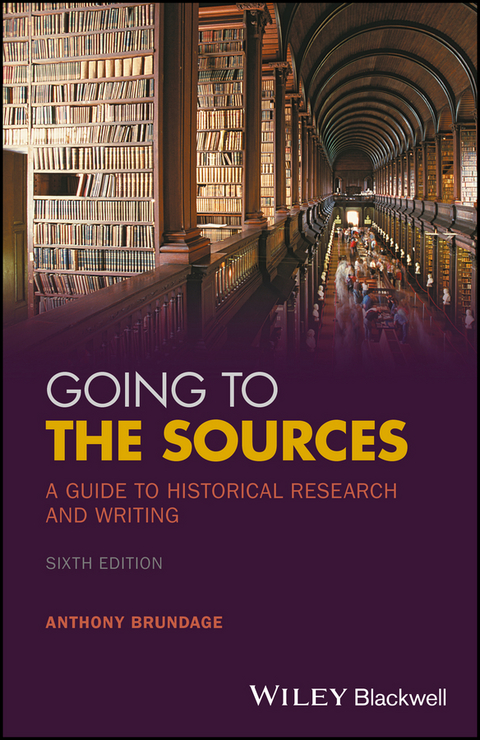
Going to the Sources (eBook)
John Wiley & Sons (Verlag)
978-1-119-26285-5 (ISBN)

It's been almost 30 years since the first edition of Going to the Sources: A Guide to Historical Research and Writing was first published. Newly revised and updated, the sixth edition of this bestselling guide helps students at all levels meet the challenge of writing their first (or their first 'real') research paper.
Presenting various schools of thought, this useful tool explores the dynamic, nature, and professional history of research papers, and shows readers how to identify, find, and evaluate both primary and secondary sources for their own writing assignments.
This new edition addresses the shifting nature of historical study over the last twenty years. Going to the Sources: A Guide to Historical Research and Writing includes:
- A new section analyzing attempts by authors of historical works to identify and cultivate the appropriate public for their writings, from scholars appealing to a small circle of fellow specialists, to popular authors seeking mass readership
- A handy style guide for creating footnotes, endnotes, bibliographical entries, as well as a list of commonly used abbreviations
Advanced Placement high school and undergraduate college students taking history courses at every level will benefit from the engaging, thoughtful, and down-to-earth advice within this hands-on guide.
Anthony Brundage is Professor of History Emeritus at California State Polytechnic University, Pomona, USA. Among his publications are seven books, the most recent of which, co-authored with Richard Cosgrove is British Historians and National Identity: From Hume to Churchill.
It s been almost 30 years since the first edition of Going to the Sources: A Guide to Historical Research and Writing was first published. Newly revised and updated, the sixth edition of this bestselling guide helps students at all levels meet the challenge of writing their first (or their first "e;real"e;) research paper. Presenting various schools of thought, this useful tool explores the dynamic, nature, and professional history of research papers, and shows readers how to identify, find, and evaluate both primary and secondary sources for their own writing assignments. This new edition addresses the shifting nature of historical study over the last twenty years. Going to the Sources: A Guide to Historical Research and Writing includes: A new section analyzing attempts by authors of historical works to identify and cultivate the appropriate public for their writings, from scholars appealing to a small circle of fellow specialists, to popular authors seeking mass readership A handy style guide for creating footnotes, endnotes, bibliographical entries, as well as a list of commonly used abbreviations Advanced Placement high school and undergraduate college students taking history courses at every level will benefit from the engaging, thoughtful, and down-to-earth advice within this hands-on guide.
Anthony Brundage is Professor of History Emeritus at California State Polytechnic University, Pomona, USA. Among his publications are seven books, the most recent of which, co-authored with Richard Cosgrove is British Historians and National Identity: From Hume to Churchill.
Preface x
1 The Ever-Changing Shape and Texture of the Past 1
Static and Dynamic Concepts of History 1
Revising Our View of the Past 3
New Forms of Historical Consciousness 4
Toward a "People's History" 6
Minorities and Women Enter History 7
The Annales School and Cliometrics 9
Psychology and History 12
Microhistory and Macrohistory 13
Postmodernism 14
A Multitude of Avenues to the Past 15
2 The Nature and Variety of Historical Sources 17
Primary Sources 17
Manuscript Sources 18
Published Sources 18
Secondary Works 21
Books 22
Essays 24
Articles 24
Dissertations and Conference Papers 26
3 Finding Your Sources: The Online Library Catalog and Beyond 30
The Online Library Catalog 31
Subject Headings, Keywords, and Title Words 32
Creating and Using a Research Bibliography 36
Published Bibliographies 38
Printed and Electronic Indexes and Abstracts 40
Finding Scholarly Essays 45
Other Important Databases 46
Historical Research on the Internet 47
Finding Useful Reference Materials 48
4 Getting the Most Out of History Books: Critical Reading and Assessment 51
The Need for More Effective Reading 51
Finding Out about Authors 53
Comparing Similar Works of History 55
Reviewing a History Book 62
5 Beyond Textual Sources: Historians'Use of Other Media 64
Words, Images, and the Historical Imagination 64
The Birth of a Nation: Entertainment, Propaganda, and Critical Response 65
Reading, Viewing, Reflecting: A Case Study 72
The Evolving Integration of Text and Image 75
6 History's Public(s) and Public History 77
Reaching Out to a Mass Public by Early Electronic Media 78
History and Journalism 80
Beyond the Classroom and the Study: Public History 82
Contested History in the Public Arena 86
7 Exploring Changing Interpretations: The Historiographic Essay 89
Selecting and Refining a Topic 89
Research for a Historiographic Essay: A Case Study 91
Writing the Historiographic Essay 94
Alternative Approaches 108
8 Engaging with Primary Sources: The Research Paper 110
Searching for a Viable Topic 111
Finding Primary Sources 112
Approaching Your Reading 113
Notetaking 114
The Outline and Structure of Your Paper 118
Some Elements of Effective Writing 119
An Open Mind and Intellectual Honesty 122
Quoting 123
Footnoting 125
Editing and Revising 127
One Final Look 129
9 Conclusion: The Open-Ended Nature of History 130
Appendix A: Published Bibliographies 133
Appendix B: Major Databases for Bibliographic Searching 135
Appendix C: Footnote/Endnote Formatting 136
Books 136
Book by a Single Author 136
Book by Two Authors 137
Book by Three Authors 137
Book by Four or More Authors 137
Book with Author(s) as Editor(s) 137
Articles and Essays (Chapters) 137
Journal Article 138
Magazine Article 138
Newspaper Article 138
Encyclopedia Article 138
Essay (Chapter) 138
Book Review 139
Other Types of Sources 139
Dissertation 139
Government Document 139
Website 139
Videorecording 139
Footnote Reference to a Previously Cited Work 139
Appendix D: Bibliography Formatting 141
Book 141
Article 141
Essay (Chapter) 141
Dissertation 141
Sample Bibliography 142
Appendix E: Commonly Used Abbreviations 144
Suggestions for Further Reading 146
Index 148
2
The Nature and Variety of Historical Sources
As we saw in Chapter 1, history is an intellectual discipline marked by ongoing change and punctuated by the periodic appearance of major revisionist works. Historians are constantly reviewing and rethinking the past, discovering new patterns and meanings. In this process they depend upon the tangible remains of the past for source materials. Any remnant of the past can serve the purpose. Although written records tend to predominate as source materials in most fields of history, in some (particularly those related to ancient and medieval history) scholars rely heavily on artifacts. Such materials are of importance to those who study modern history as well. Weapons, coins, household utensils, cathedrals, statues, and films can cast as much light on the past as can diaries, letters, and newspapers. Whether these historical raw materials are written records or artifacts, we refer to them as primary sources. The written histories that historians fashion from these (primary) sources become in turn (secondary) sources for subsequent investigators.
Primary Sources
Written primary sources can be divided into two major categories: manuscript sources and published sources. For historians, a manuscript is any handwritten or typed record or communication that has not been printed or otherwise duplicated in significant quantities for public dissemination. It can be anything, from a laundry list to the minutes of a cabinet meeting in the Oval Office. Usually manuscript materials were intended for private, or at least restricted use, although something like the notes for a speech that was never delivered would also be considered a manuscript source. A manuscript can be something as intensely personal as a diary, or something as institutional as a roster of Egyptian temple scribes. There is virtually no kind of written record that has not been used, or might someday be used, as a primary source. As social history and other new approaches to the past continue to evolve, even the seemingly most trivial or mundane remnants may acquire significance.
Manuscript Sources
We will devote most of our attention to published primary sources, since undergraduate researchers in university libraries usually have only limited access to manuscript source materials. In many cases, however, there may be significant manuscript collections close at hand. Perhaps your university library has a manuscripts or a special collections department containing important materials. There may also be nearby community libraries, local historical societies, or private individuals with such resources. A look through any of these collections might prove extremely rewarding, depending on your subject. If you are researching a topic of local history, you are more likely to be afforded the opportunity to get your hands on manuscript materials. In any event, it is worthwhile to investigate the availability of manuscript collections in your locality; this may even help you choose a viable research topic, though it should be realized that access to many major manuscript collections is limited to professional historians and advanced graduate students.
Published Sources
Published primary sources can be divided into two categories: (1) manuscript materials such as letters, diaries, and memoranda, usually intended as private, sometimes intimate, documents, often published after the death of their authors; and (2) materials that were intended from the outset to be printed and made public – for example newspaper articles, congressional debates, autobiographies, annual reports of corporations, and reports of the United States Census Bureau.
There are few major political figures in the modern world, particularly in the United States, whose writings have not been published. Library shelves groan with the massive collected works of our presidents and major public figures. Past leaders of other societies are also well represented, so that, when researching the activities of the wielders of power or shapers of opinion, you will usually find no shortage of published primary sources. While many of these writings were not, strictly speaking, intended for public consumption, it is scarcely surprising that they eventually appeared in published form. Those who attained high office during the last couple of centuries could hardly expect that their papers would remain confidential for very long after their death. Indeed, the measure of immortality attainable through the posthumous publication of one’s collected papers is apt to be a component of political ambition. Some leaders might even have “played to posterity” at certain times; for this reason we must read and consider their papers with an additional measure of critical judgment.
The injunction to be critical of the papers of society’s leaders applies with special force to personal memoirs and autobiographies written “after the fact,” when these authors/subjects were at the end of their careers or in retirement. These types of published sources require interpretive care on two grounds. First, one must remember that the validity of such sources depends to a considerable extent on the author’s ability to recall events that may have occurred much earlier in his or her life. Obviously one must always assume an erosion of reliability in such recollections, one that increases with the amount of time that has elapsed. As the historian Arthur M. Schlesinger Jr. (1917–2007) observed in the preface to his autobiography: “The generic title for all memoirs should be Things I Remember … and Things I Think I Remember.”1 Second, autobiographies and memoirs are often self-serving. As mentioned, in creating these accounts, politicians and other public leaders may have been anxious to secure their own place in history. Certain episodes in their lives may therefore be given more prominence than they deserve, as well as a highly favorable interpretation, while others, possibly less flattering, may be slighted, distorted, or ignored altogether. The same applies to the descriptions of the various other persons who are discussed in these accounts. This by no means renders memoirs or autobiographies worthless as source materials. Among other things, they provide invaluable insights into the personalities of leading figures. As with all source materials, however, the historian must begin by asking the purpose for which they were written or published, and then proceed with an appropriate measure of caution and skepticism.
A skeptical approach is also in order when considering materials like the published letters and diaries of public figures. These sources are perhaps more trustworthy in one respect, since they are contemporary with the events and not subject to the corrosive effects of time on memory. Even in this case, however, we must consider the author’s motives, ignorance, or capacity for self-deception. Moreover, published source materials are frequently only a selection, and sometimes quite a small one, of the total body of a person’s writings. We must therefore take into account the built-in bias of the selecting or editing process. How representative of the whole are the documents that are published? Did a favorably disposed editor (perhaps a member of the family) suppress unflattering material? Even the most professional and even-handed editor must make painful choices about what materials to leave out. This is why historians always consult the largest and best edited collection of primary sources available, assuming of course that they do not have access to manuscript sources.
Somewhat different considerations apply to those written primary sources that are particularly valued by social historians. The development of interest in “history from below” has encouraged the finding and publication of the writings of ordinary people, who presumably never dreamed that their words would be published. The chance survival and later publication of the diary of an American pioneer woman or of the letters of a soldier in the Crimean War can vividly illuminate the lives and experiences of ordinary people. This does not mean, of course, that such documents can be accepted uncritically. While their authors were no doubt blissfully unconcerned about the opinion of posterity, their writings can be expected to reflect the normal human biases and blind spots. These “shortcomings” need not necessarily get in the way of our understanding; they may even be precisely the sort of thing we are looking for.
Let us now turn to primary-source materials like newspapers, magazines, and official reports of government or private institutions. Not only were these intended from the outset to be made public, but in many cases they were designed to influence public opinion. This is certainly the case with newspapers, whose editorial policies must be taken into account. Thus, to accept a newspaper account of one of the Lincoln–Douglas debates without considering the paper’s political orientation would be a major critical lapse. Even if an article displayed no detectable bias, we would have to consider the problems inherent in relying upon a single reporter’s account of an event: his vantage point, his ability to hear all that was said from the podium, the reactions of those in the crowd who were closest to him, and so on. Diligent historians assemble as many such accounts as they can, treating each of them critically, sorting out obvious biases and errors, and fashioning as accurate a reconstruction as...
| Erscheint lt. Verlag | 27.4.2017 |
|---|---|
| Sprache | englisch |
| Themenwelt | Geisteswissenschaften ► Geschichte ► Allgemeines / Lexika |
| Geisteswissenschaften ► Geschichte ► Allgemeine Geschichte | |
| Geisteswissenschaften ► Geschichte ► Regional- / Ländergeschichte | |
| Schlagworte | Advice for writing a history research paper • challenge of researching a history paper • challenge of writing a research paper • commonly used abbreviations for history research papers • creating well-researched papers • Geschichte • Going to the Sources • guide to writing a history research paper • Historical Methods & Historiography • Historiographical Essay • History • history research paper • how to research history • how to write a history research paper • Methoden der Geschichtsforschung u. Geschichtsschreibung • style guide for creating • style guide for creating bibliographical entries • style guide for creating footnotes • writing a history research paper |
| ISBN-10 | 1-119-26285-2 / 1119262852 |
| ISBN-13 | 978-1-119-26285-5 / 9781119262855 |
| Informationen gemäß Produktsicherheitsverordnung (GPSR) | |
| Haben Sie eine Frage zum Produkt? |
 EPUB (Adobe DRM)
Kopierschutz: Adobe-DRM
Adobe-DRM ist ein Kopierschutz, der das eBook vor Mißbrauch schützen soll. Dabei wird das eBook bereits beim Download auf Ihre persönliche Adobe-ID autorisiert. Lesen können Sie das eBook dann nur auf den Geräten, welche ebenfalls auf Ihre Adobe-ID registriert sind.
Details zum Adobe-DRM
Dateiformat: EPUB (Electronic Publication)
EPUB ist ein offener Standard für eBooks und eignet sich besonders zur Darstellung von Belletristik und Sachbüchern. Der Fließtext wird dynamisch an die Display- und Schriftgröße angepasst. Auch für mobile Lesegeräte ist EPUB daher gut geeignet.
Systemvoraussetzungen:
PC/Mac: Mit einem PC oder Mac können Sie dieses eBook lesen. Sie benötigen eine
eReader: Dieses eBook kann mit (fast) allen eBook-Readern gelesen werden. Mit dem amazon-Kindle ist es aber nicht kompatibel.
Smartphone/Tablet: Egal ob Apple oder Android, dieses eBook können Sie lesen. Sie benötigen eine
Geräteliste und zusätzliche Hinweise
Buying eBooks from abroad
For tax law reasons we can sell eBooks just within Germany and Switzerland. Regrettably we cannot fulfill eBook-orders from other countries.
aus dem Bereich