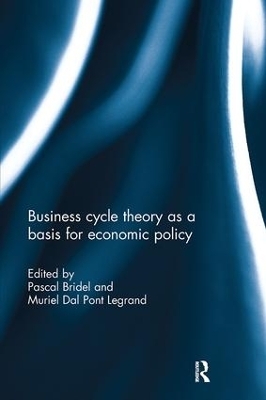
Business cycle theory as a basis for economic policy
Routledge (Verlag)
978-1-138-10665-9 (ISBN)
Since the 1970s, economic theorists excluding any economic policy interventions and favouring strictly supply-side economic policies have gained a growing influence. The development of Equilibrium Business Cycles theories coincides with the collapse, at least in academic circles, of the Keynesian consensus favouring stabilization policies. The alternative approach which emerged was based on an a priori hypothesis about the stability of the economy – or at least on its remarkable ability to stabilize itself. The direct consequence of this approach is that any stabilization objective for economic policy is not only misguided but also inefficient. There are many reasons why Keynesian policies ceased to be dominant in theoretical circles, but the most helpful circumstances for the rapid propagation of a new revolutionary theory is certainly the existence of an established orthodoxy, clearly inconsistent with the most salient facts of reality.
This book offers a sample of different theoretical approaches to business cycles, examining their respective views on economic policy with the objective of understanding business cycles that have been lost, and identifying those views which explain fluctuations and the way we conceive economic policy. This book was originally published as a special issue of The European Journal of the History of Economic Thought.
Pascal Bridel is Professor of Economics at the University of Lausanne, Switzerland. He has published in various fields including the history of economic thought and monetary theory. Muriel Dal Pont is Professor of Economics at the University Nice, France. She has published in various fields including the history of economic thought.
Introduction: Business cycle theory as a basis for economic policy 1. Economics of the crisis and the crisis of economics 2. On the importance of institutions and forms of organisation in Piero Sraffa’s economics: the case of business cycles, money, and economic policy 3. Mr Keynes, the Classics and the new Keynesians: A suggested formalisation 4. Three macroeconomic syntheses of vintage 1937: Hicks, Haberler, and Lundberg 5. Lange’s 1938 model: dynamics and the "optimum propensity to consume" 6. Toward a non-linear theory of economic fluctuations: Allais’s contribution to endogenous business cycle theory in the 1950s 7. The "Treasury View": An (un-)expected return?
| Erscheinungsdatum | 29.09.2017 |
|---|---|
| Verlagsort | London |
| Sprache | englisch |
| Maße | 156 x 234 mm |
| Gewicht | 453 g |
| Themenwelt | Geschichte ► Teilgebiete der Geschichte ► Wirtschaftsgeschichte |
| Wirtschaft ► Allgemeines / Lexika | |
| Wirtschaft ► Betriebswirtschaft / Management ► Unternehmensführung / Management | |
| Wirtschaft ► Volkswirtschaftslehre ► Makroökonomie | |
| ISBN-10 | 1-138-10665-8 / 1138106658 |
| ISBN-13 | 978-1-138-10665-9 / 9781138106659 |
| Zustand | Neuware |
| Informationen gemäß Produktsicherheitsverordnung (GPSR) | |
| Haben Sie eine Frage zum Produkt? |
aus dem Bereich