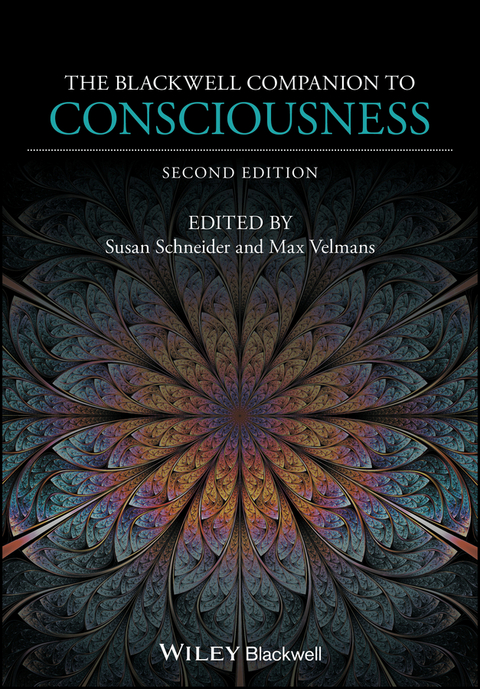
The Blackwell Companion to Consciousness (eBook)
John Wiley & Sons (Verlag)
978-1-119-00223-9 (ISBN)
Updated and revised, the highly-anticipated second edition of The Blackwell Companion to Consciousness offers a collection of readings that together represent the most thorough and comprehensive survey of the nature of consciousness available today.
- Features updates to scientific chapters reflecting the latest research in the field
- Includes 18 new theoretical, empirical, and methodological chapters covering integrated information theory, renewed interest in panpsychism, and more
- Covers a wide array of topics that include the origins and extent of consciousness, various consciousness experiences such as meditation and drug-induced states, and the neuroscience of consciousness
- Presents 54 peer-reviewed chapters written by leading experts in the study of consciousness, from across a variety of academic disciplines
Susan Schneider is Associate Professor of Philosophy and Cognitive Science at the University of Connecticut, a faculty member in the technology and ethics group at Yale's Interdisciplinary Center for Bioethics and a member at the Institute for Advanced Study in Princeton, NJ. Her work is on the nature of the self and mind, which she examines through issues in philosophy of mind, artificial intelligence (A.I.), metaphysics, astrobiology, epistemology, and neuroscience. She is the author of The Language of Thought: a New Philosophical Direction (2011) and Science Fiction and Philosophy, Second Edition (Wiley Blackwell, 2016), and was responsible for the volume's philosophical content.
Max Velmans is Emeritus Professor of Psychology, Goldsmiths, University of London, and has been involved in consciousness studies for over 40 years. He has over 100 publications on this topic including Understanding Consciousness (2000/2009) and Towards a Deeper Understanding of Consciousness (2017). He is a co-founder and former Chair of the Consciousness and Experiential Psychology Section of the British Psychological Society, and was responsible for the volume's scientific content.
Updated and revised, the highly-anticipated second edition of The Blackwell Companion to Consciousness offers a collection of readings that together represent the most thorough and comprehensive survey of the nature of consciousness available today. Features updates to scientific chapters reflecting the latest research in the field Includes 18 new theoretical, empirical, and methodological chapters covering integrated information theory, renewed interest in panpsychism, and more Covers a wide array of topics that include the origins and extent of consciousness, various consciousness experiences such as meditation and drug-induced states, and the neuroscience of consciousness Presents 54 peer-reviewed chapters written by leading experts in the study of consciousness, from across a variety of academic disciplines
Susan Schneider is Associate Professor of Philosophy and Cognitive Science at the University of Connecticut, a faculty member in the technology and ethics group at Yale's Interdisciplinary Center for Bioethics and a member at the Institute for Advanced Study in Princeton, NJ. Her work is on the nature of the self and mind, which she examines through issues in philosophy of mind, artificial intelligence (A.I.), metaphysics, astrobiology, epistemology, and neuroscience. She is the author of The Language of Thought: a New Philosophical Direction (2011) and Science Fiction and Philosophy, Second Edition (Wiley Blackwell, 2016), and was responsible for the volume's philosophical content. Max Velmans is Emeritus Professor of Psychology, Goldsmiths, University of London, and has been involved in consciousness studies for over 40 years. He has over 100 publications on this topic including Understanding Consciousness (2000/2009) and Towards a Deeper Understanding of Consciousness (2017). He is a co-founder and former Chair of the Consciousness and Experiential Psychology Section of the British Psychological Society, and was responsible for the volume's scientific content.
Title Page 5
Copyright Page 6
Contents 7
Notes on Contributors 12
Introduction 21
Part I The Problems of Consciousness 27
Chapter 1 A Brief History of the Scientific Approach to the Study of Consciousness 29
The Origin of Consciousness Studies: René Descartes 29
After Descartes 30
The Scientific Study of the Mental in the Nineteenth Century 31
Developments in the Early Twentieth Century 34
The Last 50 Years: The Triumph of Cognitive Psychology 35
Introspection, Protocol Analysis, and Meta?cognition 37
The Current State of Consciousness Research 37
Scientific Questions 39
Further Readings 40
References 40
Chapter 2 Philosophical Problems of Consciousness 43
The Problem of Ownership 44
The Problem of Perspectival Subjectivity 45
The Problem of Mechanism 46
The Problem of Duplicates 47
The Problem of the Inverted Spectrum 49
The Problem of Transparency 50
The Problem of Unity 51
The Problem of Divided Consciousness 53
The Problem of Animal Consciousness 54
Further Readings 56
References 56
Chapter 3 The Hard Problem of Consciousness 58
The Easy Problems and the Hard Problem 58
Functional Explanation 60
Some Case Studies 62
The Extra Ingredient 65
Note 67
Further Readings 67
References 67
Part II The Origins and Distribution of Consciousness 69
Chapter 4 Consciousness in Infants 71
Natural Origins of Human Consciousness and Its Growth in Human Company 71
Genesis of Awareness in Action, and in Imitation of Actions 72
Adaptations for Human Consciousness Before Birth 72
Newborn Consciousness, Dependent on Care, But Independently Imaginative and Imitative 74
How Can the Development of Infant ‘Individual’ Consciousness Be Observed Scientifically? 75
Infant Consciousness Coordinates Movements That Are Self-Aware, Emotional, and Communicative 76
Innate Rhythms of the Infant Mind, in Communication and for Elaboration of Consciousness 77
The “Musicality” of Protoconversation at 2 Months 78
From 6 Weeks to 6 Months: Tightening up Movements and Sharpening Awareness Exploring and Using Things
Sharing Routines and Rituals: Performing “Musically,” and Showing Off a Personality 79
Sharing Humor, with Self-Consciousness, Pleasure, and Pride 81
From 9 to 18 Months: Making Sense of the Space for Action in a Human-Made World 82
Coda: If Consciousness Is a Naturally Developing Function of Animal Life, Why Then Do Philosophers and Psychologists Have Problems with It? 83
Further Reading 85
References 85
Chapter 5 Animal Consciousness 89
Motivations 89
What’s the Issue? 91
Representational Theories of Phenomenal Consciousness 92
Degrees of Consciousness 93
Evolution and Distribution of Consciousness 93
Self-consciousness and Metacognition 96
Animal Pain and Suffering 97
Summary 98
Note 99
References 99
Chapter 6 Rethinking the Evolution of Consciousness 103
Introduction 103
Natural History, Adaptation, and Just?So Stories 104
Questions About the Natural History of Consciousness 106
Consciousness and the Complexity Argument 111
Just-So Stories and Beyond 113
Conclusion 115
Acknowledgements 116
Further Readings 116
References 116
Chapter 7 Machine Consciousness 119
Introduction 119
Criteria for a Conscious Machine 120
Why Build Conscious Machines? 121
A Spectrum and a Paradigm 121
Global Workspace Systems 122
Virtual Machine Functionalism 123
Integrated Information: A Link Between the Material and the Mental 125
Cognitive Neural Architectures 125
Attention and Consciousness 126
The Physiology of a Child 127
A Depictive Model 127
Phenomenology and Models 128
The Emerging Paradigm 129
Further Readings 130
References 130
Chapter 8 Panpsychism 132
Constitutive Panpsychism 132
Panpsychism and its Rivals 133
Reasons to Believe Panpsychism I – Explaining Biological Consciousness 135
Reasons to Believe Panpsychism II – Characterizing the Nature of Matter 136
Reasons to Doubt Panpsychism I – It’s Just Crazy, isn’t it? 137
Reasons to Doubt Panpsychism II – The Combination Problem 138
Conclusion 145
Notes 145
References 147
Part III Some Varieties of Conscious Experience 151
Chapter 9 States of Consciousness: Waking, Sleeping, and Dreaming 153
Definition and Components of Consciousness 153
Formal Capacities of Mind 154
The Sleep-Waking Cycle 155
The Neurophysiology of Sleep with Special Reference to Consciousness 159
A Four-Dimensional Model of Conscious State 160
Brain Imaging and Lesion Studies in Humans 162
Conclusions 164
Further Reading 164
References 164
Chapter 10 Affective Consciousness 167
Evolution of Primal Affective Consciousness 167
The Unconditional Affects of the Brain 168
Neuro-conceptual Distinctions between Affective and Cognitive Variants of Consciousness 170
Sub-neocortical Systems for Affective Consciousness 173
Summary of Emotional Systems 175
Pervasive Cognition–Emotion Interactions 177
Further Readings 179
References 179
Chapter 11 Clinical Pathologies and Unusual Experiences 183
Defining Psychopathological States 183
Common Psychological Conditions 185
The Psychoses 186
Conclusions and Clinical Implications 191
Further Readings 192
References 192
Chapter 12 Altered States of Consciousness: Drug?Induced States 197
Coda 208
Further Readings 209
References 209
Chapter 13 Anomalous Experiences 213
Introduction 213
Anomalous Experiences and Individual Differences 218
Anomalous Experiences and Psychopathology 219
Neuroscientific Research on Anomalous Experiences 221
The Beneficial Effects of Anomalous Experiences 222
Epistemological Challenges 223
Further Readings 225
References 225
Chapter 14 Mindfulness 229
Introduction 229
Mindfulness: A Therapeutic Tool 230
Cultivating Mindfulness 231
Mechanisms of Mindfulness 234
Evidence of Effectiveness 236
Quantifying Mindfulness 238
Beyond Mindfulness 239
Conclusions and Open Issues 239
Further Readings 240
References 240
Chapter 15 Altered States: Mysticism 243
The Nature of Mystical Experience 243
Further Readings 251
References 252
Part IV Some Contemporary Theories of Consciousness 253
Chapter 16 The Global Workspace Theory of Consciousness: Predictions and Results 255
Introduction 255
The Central Puzzle: Conscious Limits vs. Unconscious Vastness 258
Brain Evidence for Vast Capacity of Unconscious Processes 259
Psychological Evidence for Vast Unconscious Capacity 260
Autobiographical Memory 260
Global Access: An Answer to the Puzzle of Limited Capacity? 261
Critiques of Globalist Approaches 264
Summary and Conclusions 266
Further Readings 266
References 266
Chapter 17 The Integrated Information Theory of Consciousness: An Outline 269
Starting from Phenomenology 269
Axioms: Essential Properties of Experience 269
Postulates: Properties Required of a Physical Substrate to Support Experience 270
Identity: An Experience as a Conceptual Structure 274
Predictions and Explanations 276
Extrapolations: From Mechanisms to Phenomenology 280
Acknowledgements 281
Further Readings 281
References 281
Chapter 18 The Intermediate Level Theory of Consciousness 283
Locating Consciousness 284
Conclusions 294
Acknowledgments 294
Further Readings 294
References 295
Chapter 19 Representationalism about Consciousness 298
The Way of Ideas 298
Representation to the Rescue 299
The Exhaustion Thesis 300
Wide vs. Narrow Representationalism 302
Relational and Projectivist Approaches to the Exhaustion Thesis 303
Transparent Experience 305
The Demarcation Problem 306
Introspective Minds 309
Conclusion 310
Further Readings 311
References 311
Chapter 20 Higher-Order Theories of Consciousness 314
Higher-Order Theories Explained and Contrasted with First-Order Ones 314
Inner-Sense Theory 316
Actualist Higher-Order Thought Theory 318
Dispositionalist Higher-Order Thought Theory 320
Further Readings 322
References 322
Chapter 21 Quantum Approaches to Brain and Mind: An Overview with Representative Examples 324
1 Introduction 324
2 Quantum Brain 326
3 Quantum Mind 331
4 Brain and Mind as Dual Aspects 333
Acknowledgments 335
Further Readings 335
References 336
Chapter 22 Daniel Dennett on the Nature of Consciousness 340
Dennett’s Critique of the Cartesian Theater Model 340
Some Further Features of Dennett’s Views on Consciousness 347
Further Readings 351
References 351
Chapter 23 Biological Naturalism 353
Biological Naturalism as Scientifically Sophisticated Common Sense 353
Objections to Biological Naturalism from the Point of View of the Philosophical Tradition 357
Conclusion 362
Further Readings 362
References 362
Chapter 24 Emergentism 363
1 Objections 366
2 Emergentism’s Apologetics 369
Conclusion 373
Note 373
Further Readings 373
References 373
Chapter 25 Dualism, Reductionism, and Reflexive Monism 375
The Dualist View 375
The Reductionist View 376
Reflexive Monism 378
How Phenomenal Objects Relate to Real Objects 379
Is the Brain in the World or the World in the Brain? 383
Why This Matters 386
Further Readings 387
References 387
Chapter 26 Naturalistic Dualism 389
Nonreductive Explanation 389
Outline of a Theory of Consciousness 391
The Principle of Structural Coherence 392
The Principle of Organizational Invariance 394
The Double-Aspect Theory of Information 396
Conclusion 398
Note 398
Further Readings 398
References 398
Chapter 27 Physicalist Panpsychism 400
Folly? 401
Physicalist Panpsychism 403
Experience 403
Psychism 410
An Argument 411
Notes 413
FurtherReadings 415
References 415
Part V Some Major Topics in the Philosophy of Consciousness 417
Chapter 28 Anti-materialist Arguments and Influential Replies 419
Introduction 419
Two Forms of Anti-materialism 419
Objections to the Central State Identity Theory and Functionalism 420
The Conceivability Argument 421
The Knowledge Argument 423
The Explanatory Gap 424
Replies 425
Conclusion 428
Further Readings 428
References 428
Chapter 29 Physicalism and the Knowledge Argument 430
How the Argument Works 430
Rejecting Step 1 433
Rejecting Step 2 434
Hard-to-classify Responses 435
Jackson’s Conclusions 436
Russellian Monism 437
Concluding Remark 437
Further Readings 437
References 438
Chapter 30 Type Materialism for Phenomenal Consciousness 441
Objection 1 447
Reply 447
Objection 2 448
Reply 449
Objection 3 449
Reply 449
Follow up to Objection 3 449
Reply 449
Further Readings 454
References 454
Chapter 31 Functionalism and Qualia 456
Varieties of Functionalism 457
Views of Qualia 460
Anti-functionalist Arguments 463
Further Readings 469
References 470
Chapter 32 The Causal Efficacy of Consciousness 471
Huxley’s Epiphenomenalism 472
Scientific Considerations: Methodological Epiphenomenalism 473
Philosophical Problems of Mental Causation 475
Mental Causation and Mind–Body Reduction 477
Functionalization of Mental Properties 479
Saving What’s Important about Phenomenal Consciousness 481
Further Readings 482
References 482
Chapter 33 The Neurophilosophy of Consciousness 484
Neuroscience and Visual Consciousness 486
Neurophilosophical Theories of Consciousness 489
Further Readings 495
References 495
Chapter 34 Self-Consciousness 498
The Problems of Self-Consciousness 498
Self-Consciousness and the Metaphysics of the Self 499
Direct Awareness and Propositional Awareness 500
Immunity to Error through Misidentification 502
The Scope of Self-Consciousness 503
Self-Consciousness and the Cognitive Sciences 505
Note 507
Further Readings 507
References 508
Chapter 35 Philosophical Psychopathology and Self-Consciousness 510
Introduction 510
My Body, My Mind 511
Searching for Real Cases of Misidentification 512
Multiple Personality Disorder and Self?Consciousness 513
A Case of Alienated Self-Consciousness 515
Thought Insertion 516
Trying to Resolve the Interpretative Puzzle 519
Interpretation and Explanation 521
Conclusion 522
Further Readings 523
References 523
Chapter 36 Coming Together: The Unity of Consciousness 526
An Elusive Quarry 526
Ownership, Awareness, Attention 528
Phenomenal Spaces and Fields 531
Relational Unity: Pluralism versus Monism 533
Subsumption, Wholes, and Holism 535
Diachronic Unity 537
A Branching of the Ways 538
Further Readings 541
References 542
Chapter 37 Consciousness and Intentionality 545
Introduction 545
Inseparatism Described and Refined 547
Two Implications of Thesis C-Ins 550
Why Endorse Thesis C-Ins? 552
Nonconscious Mental States: Three Alternative Positions 554
An Epistemic Gap Counter-Argument against C-Ins 558
Inseparatism and the Impulse to Unity 559
Note 559
Further Readings 560
References 560
Part VI Major Topics in the Science of Consciousness: Topics in the Cognitive Psychology of Consciousness 563
Chapter 38 Studying Consciousness Through Inattentional Blindness, Change Blindness, and the Attentional Blink 565
Inattentional Blindness, Change Blindness, and the Attentional Blink 566
Is Attention Necessary for Consciousness? 569
To What Extent is Information Processed Unconsciously? 571
A Neural Signature of Conscious Processing 572
Conclusion 573
Further Readings 574
References 574
Chapter 39 Conscious and Unconscious Perception 577
Unconscious Perception 578
Conclusion 585
Further Readings 585
References 586
Chapter 40 Conscious and Unconscious Memory 588
Seven (Plus or Minus Two) Principles of Conscious Recollection 589
Dissociating Explicit and Implicit Memory 589
Taxonomic Issues 591
Theories of Explicit and Implicit Memory 592
Interactions between Explicit and Implicit Memory 597
The Phenomenal Experience of Remembering 598
The Implicit and the Unconscious 599
Further Reading 599
References 599
Chapter 41 Consciousness of Action 602
Introduction 602
Cues for Action Recognition 603
What is Consciously Represented in Actions 608
Further Readings 611
References 611
Topics in the Neuroscience of Consciousness 615
Chapter 42 Methodologies for Identifying the Neural Correlates of Consciousness 617
Preliminaries 617
Behavioral Correlates of Unconscious Processing 617
Neural Correlates of Unconscious Processing 618
Neural Correlates of Conscious Processing 619
Necessary and Sufficient Neural Processes? 624
Conclusions 626
Further Reading 627
References 628
Chapter 43 Conscious Processing: Unity in Time Rather Than in Space 633
Introduction 633
Conscious versus Subconscious Processing 634
Unity in Space or Time? 639
Is Consciousness a Graded Phenomenon? 642
The “Hard Problem” Revisited 642
Further Readings 644
References 644
Chapter 44 Integrated Information Theory of Consciousness: Some Ontological Considerations 647
Intrinsic and Extrinsic Existence 648
Different Kinds of Existence 650
Intrinsic Meaning: Concepts and Relations 652
Existence and Constitution: The Incoherence of Ontological Reductionism 656
Acknowledgements 658
Further Readings 658
References 658
Chapter 45 Split-brain Cases 660
Characterizing Consciousness in the Split-brain Patient 660
Examining the Corpus Callosum’s Contribution to Unified Subjective Experience 666
Explaining Unified Conscious Experience in the Split Brain 667
Toward an Understanding of the Neural Bases of Consciousness 669
Conclusions 671
Further Readings 671
References 671
Chapter 46 Duplex Vision: Separate Cortical Pathways for Conscious Perception and the Control of Action 674
Introduction 674
Two Visual Pathways in the Cerebral Cortex 674
Neurological Evidence 677
Evidence from Visual Illusions 680
Biological Tele-assistance 684
Consciousness and the Two Streams 685
Further Readings 685
References 686
Chapter 47 Altered States of Consciousness after Brain Injury 688
Altered States of Consciousness after Brain Injury 688
Coma and Chronic Disorders of Consciousness 688
Brain Anatomy in Disorders of Consciousness 690
Neurophysiology of the Minimally Conscious and Unresponsive States 691
Models of Consciousness 697
Diagnostic and Ethical Challenges 701
Conclusion and Future Directions 702
Further Readings 702
References 702
Chapter 48 Anesthesia and Consciousness 708
Anesthesia and Consciousness 708
The Evolution of General Anesthesia 708
Neural Mechanisms of Anesthesia 710
Anesthesia and Awareness 711
Unconscious Processing During Anesthesia 714
The Limits of Implicit Memory in Anesthesia 716
Implicit Perception During Anesthesia, Implicit Memory Afterward 718
Further Readings 719
References 719
Chapter 49 The Neuropsychology of Conscious Volition 721
Introduction 721
Cause and Effect 722
Hierarchical versus Dynamic Models of Decision Making and Action Initiation 722
The Empirical Study of Self?initiated Movement and Conscious Volition 724
Neuropsychological Disorders of the Will 731
Summary 731
Further Readings 732
References 732
First-Person Contributions to the Science of Consciousness 737
Chapter 50 Phenomenological Approaches to Consciousness 739
The Intentionality of Consciousness 740
The Phenomenal Aspect of Consciousness 742
The Temporal Structure of Consciousness 744
Self-awareness 745
Embodied Consciousness 748
Further Readings 749
References 750
Chapter 51 Neurophenomenology and the Micro-phenomenological Interview 752
Is Neurophenomenology a Branch of Naturalism? 753
Deep Neurophenomenology 755
At the Heart of the Neurophenomenological Method: Studying Experience 757
Neurophenomenology in the Making: Epistemology and Methodology 760
Note 763
Further Readings 763
References 763
Chapter 52 Descriptive Experience Sampling 766
Pristine Inner Experience 766
Descriptive Experience Sampling in Brief 767
Constraints 770
Applications 776
Summary 777
Further Readings 778
References 778
Chapter 53 Experiential Neuroscience of Pain 780
Defining Pain through an Experiential Perspective and Method 780
Characteristics of Pain?Related Emotions 785
Overview of Neural Processing of Pain 789
Existential Meanings of Pain 792
ExistentialMeanings of Pain 792
Further Readings 792
References 793
Chapter 54 An Epistemology for the Study of Consciousness 795
The Investigation of Conscious Experiences 795
Common Assumptions About the Way that Physical Phenomena Relate to Psychological Phenomena 796
When an Experimenter is also a Subject 798
The Sense in Which all Experienced Phenomena are Private and Subjective 800
Public Access to the Stimulus Itself 800
Public in the Sense of Similar Private Experiences 800
From Subjectivity to Intersubjectivity 801
The Quest for Objectivity 801
Four Kinds of Objectivity 802
Intra-Subjective and Inter-Subjective Repeatability 802
Consequences of the Above Analysis for a Science of Consciousness 803
The Empirical Method 804
How Methods Used to Study Consciousness Differ from Methods Used in Physics 805
Symmetries and Asymmetries of Access 805
Critical Realism 807
Critical Phenomenology 807
Further Readings 809
References 809
Resources for Students 811
1 WebResources 811
2 BlogsRelated to Consciousness 811
3 IntroductoryBooks on Consciousness and Overviews of Fields in Consciousness Studies 812
Aboutthe Editors 813
Index 814
EULA 850
| Erscheint lt. Verlag | 16.3.2017 |
|---|---|
| Sprache | englisch |
| Themenwelt | Geisteswissenschaften ► Philosophie ► Allgemeines / Lexika |
| Geisteswissenschaften ► Philosophie ► Geschichte der Philosophie | |
| Geisteswissenschaften ► Philosophie ► Philosophie der Neuzeit | |
| Schlagworte | cognitive science • Consciousness • Consciousness studies • Geistesphilosophie • Neuroscience • Philosophie • Philosophy • Philosophy of mind • Psychology |
| ISBN-10 | 1-119-00223-0 / 1119002230 |
| ISBN-13 | 978-1-119-00223-9 / 9781119002239 |
| Informationen gemäß Produktsicherheitsverordnung (GPSR) | |
| Haben Sie eine Frage zum Produkt? |
 PDF (Adobe DRM)
Kopierschutz: Adobe-DRM
Adobe-DRM ist ein Kopierschutz, der das eBook vor Mißbrauch schützen soll. Dabei wird das eBook bereits beim Download auf Ihre persönliche Adobe-ID autorisiert. Lesen können Sie das eBook dann nur auf den Geräten, welche ebenfalls auf Ihre Adobe-ID registriert sind.
Details zum Adobe-DRM
Dateiformat: PDF (Portable Document Format)
Mit einem festen Seitenlayout eignet sich die PDF besonders für Fachbücher mit Spalten, Tabellen und Abbildungen. Eine PDF kann auf fast allen Geräten angezeigt werden, ist aber für kleine Displays (Smartphone, eReader) nur eingeschränkt geeignet.
Systemvoraussetzungen:
PC/Mac: Mit einem PC oder Mac können Sie dieses eBook lesen. Sie benötigen eine
eReader: Dieses eBook kann mit (fast) allen eBook-Readern gelesen werden. Mit dem amazon-Kindle ist es aber nicht kompatibel.
Smartphone/Tablet: Egal ob Apple oder Android, dieses eBook können Sie lesen. Sie benötigen eine
Geräteliste und zusätzliche Hinweise
Buying eBooks from abroad
For tax law reasons we can sell eBooks just within Germany and Switzerland. Regrettably we cannot fulfill eBook-orders from other countries.
aus dem Bereich