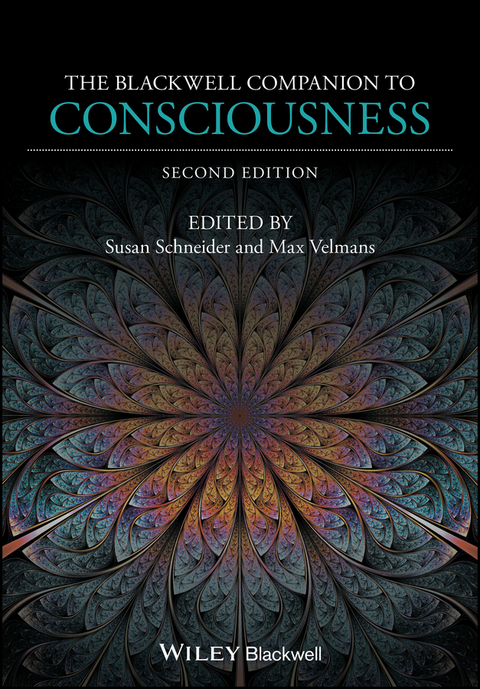
The Blackwell Companion to Consciousness (eBook)
John Wiley & Sons (Verlag)
978-1-119-00220-8 (ISBN)
Updated and revised, the highly-anticipated second edition of The Blackwell Companion to Consciousness offers a collection of readings that together represent the most thorough and comprehensive survey of the nature of consciousness available today.
- Features updates to scientific chapters reflecting the latest research in the field
- Includes 18 new theoretical, empirical, and methodological chapters covering integrated information theory, renewed interest in panpsychism, and more
- Covers a wide array of topics that include the origins and extent of consciousness, various consciousness experiences such as meditation and drug-induced states, and the neuroscience of consciousness
- Presents 54 peer-reviewed chapters written by leading experts in the study of consciousness, from across a variety of academic disciplines
Susan Schneider is Associate Professor of Philosophy and Cognitive Science at the University of Connecticut, a faculty member in the technology and ethics group at Yale's Interdisciplinary Center for Bioethics and a member at the Institute for Advanced Study in Princeton, NJ. Her work is on the nature of the self and mind, which she examines through issues in philosophy of mind, artificial intelligence (A.I.), metaphysics, astrobiology, epistemology, and neuroscience. She is the author of The Language of Thought: a New Philosophical Direction (2011) and Science Fiction and Philosophy, Second Edition (Wiley Blackwell, 2016), and was responsible for the volume's philosophical content.
Max Velmans is Emeritus Professor of Psychology, Goldsmiths, University of London, and has been involved in consciousness studies for over 40 years. He has over 100 publications on this topic including Understanding Consciousness (2000/2009) and Towards a Deeper Understanding of Consciousness (2017). He is a co-founder and former Chair of the Consciousness and Experiential Psychology Section of the British Psychological Society, and was responsible for the volume's scientific content.
Updated and revised, the highly-anticipated second edition of The Blackwell Companion to Consciousness offers a collection of readings that together represent the most thorough and comprehensive survey of the nature of consciousness available today. Features updates to scientific chapters reflecting the latest research in the field Includes 18 new theoretical, empirical, and methodological chapters covering integrated information theory, renewed interest in panpsychism, and more Covers a wide array of topics that include the origins and extent of consciousness, various consciousness experiences such as meditation and drug-induced states, and the neuroscience of consciousness Presents 54 peer-reviewed chapters written by leading experts in the study of consciousness, from across a variety of academic disciplines
Susan Schneider is Associate Professor of Philosophy and Cognitive Science at the University of Connecticut, a faculty member in the technology and ethics group at Yale's Interdisciplinary Center for Bioethics and a member at the Institute for Advanced Study in Princeton, NJ. Her work is on the nature of the self and mind, which she examines through issues in philosophy of mind, artificial intelligence (A.I.), metaphysics, astrobiology, epistemology, and neuroscience. She is the author of The Language of Thought: a New Philosophical Direction (2011) and Science Fiction and Philosophy, Second Edition (Wiley Blackwell, 2016), and was responsible for the volume's philosophical content. Max Velmans is Emeritus Professor of Psychology, Goldsmiths, University of London, and has been involved in consciousness studies for over 40 years. He has over 100 publications on this topic including Understanding Consciousness (2000/2009) and Towards a Deeper Understanding of Consciousness (2017). He is a co-founder and former Chair of the Consciousness and Experiential Psychology Section of the British Psychological Society, and was responsible for the volume's scientific content.
Notes on Contributors
Igor Aleksander is an electrical engineer who has researched artificial intelligence, cognitive systems, and the analysis of conscious organisms. Author of fourteen books and over 200 papers, in 1987 he was elected to the Royal Academy of Engineering, and in 2000 was awarded a Lifetime Achievement medal for Informatics by the Institution for Electrical Engineering. He is currently Emeritus Professor in Neural Systems Engineering and Senior Research Investigator at Imperial College, London.
Colin Allen is Provost Professor at Indiana University, where he teaches in the Cognitive Science Program and the Department of History & Philosophy of Science & Medicine. He has published numerous books and articles on topics spanning animal cognition, artificial moral agents, and digital methods in philosophy and history of science. His work has been funded by the National Science Foundation, the National Endowment for the Humanities, the Alexander von Humboldt Foundation, and he is a member of a group of five faculty at Indiana University working on the evolution of human cognition and expertise with a multi‐year grant from the Templeton Foundation.
Torin Alter is Associate Professor of Philosophy at The University of Alabama. He specializes in philosophy of mind and language, with a special interest in consciousness, intentionality, and the mind–body problem. He has also written on free will and personal identity
Harald Atmanspacher works at Collegium Helveticum, University and ETH Zurich. Until 2013 he was head of the theory group at the Institute for Frontier Areas of Psychology at Freiburg, and is currently President of the Society for Mind‐Matter Research, and editor‐in‐chief of the interdisciplinary international journal Mind and Matter. His fields of research are the theory of complex dynamical systems, conceptual and theoretical aspects of (algebraic) quantum theory, and mind‐matter relations from interdisciplinary perspectives.
Bernard J. Baars PhD is an affiliate research Fellow of the Neurosciences Institute in San Diego, California (www.nsi.edu). He is the author of A Cognitive Theory of Consciousness (1988), In the Theater of Consciousness: The Workspace of the Mind (1997), and editor of Essential Sources in the Scientific Study of Consciousness (2003, with William P. Banks and James R. Newman). Baars was founding co‐editor of the Elsevier/Academic Press journal Consciousness and Cognition with William P. Banks. Recent journal articles have appeared in Trends in Cognitive Sciences and Trends in Neurosciences.
Richard P. Bentall is Professor of Clinical Psychology at Liverpool University and has previously held chairs at Manchester University and Bangor University. His research interests have mainly focused on psychosis. He has studied the cognitive and emotional mechanisms involved in psychotic symptoms such as hallucinations, paranoid delusions, and manic states, using methods ranging from psychological experiments and experience sampling to functional magnetic resonance imaging. He has published over 200 peer‐review papers and a number of books including Madness Explained: Psychosis and Human Nature (2003) and Doctoring the Mind: Why Psychiatric Treatments Fail (2009).
José Luis Bermúdez is a Professor of Philosophy and the Director of the Philosophy‐Neuroscience‐Psychology program at Washington University in St Louis. He is the author of The Paradox of Self‐Consciousness (1998), Thinking without Words (2003), and Philosophy of Psychology: A Contemporary Introduction (2005).
Michel Bitbol is a researcher at the Centre National de la Recherche Scientifique, based at the Husserl Archive, Ecole Normale Supérieure, Paris (France). He successively received an MD, a PhD in physics, and a “Habilitation” in philosophy. After starting in scientific research, he turned to philosophy, editing texts by Erwin Schrödinger and formulating a neo‐kantian philosophy of quantum mechanics. He then studied the relations between the philosophy of physics and the philosophy of mind, working in close collaboration with Francisco Varela, and is currently developing a phenomenological critique of naturalist theories of consciousness.
David Bourget is completing his PhD at the University of Toronto and is currently on exchange to the Australian National University. His work centers around the topics of consciousness and representation, although he has recently published an article on quantum mechanics and consciousness in the Journal of Consciousness Studies.
Etzel Cardeña holds the Thorsen Professor Chair at Lund University. His PhD is from the University of California, Davis, and he was a postdoctoral fellow at Stanford University. A fellow of the American Psychological Association, the Association for Psychological Studies, and other societies, his areas of research include anomalous experiences, dissociation and trauma, hypnosis, and the stream of consciousness. His more than 300 publications include the books Varieties of Anomalous Experience, and Altering Consciousness.
Peter Carruthers is Professor and Chair of the Philosophy Department at the University of Maryland (College Park). He works primarily on issues in the philosophy of psychology: on consciousness, on modularity, on innateness, on the nature of intentional content, and on the place of natural language in human cognition.
David Chalmers is a Professor of Philosophy and Director of the Centre for Consciousness at the Australian National University, and an ARC Federation Fellow. He works especially in the philosophy of mind, and in related areas of philosophy and cognitive science. He is especially interested in consciousness, but also in philosophical issues about meaning and possibility, and in the foundations of cognitive science.
Marvin M. Chun is the Richard M. Colgate Professor of Psychology at Yale University with joint appointments in the Cognitive Science Program and the Yale School of Medicine Neurobiology Department. His research program uses brain imaging to study visual attention, perception, and memory.
Michael A. Cohen is a postdoctoral fellow at the McGovern Institute of Brain Research and Department of Brain and Cognitive Sciences at the Massachusetts Institute of Technology. His work focuses on the capacity limits of visual cognition and visual awareness. He has published on these topics in Trends in Cognitive Sciences, Proceedings of the National Academy of Sciences USA, and Psychological Science.
Mary (Molly) Colvin is a staff clinical neuropsychologist at Massachusetts General Hospital (MGH) and an Instructor of Psychology at Harvard Medical School. She completed a doctorate in cognitive neuroscience at Dartmouth College, mentored by Michael Gazzaniga. Her clinical training included a graduate program in clinical psychology at Suffolk University, followed by an internship and postdoctoral fellowship in clinical neuropsychology at MGH and Brigham and Women’s Hospital in Boston, MA. Her current research relates to clinical syndromes and brain function. She has particular interests in understanding the emergence of atypical patterns of lateralization across the lifespan and in the development of systems involved in emotional and behavioral regulation.
Randall C. Cork was a Professor in the Department of Anesthesiology and Director of the Pain Management Clinic at the Louisiana State University Health Sciences Center. He received his PhD in Electrical Engineering from Arizona State University and his MD from the University of Arizona.
Barry Dainton is Professor of Philosophy at the University of Liverpool, and author of Stream of Consciousness (2000) and Time and Space (2001).
Jennifer Dorfman received her PhD from the University of California, San Diego, and has been a Visiting Scholar at UC Berkeley.
Nathan Faivre is a cognitive neuroscientist working at the Ecole Polytechnique Fédérale de Lausanne (Switzerland). His work focuses on the interplay between perceptual consciousness and the sense of self. He studied the behavioral and neural bases of unconscious processing in different sensory modalities including vision, audition, and touch. His recent work on self‐consciousness focuses on the multisensory integration of bodily signals and metacognition.
David Fontana (1934–2010) was Reader in educational Psychology at the University of Cardiff, visiting Professor of Educational Psychology at the University of the Algarve, and a visiting professor of Transpersonal Psychology at Liverpool John Moores University. He authored over 150 papers and over 30 books translated into 26 languages that include The Elements of Meditation, The Secret Language of Symbols, The Meditator's Handbook, Learn to Meditate, and The Secret Language of Dreams. He was a co‐founder and for many years chair of the Transpersonal Psychology Section of the British Psychological Society.
Chris D. Frith FRS FBA is Emeritus Professor of Neuropsychology at University College London and Honorary Research Fellow at the Institute of Philosophy, University of London. His publications include The Cognitive Neuropsychology of Schizophrenia (1992/2015), and Making up the Mind: How the Brain Creates Our Mental World (2007).
Shaun...
| Erscheint lt. Verlag | 16.3.2017 |
|---|---|
| Sprache | englisch |
| Themenwelt | Geisteswissenschaften ► Philosophie ► Allgemeines / Lexika |
| Geisteswissenschaften ► Philosophie ► Geschichte der Philosophie | |
| Geisteswissenschaften ► Philosophie ► Philosophie der Neuzeit | |
| Schlagworte | cognitive science • Consciousness • Consciousness studies • Geistesphilosophie • Neuroscience • Philosophie • Philosophy • Philosophy of mind • Psychology |
| ISBN-10 | 1-119-00220-6 / 1119002206 |
| ISBN-13 | 978-1-119-00220-8 / 9781119002208 |
| Informationen gemäß Produktsicherheitsverordnung (GPSR) | |
| Haben Sie eine Frage zum Produkt? |
 EPUB (Adobe DRM)
Kopierschutz: Adobe-DRM
Adobe-DRM ist ein Kopierschutz, der das eBook vor Mißbrauch schützen soll. Dabei wird das eBook bereits beim Download auf Ihre persönliche Adobe-ID autorisiert. Lesen können Sie das eBook dann nur auf den Geräten, welche ebenfalls auf Ihre Adobe-ID registriert sind.
Details zum Adobe-DRM
Dateiformat: EPUB (Electronic Publication)
EPUB ist ein offener Standard für eBooks und eignet sich besonders zur Darstellung von Belletristik und Sachbüchern. Der Fließtext wird dynamisch an die Display- und Schriftgröße angepasst. Auch für mobile Lesegeräte ist EPUB daher gut geeignet.
Systemvoraussetzungen:
PC/Mac: Mit einem PC oder Mac können Sie dieses eBook lesen. Sie benötigen eine
eReader: Dieses eBook kann mit (fast) allen eBook-Readern gelesen werden. Mit dem amazon-Kindle ist es aber nicht kompatibel.
Smartphone/Tablet: Egal ob Apple oder Android, dieses eBook können Sie lesen. Sie benötigen eine
Geräteliste und zusätzliche Hinweise
Buying eBooks from abroad
For tax law reasons we can sell eBooks just within Germany and Switzerland. Regrettably we cannot fulfill eBook-orders from other countries.
aus dem Bereich