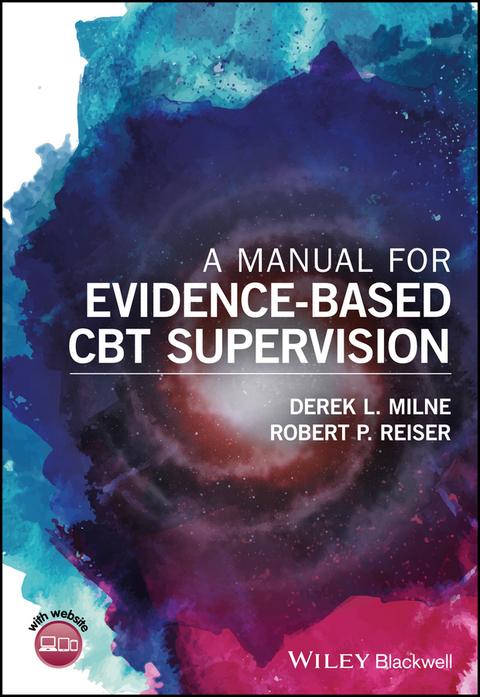
A Manual for Evidence-Based CBT Supervision (eBook)
John Wiley & Sons (Verlag)
978-1-119-03045-4 (ISBN)
The effectiveness of CBT depends on the quality of supervision and training that is provided to its practitioners. This manual is intended to significantly strengthen the available resources for training CBT supervisors (primarily) working within clinical services in the mental health field. The manual and its associated content are structured in user-friendly modules, designed to support multiple potential training functions including the initial credentialing and certification of supervisors, providing training to individual supervisors in a continuing education/professional development format, assisting in a 'train the trainer' approach, and distance learning. The authors drew on the insights of many accredited CBT supervisors to develop the guidance, and the work is built firmly on an evidence-based approach.
Derek Milne is a former Director of the Newcastle University Doctorate in Clinical Psychology training programme. In addition to practicing as a clinical psychologist within the National Health Service and teaching within Higher Education, he has been a coach, supervisor, trainer, researcher, mentor and organizational consultant. He wrote the British Psychological Society guidelines on Clinical Supervision and is the co-editor of The Wiley International Handbook of Clinical Supervision (2014).
Robert Reiser is one of the most visible worldwide experts on supervision in mental health. He is currently a licensed psychologist in private practice, an associate professor at Palo Alto University and a Fellow of the Academy of Cognitive Therapy.
The effectiveness of CBT depends on the quality of the supervision and training that is provided to its practitioners. A Manual for Evidence-Based CBT Supervision is intended to significantly strengthen the available resources for training and supporting CBT supervisors. The authors drew on the insights of many accredited CBT supervisors to develop the guidance, and the work is built firmly on an evidence-based approach. This manual will also be useful for individual supervisors and to those who support and guide trainers and supervisors (e.g., peer groups, consultants, managers, administrators, training directors), as the authors include training supervision guidelines and training materials (e.g., video clips, guidelines and PowerPoint slides). In summary, this manual provides critical guidance in a number of areas: Training resources and evidence based guidance to individual supervisors in a continuing education/professional development workshop format Criteria and guidance (including measurement tools and competence standards) to support the certification of supervisors Assisting in a train the trainers approach suitable for agency or organization-based training of supervisors Coaching and training supervisors and supervisees remotely, through supplementary materials and an interactive website
Derek Milne is a former Director of the Newcastle University Doctorate in Clinical Psychology training programme. In addition to practicing as a clinical psychologist within the National Health Service and teaching within Higher Education, he has been a supervisor, a trainer of supervisors, and a supervision researcher. He wrote Evidence-Based Clinical Supervision (2009) and is the co-editor of The Wiley International Handbook of Clinical Supervision (2014). Dr. Reiser, a licensed clinical psychologist in California and a Fellow of the Academy of Cognitive Therapy, has been an active clinical supervisor over the past 20 years with 8 years' experience in running a training clinic for an APA approved doctoral program; as a consulting supervisor providing CBT training to Veterans Administration clinicians within the CBT?-D national training program; and, currently, he supervises medical residents in the Department of Psychiatry at the University of California, San Francisco.
About the Authors viii
Preface x
Acknowledgments xv
1 Introduction and Overview of Enhanced CBT Supervision 1
2 Guiding Principles behind Our CBT Supervision Manual 14
3 The Context for CBT Supervision 32
4 Training CBT Supervisors 57
5 The Alliance in CBT Supervision 79
6 Goal-Setting in CBT Supervision 104
7 Facilitating Learning in CBT Supervision 128
8 Feedback and Evaluation in CBT Supervision 153
9 Support and Guidance in CBT Supervision 179
10 Concluding Remarks 198
Appendix: Video catalogue 205
Index 212
Preface
Motivation
Undertaking a task as challenging and unpromising as an evidence‐based supervision manual requires a good explanation. We certainly hesitated before deciding to give it a go, but in the end we were influenced by a sense that at long last the world of clinical supervision was evolving and moving toward a new paradigm. For decades we had labored alongside enthusiastic colleagues to get supervision acknowledged as the cornerstone of professional development within the mental health professions. We now believe we have reached that threshold (Watkins & Milne, 2014), making the next phase appropriate. Recent developments in CBT supervision further increased our sense that the time was right to contribute this much‐needed manual. There was also important and timely research progress in neighboring literatures, such as those concerned with expertise, education, and staff training. This progress suggested real improvements in the way we might address CBT supervision, in such issues as facilitating learning and providing effective feedback within supervision. Similar progress was evident concerning the optimal ways to train mental health professionals, with direct relevance to training and supporting CBT supervisors (e.g., Beidas & Kendall, 2010; Rakovshik & McManus, 2010).
Collaboration
Another boost to our ambitions was that we felt part of a small but effective group of like‐minded professionals, all striving in the “swampy lowlands,” but with the goal of finding a firmer footing in the supervision uplands (e.g., The International Handbook of Clinical Supervision, 2014; and the special issue of The Cognitive Behaviour Therapist, 2016). We received further encouragement in our workshops for supervisors, which were met with positive responses to our ideas and materials. This led naturally to some close collaboration with the intended users of this manual in the form of over 100 CBT supervisors who helped us develop the six supervision guidelines. Linked to this operational activity we were supported by a specially convened working party of the British Association for Behavioural and Cognitive Psychotherapy (BABCP), guiding us on strategic issues.
Learning
Something else helped, and made us aware we were pushing against an open and inviting door: this was the close connection between CBT and these developments in clinical supervision. Few models in the mental health sphere can match CBT for the clarity, relevance, transferability, and empirical depth of its learning principles, ones that also apply so readily to supervision. Based on many years of working as CBT therapists, supervisors, and researchers, we felt well placed, as individuals with relevant expertise, to combine this emerging material on supervision with the principles of CBT, blending in the exciting developments in neighboring literatures. Finally, our personal history of collaboration over eight years began with our initial n = 1 study of training effects in developing supervisory competence. It continued with the development of an assessment instrument – SAGE – designed to quantify competences in CBT supervision. Our working alliance continued with more joint scientific papers, alongside a series of international workshops and conferences, whch focused on improving supervisor training through evidence‐based practices. We feel that this joint work exemplifies the kind of enriching development through experiential learning that we aim to convey in this manual.
Originality
Of course, there are other manuals on CBT supervision (e.g., Newman & Kaplan, 2016; Sudak, et al., 2016), so we needed to contribute something original. This we feel we have done by taking an evidence‐based and systematic approach. Specifically, and unlike other manuals, we have critically reviewed the existing literatures in clinical supervision and the most relevant neighboring literatures to a standard comparable to scientific journal reviews. This is indicated by our linked publications in scientific journals (e.g., a survey of CBT supervisors and trainers; Reiser & Milne, 2016), in order to conduct a needs assessment for our manual; and reviews intended to clarify how we might best make a manual effective (including supervision guidelines; Milne, 2016a; Milne 2016b; Milne & Reiser, 2016). This text is also unique in terms of providing a systematic training manual, including everything needed for trainers to deliver a CBT supervision workshop. We include things that other manuals do not offer (e.g., slideshows and road‐tested guidelines), and more varied and extensive material (e.g., video‐based demonstrations of the supervision competences, linked to the competence framework of Roth & Pilling, 2008). We also offer well‐established, proven methods of training and supervision in that this manual builds on extensive earlier work (the manual linked to the text by Milne, 2009), work which has been evaluated and developed in our own workshops and more formally (e.g. Milne, 2010; Milne & Dunkerley, 2010). In summary, we believe this manual is the best available resource for CBT supervisors, providing a carefully tailored collection of video demonstrations from a variety of supervisors and supervisees. To these we have added slideshows with suitable learning exercises and supervision guidelines, representing a far more complete and evidence‐based training resource than other CBT supervision manuals or texts. In summary, we offer a comprehensive, evidence‐based procedural account of CBT supervision that is lacking in all other textbooks and manuals.
Aims
As outlined above, we hope that this manual will contribute significantly to CBT supervision by indicating how supervisors can be trained and supported according to the best available, most firmly evidence‐based practice. We aim to reduce the gap between the hope for and reality of CBT supervision, to help to “make things compute” better in this vital professional activity (Watkins, 1997). As a result, we believe that practitioners will feel more confident and skilled, and hope that their patients will receive safer and more effective therapy.
Scope
As described more fully in chapter 1, this manual has been written primarily for workshop leaders who train CBT supervisors. However, it will also be useful to individual supervisors, and to those who support and guide trainers and supervisors (e.g., peer groups, consultants, managers, administrators, training directors), as we include suggestions and materials (e.g,. video clips and guidelines. which can be used independently by supervisors). In summary, this manual is designed to support and enhance multiple training functions, including:
- Providing training to individual supervisors in a continuing education/professional development workshop format
- Credentialing and the certification of supervisors
- Assisting in a “train the trainers” approach suitable for agency or organization‐based training of supervisors
- Coaching and training supervisors and supervisees remotely, through supplementary materials and an interactive website
We also aim to be multidisciplinary and systemic, as we recognize that supervision requires a supportive context and a suitable infrastructure (Milne & Reiser, 2016).
Method
The introductory chapter sets out our plan for achieving these aims, but here we note how, even in our manual design, we have been guided by the available evidence. We were particularly persuaded by the literature on instructional design (e.g., de Jong & Ferguson‐Hessler, 1996), which suggested that the manual needed to address strategic, declarative, and procedural knowledge. In practice, this means that the first three chapters are strategic and academic in style, setting out our guiding principles and core theory (e.g., on the role of organizational context on training). The heart of the manual are the six guideline chapters that follow, each chapter tackling one of the elements in effective CBT supervision. They follow the standard organization of workshops by starting with the necessary didactic teaching in order to provide a foundation in declarative knowledge. This leads on to our evidence‐based recommendations, incorporating principles of experiential learning, designed to develop procedural knowledge. Together, these three complementary forms of knowledge address the best available evidence on how to train CBT supervisors and how to conduct CBT supervision effectively. Those looking for a quick procedural guide can turn straight to the relevant guideline chapter. Each guideline chapter is written in a concise and direct style (as are the six guidelines), and summarizes the evidence for each recommendation that we offer. In the final chapter we reflect on the material and draw some conclusions on the strengths and weaknesses of the manual, and on the challenges that lie ahead.
We hope that you find this approach appealing and that you can draw on this manual to improve your work.
Derek L. Milne
Morpeth, Northumberland
and
Robert P. Reiser
Kentfield, California
July 2016
References
- Beidas, R. S., & Kendall, P. C. (2010). Training therapists in evidence‐based practice: A critical review of studies from a systems‐contextual perspective. Clinical Psychology: Science & Practice, 17,...
| Erscheint lt. Verlag | 14.3.2017 |
|---|---|
| Sprache | englisch |
| Themenwelt | Geisteswissenschaften ► Psychologie ► Klinische Psychologie |
| Medizin / Pharmazie ► Gesundheitsfachberufe | |
| Medizin / Pharmazie ► Medizinische Fachgebiete ► Psychiatrie / Psychotherapie | |
| Schlagworte | A-B-C Model • Acceptance and Commitment Therapy • Act • activity scheduling • Amt • Anxiety Management Training • Arbitrary Inferences • automatic thoughts • BAT • behavioral psychotherapy • behavior therapy • Behavioural Activation Therapy • Behavioural Psychotherapy • behaviour therapy • CBT • CBT certification • CBT credentials • CBT supervisors • CFT • Clinical psychology • CMT • cognitive behavioral psychotherapy • Cognitive behavioral therapy (CBT) • Cognitive behavior therapy • cognitive behavioural psychotherapy • Cognitive Behaviour Therapy • Cognitive errors • Cognitive Homework • Cognitive restructuring • cognitive therapy • collaborative empiricism • Compassionate Mind Training • compassion focussed therapy • Coping Skills Program • DBT • Dialectical behaviour therapy • Disputational Methods • Distortion of reality • EMDR • ERP • evidence-based approach • Exposure therapy • Exposure with Response Prevention • Eye Movement Desensitisation/Reprocessing • Graded Exercise • Imaginal Exposure Therapy • Internal Dialogue/Inner Speech • Irrational Belief • Klinische Psychologie • Kognitive Verhaltenstherapie • Label and Mislabeling • MBCT • MBSR • Mindfulness based Cognitive Therapy • mindfulness based stress reduction • Musturbation • overgeneralization • personalization • Polarized thinking • Psychologie • Psychology • Rational Emotive Behaviour Therapy • Rational Emotive Therapy • Rationality • REBT • Relational Frame Theory • RET • RFT • role playing • Selective Abstraction • Self-Instructional Therapy • Shame- Attacking Exercises • Sleep Hygiene Training • Stress-Inoculation Training • training CBT supervisors |
| ISBN-10 | 1-119-03045-5 / 1119030455 |
| ISBN-13 | 978-1-119-03045-4 / 9781119030454 |
| Informationen gemäß Produktsicherheitsverordnung (GPSR) | |
| Haben Sie eine Frage zum Produkt? |
 EPUB (Adobe DRM)
Kopierschutz: Adobe-DRM
Adobe-DRM ist ein Kopierschutz, der das eBook vor Mißbrauch schützen soll. Dabei wird das eBook bereits beim Download auf Ihre persönliche Adobe-ID autorisiert. Lesen können Sie das eBook dann nur auf den Geräten, welche ebenfalls auf Ihre Adobe-ID registriert sind.
Details zum Adobe-DRM
Dateiformat: EPUB (Electronic Publication)
EPUB ist ein offener Standard für eBooks und eignet sich besonders zur Darstellung von Belletristik und Sachbüchern. Der Fließtext wird dynamisch an die Display- und Schriftgröße angepasst. Auch für mobile Lesegeräte ist EPUB daher gut geeignet.
Systemvoraussetzungen:
PC/Mac: Mit einem PC oder Mac können Sie dieses eBook lesen. Sie benötigen eine
eReader: Dieses eBook kann mit (fast) allen eBook-Readern gelesen werden. Mit dem amazon-Kindle ist es aber nicht kompatibel.
Smartphone/Tablet: Egal ob Apple oder Android, dieses eBook können Sie lesen. Sie benötigen eine
Geräteliste und zusätzliche Hinweise
Buying eBooks from abroad
For tax law reasons we can sell eBooks just within Germany and Switzerland. Regrettably we cannot fulfill eBook-orders from other countries.
aus dem Bereich