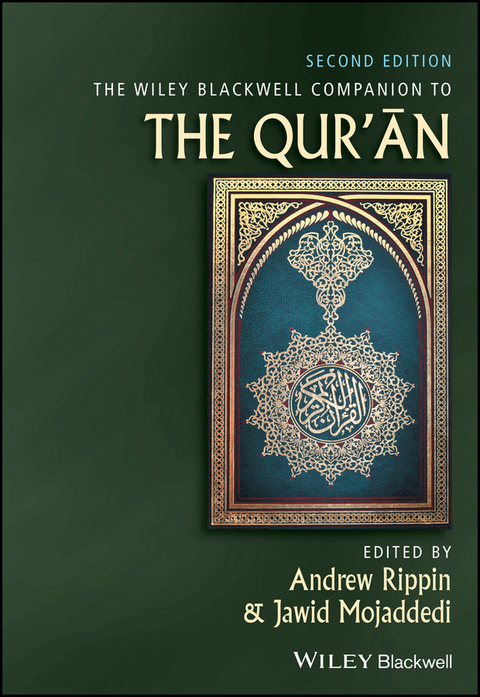
The Wiley Blackwell Companion to the Qur'an (eBook)
John Wiley & Sons (Verlag)
978-1-118-96483-5 (ISBN)

Fully revised and updated, the second edition of The Wiley Blackwell Companion to the Qur'?n offers an ideal resource for anyone who wishes to read and understand the Qur'?n as a text and as a vital component of Muslim life. While retaining the literary approach to the subject, this new edition extends both the theological and philosophical approaches to the Qur'?n.
Edited by the noted authority on the Qur'?n, Andrew Rippin, and Islamic Studies scholar Jawid Mojaddedi, and with contributions from other internationally renowned scholars, the book is comprehensive in scope and written in clear and accessible language. New to this edition is material on modern exegesis, the study of the Qur'?n in the West, the relationship between the Qur'?n and religions prior to Islam, and much more.
The Wiley Blackwell Companion to the Qur'?n is a rich and wide-ranging resource, exploring the Qur'?n as both a religious text and as a work of literature.
Andrew Rippin (d. 2016) was the Emeritus Professor of Islamic History at the University of Victoria, Canada. He was one of the world's leading scholars on the Qur'?n.
Jawid Mojaddedi is Professor of Religion at Rutgers University in New Jersey, USA. He is a leading scholar of ??fism with a focus on R?m?.
Fully revised and updated, the second edition of The Wiley Blackwell Companion to the Qur' n offers an ideal resource for anyone who wishes to read and understand the Qur' n as a text and as a vital component of Muslim life. While retaining the literary approach to the subject, this new edition extends both the theological and philosophical approaches to the Qur' n. Edited by the noted authority on the Qur' n, Andrew Rippin, and Islamic Studies scholar Jawid Mojaddedi, and with contributions from other internationally renowned scholars, the book is comprehensive in scope and written in clear and accessible language. New to this edition is material on modern exegesis, the study of the Qur' n in the West, the relationship between the Qur' n and religions prior to Islam, and much more. The Wiley Blackwell Companion to the Qur' n is a rich and wide-ranging resource, exploring the Qur' n as both a religious text and as a work of literature.
Andrew Rippin (d. 2016) was the Emeritus Professor of Islamic History at the University of Victoria, Canada. He was one of the world's leading scholars on the Qur'an. Jawid Mojaddedi is Professor of Religion at Rutgers University in New Jersey, USA. He is a leading scholar of ufism with a focus on Rumi.
List of Contributors viii
Preface xi
Andrew Rippin
Introduction 1
Jawid Mojaddedi
Part I Orientation 5
1 Introducing 7
Tamara Sonn
2 Discovering 23
Christopher Buck
3 Contextualizing 43
Abdullah Saeed
Part II Text 59
4 Linguistic Structure 61
Salwa El-Awa
5 Patterns of Address 82
Rosalind Ward Gwynne
6 Language 97
Mustansir Mir
7 Poetry and Language 117
Navid Kermani
8 Foreign Vocabulary 130
Michael Carter
9 Structure and the Emergence of Community 151
Angelika Neuwirth
10 Sacrality and Collection 171
Aliza Shnizer
11 Written Transmission 184
François Déroche
12 Context: Muhammad 200
Herbert Berg
13 Context: Umar b. al-Khatta¯b 218
Avraham Hakim
Part III Content 235
14 God 237
Andrew Rippin
15 Prophets and Prophethood 248
Uri Rubin
16 Moses 262
Brannon Wheeler
17 Abraham 280
Carol Bakhos
18 Jesus 288
Gordon Nickel
19 Biblical Background 303
Gabriel Said Reynolds
20 Other Religions 320
Mun'im Sirry
21 Argumentation 333
Kate Zebiri
22 Knowing and Thinking 349
A. H. Mathias Zahniser
23 Sex, Sexuality, and the Family 365
Khaleel Mohammed
24 Jiha¯d 376
Reuven Firestone
Part IV Interpretation 389
25 Hermeneutics: al-Thalabi 391
Walid Saleh
26 Stories of the Prophets 406
Marianna Klar
27 Su¯fism 418
Alan Godlas
28 Ru¯mi 430
Jawid Mojaddedi
29 Ibn al-Arabi 442
Binyamin Abrahamov
30 Twelver Shii Tawil 449
Diana Steigerwald
31 Isma¯ili Tawil 463
Diana Steigerwald
32 Modern and Contemporary Interpretation of the Qura¯n 479
Johanna Pink
Part V Application 493
33 Exegetical Sciences 495
Jane Dammen McAuliffe
34 Theology 512
Binyamin Abrahamov
35 Jurisprudence 526
A. Kevin Reinhart
36 Contemporary Ethical Issues 543
Leah Kinberg
37 Narrative Literature 562
Roberto Tottoli
38 Recitation 577
Anna M. Gade
Bibliography 591
Index of People, Places and Topics 632
Index of Qura¯n Verses 651
Preface
Andrew Rippin
The publication of a volume devoted to the Qurʾān in the “companion” genre marks the emergence of the text of Muslim scripture within the canon of world literature in a manner particularly appropriate to the twenty‐first century. This companion is explicitly designed to guide the reader who may have little exposure to the Qurʾān beyond a curiosity evoked by the popular media. It aims to provide such a person with the starting point of a general orientation and take him or her to a well‐advanced state of understanding regarding the complexities of the text and its associated traditions. However, a “companion” volume such as this is also an opportunity for scholars to extend the boundaries of what might be deemed to be the “accepted” approaches to the text of the Qurʾān because such a volume provides, it is to be hoped, the material which will inspire future generations of scholars who first encounter the Qurʾān in the classroom and for whom new avenues of exploration provide the excitement of research and discovery.
Organization
This companion has been organized in order to facilitate its usefulness for the groups of readers who may wish to embark on a deeper understanding of the Qurʾān in its historical context and as an object of scholarly study. Part I functions as an introduction to the text but its three chapters are oriented in different, yet complementary ways. All readers, but especially those who are coming to the Qurʾān with little foreknowledge of the text and/or the scholarly study of it, will find these chapters the place to start. “Introducing” the Qurʾān (chapter 1) means orienting the reader to the basic facts, themselves coming from a variety of perspectives both internal and external to the text. “Discovering” the Qurʾān (chapter 2) speaks to the experience of a student and considers how one might integrate the Qurʾān within a framework of religious studies. “Contextualizing” the Qurʾān (chapter 3) orients the reader to a Muslim scholarly perspective, putting the emphasis on the historical context in which the facts about the Qurʾān are to be understood. Each chapter thus adds a level of complexity to the task of approaching the Qurʾān, although each chapter recognizes certain common elements which pose a challenge to the reader, especially the question of the choice of “lens” through which one should read the text.
Part II addresses the text of the Qurʾān on both the structural and the historical level, two dimensions which have always been seen in scholarly study as fully intertwined. Issues of origin and composition lie deeply embedded in all of these concerns because, it is argued, the structure of the text – which is what makes the book a challenge to read – must be accounted for through the process of history. However, the final aim of these attempts at explaining the Qurʾān is directed towards a single end, that of coming to an understanding of the text. The internal structure of the Qurʾān is the focus of chapter 4. These observations are complemented by an intricate series of observations about the nature of the text and its language, including the patterns of address used in the text (chapter 5), language – especially its use of literary figures – in chapter 6, the relationship between poetry and language as it affects the Qurʾān (chapter 7), and the range of the vocabulary of the text that is thought to come from non‐Arabic sources in chapter 8. All of these factors – structure, language, and vocabulary – combine and become manifested in the emergence of a text of the scripture within the context of a community of Muslims (chapter 9), creating the text which emerges as sacred through the complex passage of history (chapter 10), which is then transmitted through the generations of Muslims, the focus of chapter 11. All of this happens in a historical context of the early community which is shown to be foundational to the understanding of the text in both the person of Muḥammad and his life (chapter 12) and that of the early leader ʿUmar b. al‐Khaṭṭāb (chapter 13).
Such details provide an understanding of the text on a linguistic and historical level, but the overall nature of its message is fundamentally ignored in such considerations. Part III thus turns to consider some of the major topics which characterize that message. Muslims have, in fact, seen the Qurʾān as all‐encompassing in its treatment of human existence and an inventory of themes can really only provide examples of ways of analyzing and categorizing the contents of the scripture: there is little substitute for a rigorous study of the text itself if one wishes to gain a clear sense of what it is really about as a whole. However, certain aspects do provide key ideas and provide the opportunity to illustrate methods of approach. Dominating all of the message of the Qurʾān is, of course, the figure of Allāh, the all‐powerful, one God revealed in the Qurʾān just as He is in the biblical tradition (chapter 14), through a process of revelation brought by prophets (chapter 15), three important ones of whom in the Qurʾān are Moses (chapter 16), Abraham (chapter 17), and Jesus (chapter 18). The inclusion of such prophets in the Qurʾān highlights the importance of understanding the biblical background in the Qurʾān (chapter 19) and its references to other religions in general (chapter 20). The message those prophets (including Muḥammad in the Qurʾān) bring argues for belief in God (chapter 21) among reflective, thinking human beings (chapter 22). However, the prophets also bring a message of how life should be lived in both love (chapter 23) and war (chapter 24).
This text of the Qurʾān, as all of the preceding material has made clear, is a complex one that Muslims have always known needed interpretation. This might be said to be the nature of divine revelation, which poses the problem of how the infinity and absoluteness of God can be expressed in the limited and ambiguous format of human language. Such a situation calls for a hermeneutics that is elaborated within the framework of Islam (chapter 25) which can also draw its inspiration from a multitude of sources, always filtered through Islamic eyes and needs (chapter 26). Differing approaches to Islam developed in the Muslim world, variations which the Qurʾān facilitated through its conduciveness to interpretation: thus ṣūfīs (chapter 27), two of the most influential of whom were Rūmī (chapter 28) and Ibn al‐ʿArabī (chapter 29), Twelver Shīʿites (chapter 30), and Ismāʿīlīs (chapter 31) all sought strength and support for their ideas in the text of the Qurʾān and developed their own principles by which to understand the scripture. Modernity has posed its own distinct challenges that can be seen reflected in changes in the interpretation of the Qurʾān (chapter 32).
However, the Qurʾān has far more significance within Muslim life than as an object functioning as a ground for exegesis. The world of the Qurʾān extends much further, becoming the basis of scholastic consideration and development of learning within the context of exegetical elaboration (chapter 33), theology (chapter 34), and jurisprudence (chapter 35). It is a touchstone for every discussion of ethical issues in the modern world (chapter 36), just as it was the basis for literary development in the classical world (chapter 37). Underlying all of that, however, is the status of the Qurʾān not so much as a rational launching pad for further thought but as a text of devotion, as displayed in the attention to its orality and manifestation in recitation (chapter 38). The application of the Qurʾān thus extends through the many aspects of Muslim day‐to‐day life.
Technical Considerations
A work such as this depends upon a significant number of scholars interested in making their academic work accessible to a broad reading public and a new generation of students. As editors of the volume, we would like to express our appreciation to all of the contributors – a truly international gathering of scholars – for their efforts. There is a delicate balance in a work such as this between documenting and annotating every thought and being mindful of the variety of readers who are the potential audience; thus, the number of references and endnotes has been drastically reduced but not totally eliminated, for it is in such supporting apparatus that there lies one of the sources of research directions for future generations of scholars. As well, it is notable that there clearly continues to be a need to justify many points of discussion with reference to original and secondary sources; it is perhaps indicative of the still‐developing nature of Qurʾānic studies that it is not possible to assume an agreed‐upon core of basic data and interpretation that would simplify much of the documentation in a volume such as this.
In an attempt to eliminate some of the...
| Erscheint lt. Verlag | 16.3.2017 |
|---|---|
| Reihe/Serie | Blackwell Companions to Religion |
| Blackwell Companions to Religion | Wiley Blackwell Companions to Religion |
| Sprache | englisch |
| Themenwelt | Geisteswissenschaften ► Religion / Theologie ► Islam |
| Schlagworte | Andrew Rippin • Approaches to the Qur'an • bestselling book about the Qur'an • Companion to the Qur'an • essays about the Qur'an • experts on the Qur'an • history of the Qur'an • influence of the Qur'an • Islam • Jawid Mojaddedi • learning about the Qur'an • literary approach to the Qur'an • reference to the Qur'an • Religion & Theology • Religion u. Theologie • scholarly debates about the Qur'an • scholarly theories of Qur'an • scholarly view of Qur'an • the Qur'an in Africa • the Qur'an in different countries • the Qur'an in Indian • the Qur'an in Pakistan • the Qur'an in South East Asia • The Wiley Blackwell Companion to the Qur'an • understanding the Qur'an introduction to the Qur'an • Use of the Qur'an |
| ISBN-10 | 1-118-96483-7 / 1118964837 |
| ISBN-13 | 978-1-118-96483-5 / 9781118964835 |
| Informationen gemäß Produktsicherheitsverordnung (GPSR) | |
| Haben Sie eine Frage zum Produkt? |
 EPUB (Adobe DRM)
Kopierschutz: Adobe-DRM
Adobe-DRM ist ein Kopierschutz, der das eBook vor Mißbrauch schützen soll. Dabei wird das eBook bereits beim Download auf Ihre persönliche Adobe-ID autorisiert. Lesen können Sie das eBook dann nur auf den Geräten, welche ebenfalls auf Ihre Adobe-ID registriert sind.
Details zum Adobe-DRM
Dateiformat: EPUB (Electronic Publication)
EPUB ist ein offener Standard für eBooks und eignet sich besonders zur Darstellung von Belletristik und Sachbüchern. Der Fließtext wird dynamisch an die Display- und Schriftgröße angepasst. Auch für mobile Lesegeräte ist EPUB daher gut geeignet.
Systemvoraussetzungen:
PC/Mac: Mit einem PC oder Mac können Sie dieses eBook lesen. Sie benötigen eine
eReader: Dieses eBook kann mit (fast) allen eBook-Readern gelesen werden. Mit dem amazon-Kindle ist es aber nicht kompatibel.
Smartphone/Tablet: Egal ob Apple oder Android, dieses eBook können Sie lesen. Sie benötigen eine
Geräteliste und zusätzliche Hinweise
Buying eBooks from abroad
For tax law reasons we can sell eBooks just within Germany and Switzerland. Regrettably we cannot fulfill eBook-orders from other countries.
aus dem Bereich