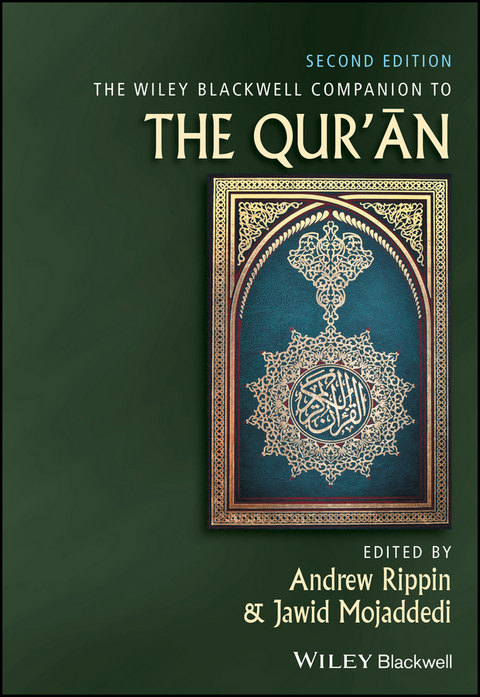
The Wiley Blackwell Companion to the Qur'an (eBook)
John Wiley & Sons (Verlag)
978-1-118-96484-2 (ISBN)
Fully revised and updated, the second edition of The Wiley Blackwell Companion to the Qur'?n offers an ideal resource for anyone who wishes to read and understand the Qur'?n as a text and as a vital component of Muslim life. While retaining the literary approach to the subject, this new edition extends both the theological and philosophical approaches to the Qur'?n.
Edited by the noted authority on the Qur'?n, Andrew Rippin, and Islamic Studies scholar Jawid Mojaddedi, and with contributions from other internationally renowned scholars, the book is comprehensive in scope and written in clear and accessible language. New to this edition is material on modern exegesis, the study of the Qur'?n in the West, the relationship between the Qur'?n and religions prior to Islam, and much more.
The Wiley Blackwell Companion to the Qur'?n is a rich and wide-ranging resource, exploring the Qur'?n as both a religious text and as a work of literature.
Andrew Rippin (d. 2016) was the Emeritus Professor of Islamic History at the University of Victoria, Canada. He was one of the world's leading scholars on the Qur'?n.
Jawid Mojaddedi is Professor of Religion at Rutgers University in New Jersey, USA. He is a leading scholar of ??fism with a focus on R?m?.
Fully revised and updated, the second edition of The Wiley Blackwell Companion to the Qur' n offers an ideal resource for anyone who wishes to read and understand the Qur' n as a text and as a vital component of Muslim life. While retaining the literary approach to the subject, this new edition extends both the theological and philosophical approaches to the Qur' n. Edited by the noted authority on the Qur' n, Andrew Rippin, and Islamic Studies scholar Jawid Mojaddedi, and with contributions from other internationally renowned scholars, the book is comprehensive in scope and written in clear and accessible language. New to this edition is material on modern exegesis, the study of the Qur' n in the West, the relationship between the Qur' n and religions prior to Islam, and much more. The Wiley Blackwell Companion to the Qur' n is a rich and wide-ranging resource, exploring the Qur' n as both a religious text and as a work of literature.
Andrew Rippin (d. 2016) was the Emeritus Professor of Islamic History at the University of Victoria, Canada. He was one of the world's leading scholars on the Qur'an. Jawid Mojaddedi is Professor of Religion at Rutgers University in New Jersey, USA. He is a leading scholar of ufism with a focus on Rumi.
Title Page 5
Copyright Page 6
Contents 7
List of Contributors 10
Preface 13
Introduction 17
Part I Orientation 21
Chapter 1 Introducing 23
Structure of the Text 24
Voice and Audience 25
History of the Text 26
Relationship of the Qur?a?n to Other Scriptures 27
Themes of the Qur?a?n 29
Role of the Qur?a?n in Islamic Life: Ritual and Art 32
The Qur?a?n in Law 33
Principles and Practice of Qur?a?nic Interpretation 34
Chapter 2 Discovering 39
Why the Qur?a?n? 39
Academic Study of the Qur?a?n 39
How to Read the Qur?a?n? 41
Revelation and the Abrahamic Faiths 43
How the Qur?a?n Was Revealed 44
Sources of Revelation? 46
Major Themes of Revelation 47
Reading Revelation 51
Assessing the Qur?a?n 56
Appreciating the Qur?a?n 56
Applying the Qur?a?n 57
Academically Assimilating the Qur?a?n 57
Chapter 3 Contextualizing 59
The Broad Historical Context of the Qur?a?n 59
Outline of Muh?ammad’s Life as a Framework for Understanding the Qur?a?n 61
The Qur?a?n as “Revelation” in Arabic 63
The Qur?a?n as Scripture 65
Central Themes of the Qur?a?n 66
Understanding the Su?ra 69
Understanding Parts of the Qur?a?n with the Help of Other Parts 71
Concluding Remarks 73
Part II Text 75
Chapter 4 Linguistic Structure 77
The Problem 77
Previous Works 81
A New View of Qur?a?nic Structure 83
Conclusions 95
Chapter 5 Patterns of Address 98
Particles, Pronouns, and Other Methods of Designating the Audience 99
Effects on the Audience 102
Patterns of Utterance 106
Chapter 6 Language 113
The Qur?a?n as a “Clear” Book 113
Valorization 115
Orality 118
Genres 121
Verbal Economy 123
Parataxis 125
Repetition 126
Imagery 127
Concluding Remarks 131
Chapter 7 Poetry and Language 133
Author note 144
Chapter 8 Foreign Vocabulary 146
Attitudes of the Medieval Arabs 147
Bibliographical Resources 150
The Scope of Jeffery and Supplementary Studies 151
A Classified Presentation of Jeffery’s Data 154
Ancient Borrowings 155
Pre-Islamic Borrowings 156
Contemporary Borrowings 158
New Meanings 159
Proper Names and Problem Words 160
Conclusion 165
Chapter 9 Structure and the Emergence of Community 167
Three Self-designations of the Qur?a?n: Mus?h?af–Qur?a?n–Kita?b 167
Structure of the Codex: Shape 169
Place, Time, and Agents of the Mus?h?af 171
The Oral Qur?a?n: The Message and its Communication Process 173
The Oral Qur?a?n: The Early Meccan Texts and their Structure 174
Structure of the Later Meccan Texts 179
From Ritual to Textual Coherence 181
Becoming a Representation of the “Scripture”: Medinan Texts 183
Chapter 10 Sacrality and Collection 187
The Qur?a?n’s Divine Origin and Nature 188
The Distinction Between the Actual Qur?a?n and the Heavenly Qur?a?n 193
Further reading 199
Chapter 11 Written Transmission 200
The First Qur?a?n Manuscripts 201
Experimentation During the First Centuries 203
Written Copies of the Qur?a?n from the Fifth/Eleventh Century Onwards 206
The Qur?a?n Manuscripts in Muslim Societies 209
From Printed Editions to the Qur?a?n Online 213
Chapter 12 Context: Muh?ammad 216
The Revelation(s) of the Qur?a?n to Muh?ammad 217
The Qur?a?n on Muh?ammad 220
Muh?ammad’s Role in Shaping the Qur?a?n 221
Muh?ammad on the Qur?a?n 224
The Tafs??r of Muh?ammad 225
The S??ra of Muh?ammad 227
The Qur?a?n’s Role in Shaping the Biography of Muh?ammad 229
Conclusions 231
Chapter 13 Context: ?Umar b. al-Khat?t?a?b 234
Aiming at God’s Mind 235
Mutual Agreement 235
The Jewish Sources: Moses 236
Anticipating God’s Revelation 237
The Case of the H?ija?b Verse 237
The Case of the Prohibition Against Wine 240
The Ransom of the Prisoners of the Battle of Badr 241
?Umar and the Hypocrites 245
Conclusion 248
Part III Content 251
Chapter 14 God 253
God as King 256
God is King 257
God as Judge 258
God and His Covenant 259
God of the House 260
The Meaning of the Symbolic God 261
Chapter 15 Prophets and Prophethood 264
Stories about the Prophets 264
Status of the Prophets 265
Virtues of Individual Prophets 266
Ranks of Prophets 266
Modes of Prophetic Revelation 267
Revealed Scriptures 270
Prophets and Messengers 271
Scope of the Prophetic Mission 272
Aims of the Prophetic Mission 272
Signs and Miracles 273
Reception of the Prophets 275
Polemics 276
Chapter 16 Moses 278
Moses in Egypt 279
Moses and the Israelites 282
Mythology and Intertextuality of the Islamic Moses 287
Moses and Jacob 287
Moses and Alexander 290
Moses in Q 18 and 28 293
Conclusions 294
Chapter 17 Abraham 296
Abraham’s Trials 299
Battle with Nimrod (Namru?d) 300
The Sacrifice of Abraham’s Son 300
Abraham’s visit to Ishmael 301
Chapter 18 Jesus 304
Introduction 304
Description of the Qur?a?nic Material 305
Miracles 306
Death of Jesus 306
Deity of Jesus 307
Lacunae in the Qur?a?nic Portrait 308
Tone and Context 309
Qur?a?nic Commentary 310
Medieval Trends 314
Christian Backgrounds 315
Contemporary Discussions 316
Chapter 19 Biblical Background 319
The Biblical Material in the Qur?a?n 319
Adam and Eve 320
Cain and Abel 320
Noah 321
Abraham and Lot 321
Joseph 322
Moses and Aaron 323
Saul, David, and Solomon 324
Jonah 325
John, Zechariah, and Mary 326
Jesus and the Holy Spirit 327
Other Biblical Material in the Qur?a?n 328
Biblical Material not Mentioned by the Qur?a?n 329
Knowledge of the Canonical Bible 330
Departures from the Bible 331
The Qur?a?n’s Assessment of the Bible 331
Debates over the Nature of Biblical Material in the Qur?a?n 332
Chapter 20 Other Religions 336
Ambivalent Attitudes 337
The Qur?a?n and Its Interreligious Context 340
Approaches to Polemical Passages 343
Concluding Remarks 346
Chapter 21 Argumentation 349
Qur?a?nic Attitude to Argumentation 352
God’s Unity (Tawh??d) 353
Authenticity of Muh?ammad’s Prophethood 357
Resurrection 360
Conclusion 362
Chapter 22 Knowing and Thinking 365
Divine and Human Knowledge in the Qur?a?n 365
Divine Knowing and Teaching 365
God as Teacher 368
Human Knowing as Perception, Cognition, and Understanding 368
Supposition and Assertion 369
Perception: Seeing, Hearing, Awareness, and Recognition 369
Cognition: Recollection, Reflection, and Understanding 370
Knowing 373
Divine Knowledge and Human Knowing 374
Limits of Human Knowing 378
Necessity of Divine Knowledge 378
Conclusions 379
Chapter 23 Sex, Sexuality, and the Family 381
Chapter 24 Jiha?d 392
Contextual Meanings of Jiha?d, Qita?l, and H?arb 393
Qur?a?nic Militancy in Historical Context 396
The Range of Qur?a?nic Articulations of War 398
Qur?a?n and Jiha?d in the Contemporary Period 403
Part IV Interpretation 405
Chapter 25 Hermeneutics: al-Tha?lab?? 407
The Détente with Philology 409
Tafs??r and Pietistic Sensibilities 410
Narration and Exegesis 412
Exegesis and Theology 414
Prophetic H?adith and Tafs??r 414
Tafs??r as the Absorber of New Challenges to Sunnism 415
Sh????? Traditions in Al-Kashf 418
Al-Tha?lab?? and Medieval Qur?a?nic Exegesis 419
Chapter 26 Stories of the Prophets 422
Introduction to the Text 422
Publication History 423
Major Sources 424
Construction of the Text 426
Social and Intellectual Context 429
Reception of the Text 430
Chapter 27 S?u?fism 434
Chapter 28 Ru?m?? 446
Ru?m?? 447
The Qur?a?n and the Mathnaw?? 448
The Mathnaw?? in Relation to the Qur?a?n 452
Conclusion 455
Chapter 29 Ibn al-?Arab?? 458
Using Simple Logical Arguments 459
Exploiting the First Meanings of the Words 461
Word-Play with the Etymology of Words 461
Paraphrasing of Verses 462
Creating a Whole Picture through Adding Verses from Other Su?ras 462
Conclusion 463
Chapter 30 Twelver Sh????? Ta?w??l 465
Origin of Sh????? Islam 465
Early Debates on the Qur?a?n 470
Early Exegetes 472
Medieval Exegetes 474
Modern Exegetes 476
Conclusion 477
Chapter 31 Isma????l?? Ta?w??l 479
Early Exegetes 481
Fa?t?imid Exegetes 482
Alamu?t Exegetes 486
Gina?nic Exegetes 489
Modern Exegetes 491
Conclusion 493
Chapter 32 Modern and Contemporary Interpretation of the Qur?a?n 495
The Evolution of the Exegetical Tradition 496
Revolutionizing an Evolutionary Tradition 498
Mass Media, Popular Exegesis, and Apologetics 501
Modernism and Postmodernism 502
Contexts and Conflicts 505
Unity and Diversity 506
Part V Application 509
Chapter 33 Exegetical Sciences 511
Starting with Summation 511
Comparing Two Compendia 512
Selecting Some Samples 514
Seeking the Sources 521
Evolution and Expansion 524
Chapter 34 Theology 528
Theology in the Qur?a?n 529
The Qur?a?n as Stimulus to Theological Discussions 530
Types of Theology 531
Conclusion 539
Chapter 35 Jurisprudence 542
Defining the Book 542
Reliability (Tawa?tur) 543
The Basmala 543
Abrogation – The Assessment but Not the Recitation 544
Abrogating – The Recitation but Not the Assessment 544
Translation 545
Hermeneutics: Found Text and the Construction of Context 546
The Qur?a?n Is Language 546
The Qur?a?n Is Arabic 547
Particles 547
The Qur?a?n’s Context 549
Self-subsistence: Manifest and Indeterminate, Figurative and Literal 549
Textual Force: General and Restricted 552
H?anaf?? Rhetorical Analysis: The Sliding Scale of Clarity and Effective Force 554
Conclusion 555
Chapter 36 Contemporary Ethical Issues 559
Classical Background 561
Modern-day Texts 562
Conclusions 574
Chapter 37 Narrative Literature 578
Past: The Stories of the Prophets 580
Present: The Life of Muh?ammad 583
Future: Heaven or Hell 586
Conclusion 589
Chapter 38 Recitation 593
The Qur?a?n and the Sunna on the Recited Qur?a?n 593
Systems for Reading the Qur?a?n: Qira??a?t and Tajw??d 595
Norms of Qur?a?nic Worship, Preservation, and Piety 598
Qur?a?nic Aesthetics and Performance 601
The Recited Qur?a?n and Contemporary Islamic Revitalization 603
Conclusion 605
Bibliography 607
Index of People, Places and Topics 648
Index of Qur?a?n Verses 667
EULA 690
| Erscheint lt. Verlag | 14.3.2017 |
|---|---|
| Reihe/Serie | Blackwell Companions to Religion | Wiley Blackwell Companions to Religion |
| Sprache | englisch |
| Themenwelt | Geisteswissenschaften ► Religion / Theologie ► Islam |
| Schlagworte | Andrew Rippin • Approaches to the Qur'an • bestselling book about the Qur'an • Companion to the Qur'an • essays about the Qur'an • experts on the Qur'an • history of the Qur'an • influence of the Qur'an • Islam • Jawid Mojaddedi • learning about the Qur'an • literary approach to the Qur'an • reference to the Qur'an • Religion & Theology • Religion u. Theologie • scholarly debates about the Qur'an • scholarly theories of Qur'an • scholarly view of Qur'an • the Qur'an in Africa • the Qur'an in different countries • the Qur'an in Indian • the Qur'an in Pakistan • the Qur'an in South East Asia • The Wiley Blackwell Companion to the Qur'an • understanding the Qur'an introduction to the Qur'an • Use of the Qur'an |
| ISBN-10 | 1-118-96484-5 / 1118964845 |
| ISBN-13 | 978-1-118-96484-2 / 9781118964842 |
| Informationen gemäß Produktsicherheitsverordnung (GPSR) | |
| Haben Sie eine Frage zum Produkt? |
 PDF (Adobe DRM)
Kopierschutz: Adobe-DRM
Adobe-DRM ist ein Kopierschutz, der das eBook vor Mißbrauch schützen soll. Dabei wird das eBook bereits beim Download auf Ihre persönliche Adobe-ID autorisiert. Lesen können Sie das eBook dann nur auf den Geräten, welche ebenfalls auf Ihre Adobe-ID registriert sind.
Details zum Adobe-DRM
Dateiformat: PDF (Portable Document Format)
Mit einem festen Seitenlayout eignet sich die PDF besonders für Fachbücher mit Spalten, Tabellen und Abbildungen. Eine PDF kann auf fast allen Geräten angezeigt werden, ist aber für kleine Displays (Smartphone, eReader) nur eingeschränkt geeignet.
Systemvoraussetzungen:
PC/Mac: Mit einem PC oder Mac können Sie dieses eBook lesen. Sie benötigen eine
eReader: Dieses eBook kann mit (fast) allen eBook-Readern gelesen werden. Mit dem amazon-Kindle ist es aber nicht kompatibel.
Smartphone/Tablet: Egal ob Apple oder Android, dieses eBook können Sie lesen. Sie benötigen eine
Geräteliste und zusätzliche Hinweise
Buying eBooks from abroad
For tax law reasons we can sell eBooks just within Germany and Switzerland. Regrettably we cannot fulfill eBook-orders from other countries.
aus dem Bereich