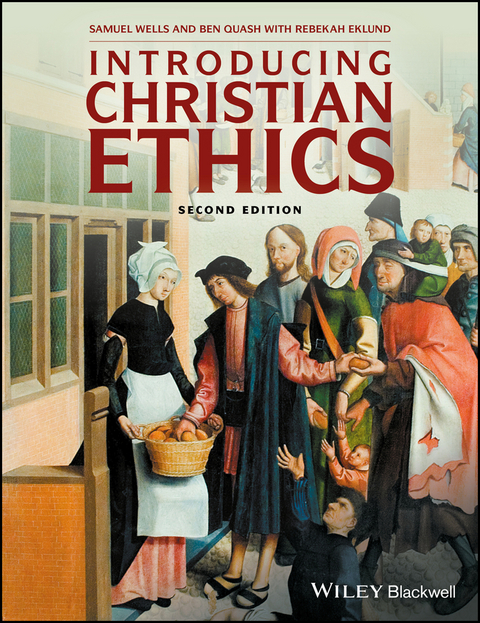
Introducing Christian Ethics (eBook)
John Wiley & Sons (Verlag)
978-1-119-15575-1 (ISBN)
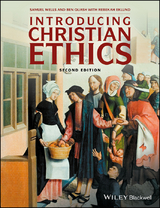
Introducing Christian Ethics 2e, now thoroughly revised and updated, offers an unparalleled introduction to the study of Christian Ethics, mapping and exploring all the major ethical approaches, and offering thoughtful insights into the complex moral challenges facing people today.
- This highly successful text has been thoughtfully updated, based on considerable feedback, to include increased material on Catholic perspectives, further case studies and the augmented use of introductions and summaries
- Uniquely redefines the field of Christian ethics along three strands: universal (ethics for anyone), subversive (ethics for the excluded), and ecclesial (ethics for the church)
- Encompasses Christian ethics in its entirety, offering students a substantial overview by re-mapping the field and exploring the differences in various ethical approaches
- Provides a successful balance between description, analysis, and critique
- Structured so that it can be used alongside a companion volume, Christian Ethics: An Introductory Reader, which further illustrates and amplifies the diversity of material and arguments explored here
Samuel Wells is Vicar of St Martin-in-the-Fields, and a widely-known theologian, preacher, pastor, writer, and broadcaster. He is also Visiting Professor of Christian Ethics at King's College, London. He has published 25 books, including Improvisation, God's Companions, and A Nazareth Manifesto. He edited the partner book to this volume, Christian Ethics: An Introductory Reader (Oxford: Wiley-Blackwell, 2010).
Ben Quash is Professor of Christianity and the Arts at King's College London. He is the author of Theology and the Drama of History (2005), and is former Reviews Editor of Studies in Christian Ethics.
Rebekah Eklund is Assistant Professor of Theology at Loyola University Maryland in Baltimore, where she teaches theology, ethics, and Christian Scripture. She is the author of Jesus Wept: The Significance of Jesus' Laments in the New Testament (2015).
Introducing Christian Ethics 2e, now thoroughly revised and updated, offers an unparalleled introduction to the study of Christian Ethics, mapping and exploring all the major ethical approaches, and offering thoughtful insights into the complex moral challenges facing people today. This highly successful text has been thoughtfully updated, based on considerable feedback, to include increased material on Catholic perspectives, further case studies and the augmented use of introductions and summaries Uniquely redefines the field of Christian ethics along three strands: universal (ethics for anyone), subversive (ethics for the excluded), and ecclesial (ethics for the church) Encompasses Christian ethics in its entirety, offering students a substantial overview by re-mapping the field and exploring the differences in various ethical approaches Provides a successful balance between description, analysis, and critique Structured so that it can be used alongside a companion volume, Christian Ethics: An Introductory Reader, which further illustrates and amplifies the diversity of material and arguments explored here
Samuel Wells is Vicar of St Martin-in-the-Fields, and a widely-known theologian, preacher, pastor, writer, and broadcaster. He is also Visiting Professor of Christian Ethics at King's College, London. He has published 25 books, including Improvisation, God's Companions, and A Nazareth Manifesto. He edited the partner book to this volume, Christian Ethics: An Introductory Reader (Oxford: Wiley-Blackwell, 2010). Ben Quash is Professor of Christianity and the Arts at King's College London. He is the author of Theology and the Drama of History (2005), and is former Reviews Editor of Studies in Christian Ethics. Rebekah Eklund is Assistant Professor of Theology at Loyola University Maryland in Baltimore, where she teaches theology, ethics, and Christian Scripture. She is the author of Jesus Wept: The Significance of Jesus' Laments in the New Testament (2015).
Preface viii
Introduction 1
Part One The Story of Christian Ethics 3
1 The Story of God 5
2 The Story of the Church 34
3 The Story of Ethics 64
4 The Story of Christian Ethics 90
Part Two The Questions Christian Ethics Asks 123
5 Universal Ethics 127
6 Subversive Ethics 159
7 Ecclesial Ethics 200
Part Three The Questions Asked of Christian Ethics 233
8 Good Order 235
9 Good Life 270
10 Good Relationships 303
11 Good Beginnings and Endings 343
12 Good Earth 369
Timeline 396
Glossary of Names 398
Glossary of Terms 409
Name Index 417
Subject Index 422
Chapter One
The Story of God
Christians sometimes talk as if the Bible has all the answers to life’s questions and problems. But a thorough reading of the Bible reveals various complexities. There are some ethical issues that the Bible does not specifically address. There are others where either the Bible seems to offer instruction (such as stoning wrongdoers) that is unpalatable to the contemporary world, or where the Scriptures seem to hold a worldview (such as ancient cosmology) that has since been largely abandoned. Finally, there are other issues where different verses or injunctions or stories seem to offer contradictory counsel.
For example, in the eighteenth and nineteenth centuries, especially in the American South, both abolitionists and slaveholders appealed to Christian Scripture to support their respective positions. According to the latter, Scripture clearly upholds the right of masters to own and discipline slaves; for the former, the Bible’s trajectory of liberation and love categorically rules out any person owning another human being. The Bible continues to be invoked as a witness on both sides of many ethical debates, including same‐sex marriage and war. What’s seldom in question is the centrality of Scripture to Christian ethics; what’s more complex is how that relationship plays out in practice.
The question of the relationship between Scripture and ethics necessarily involves one’s understanding of what Scripture is in the first place. Christians, in fact, do not completely agree on what constitutes sacred Scripture. Orthodox, Catholic, and Anglican Christians include slightly different versions of the collection of books known as the Apocrypha in their Old Testament canons, whereas Protestant Bibles exclude the Apocrypha altogether. And then there is the nature of the text. Is the Bible a prescriptive code of conduct, a rulebook, a source of moral law? Is it a window into the heart of God, or a conduit through which the Holy Spirit shapes the moral imagination? Does it provide patterns for emulation or a clarion call to mend our ways? Is it a love song designed to woo humanity closer to God or a dash of icewater meant to awaken a sleepy conscience?
When it comes to describing the place of Scripture in Christian ethics, therefore, challenges abound; we will describe two of the most pressing here.
- Historical and cultural distance. Reading the Bible is sometimes described as reading someone else’s mail: these texts were written to and for other people in other times and places, often radically different from ours. The Bible does not explicitly address pressing contemporary issues like stem cell research or climate change. “The world of Leviticus is not the world of 1 Corinthians, and neither of these is our world” (Joel Green).
- The multivocity of Scripture. While it is commonplace to talk about the Bible as if it were one book, it is instead a collection of books written by multiple authors and compiled by various editors over the course of thousands of years. It encompasses a wide variety of genres, some of which relate less obviously to ethics: in what sense is a poetic text an ethical one? Thus, describing the ethics contained within Scripture is itself fraught with tensions. New Testament scholar Richard Hays notes that careful, critical exegesis only heightens the problem by sharpening “our awareness of the ideological diversity within Scripture and of our historical distances from the original communities.” He cites Oliver O’Donovan, who writes, wryly, “interpreters who think that they can determine the proper ethical application of the Bible solely through more sophisticated exegesis are like people who believe that they can fly if they only flap their arms hard enough.”
And yet Christian ethics generally operates under the conviction that the ancient texts of Scripture nonetheless have enduring relevance and even binding authority over the lives of Christians in the present. (Some exceptions to this rule are taken up in Chapter Six.) But in what way are these texts authoritative? That is, where does authority reside when it comes to applying the Bible to ethical matters? There are three primary options.
- Authority resides in the events behind the text of Scripture. That is, authority resides in God and in God’s creating, saving, and liberating actions as narrated by the biblical books. For some, this has meant seeking to recreate as closely as possible the worlds and events described by the text, or to insist on the historicity of every event in the text (thus leading to long, heated battles over the historical character of the creation or the great flood in Genesis). For others, it has meant noting, more pragmatically, that Scripture is the best (or only) witness that we have to the Triune God. This leads to the next view.
- Authority is inherent within the text itself, a position often associated with belief in the inspiration of Scripture. In this view, the Holy Spirit inspired each author (and perhaps editor) of the sacred books, and therefore the recorded words themselves are holy. In this sense the text has a kind of derivative authority, since its authority comes from its divine author; but critics worry that this position makes the Bible itself a focus of worship, rather than a book that directs people to the worship of God.
A subset of this view focuses on the “final form” of the biblical books as we now have them, rather than on a reconstruction of the “original” text or the events described by the text, as the proper object of study. This approach is sometimes known as canonical criticism, which is a method that seeks to read all the books of the canon, Old and New Testaments, in relation to one another. Canonical reading reflects Augustine of Hippo’s (354–430 CE) principle that Scripture interprets Scripture. Thus, the four gospels are to be read not only alongside one another, but in the context of Israel’s story in the Old Testament and the early church’s story in the rest of the New Testament as well.
- A third view locates authority in front of the text – that is, in the reader and the reading community. This view sometimes draws on postmodern literary theory, which proposes that texts themselves have no meaning until they are read and interpreted. Related to this is the view that sacred texts have no authority apart from the communities that interpret and adhere to them. Thus, authority resides in various interpreting communities: for Roman Catholics, this means the magisterium, or the apostolic teaching authority exercised by the bishops and the Pope; for some Protestants, authority is located in the local pastor or the local congregation. The approach sometimes known as liberationist ethics – described in this book as subversive ethics – tends to locate authority rather in the daily experience of the common people, especially the oppressed (more on this in Chapter Six).
One recent subset of this third view proposes that authority lies finally not in the reading of the text but in its communal embodiment – i.e., in faithfully “performing” or living out the Scriptures as members of a worshipping community. (This position is closely associated with ecclesial ethics, which will be taken up in Chapter Seven.)
Scripture also bears authority alongside what is typically called tradition, which includes summaries of Christian beliefs like the Nicene Creed and the ongoing teaching authority of the apostolic church. For Orthodox and Catholic Christians, Scripture itself is often viewed as an element of the church’s tradition and therefore not finally distinguishable from a separate body of writings called “tradition.” For example, in the Catholic Church, Scripture and tradition “flow from the same divine well‐spring” and as such they both preserve and transmit the Word of God. For this reason Scripture and tradition are “accepted and honored with equal sentiments of devotion and reverence” (Dei Verbum). By contrast Anglicanism is associated with reading Scripture in creative tension with tradition and reason.
While most Protestants adhere to some version of the Reformation principle sola Scriptura (Scripture alone), almost every Protestant group uses written traditions such as the Augsburg Confession (the central statement of faith for the Lutheran tradition), or unwritten traditions such as the perspicuity of Scripture (the idea that Scripture has a single, plain meaning), as important but less authoritative guides to interpreting Scripture. In practice any view that looks to Scripture for moral guidance must decide how to adjudicate differences in the interpretation of that Scripture – for example, when the slaveholder and abolitionist both appeal to the biblical text.
The diversity of the biblical material in relation to ethics can be a significant challenge. Yet it can also enliven the ethical imagination, if this diversity is taken as a gift rather than a problem – as a prompt to creative faithfulness in new situations. This depends on discerning an underlying unity threading through the complexity of the scriptural texts – a coherent story about God. We now turn to a brief account of that story, in all its diversity.
The People of God
What Christians call the Old Testament is a collection of books that record the faith and the experience and the insights of God’s...
| Erscheint lt. Verlag | 14.3.2017 |
|---|---|
| Co-Autor | Rebekah Eklund |
| Sprache | englisch |
| Themenwelt | Religion / Theologie ► Christentum ► Kirchengeschichte |
| Schlagworte | Abortion • Christentum • Christian Ethics • Christianity • ecclesial ethics • Ecological Ethics • euthanasia • Genetic Engineering • justice and punishment • Moraltheologie, christliche Ethik • Moral Theology • Moral Theology / Christian Ethics • Philosophical Ethics • Professional Ethics • Religion & Theology • Religion u. Theologie • right actions • right outcomes • right relationships • same-sex relationships • subversive ethics • Universal Ethics |
| ISBN-10 | 1-119-15575-4 / 1119155754 |
| ISBN-13 | 978-1-119-15575-1 / 9781119155751 |
| Informationen gemäß Produktsicherheitsverordnung (GPSR) | |
| Haben Sie eine Frage zum Produkt? |
 EPUB (Adobe DRM)
Kopierschutz: Adobe-DRM
Adobe-DRM ist ein Kopierschutz, der das eBook vor Mißbrauch schützen soll. Dabei wird das eBook bereits beim Download auf Ihre persönliche Adobe-ID autorisiert. Lesen können Sie das eBook dann nur auf den Geräten, welche ebenfalls auf Ihre Adobe-ID registriert sind.
Details zum Adobe-DRM
Dateiformat: EPUB (Electronic Publication)
EPUB ist ein offener Standard für eBooks und eignet sich besonders zur Darstellung von Belletristik und Sachbüchern. Der Fließtext wird dynamisch an die Display- und Schriftgröße angepasst. Auch für mobile Lesegeräte ist EPUB daher gut geeignet.
Systemvoraussetzungen:
PC/Mac: Mit einem PC oder Mac können Sie dieses eBook lesen. Sie benötigen eine
eReader: Dieses eBook kann mit (fast) allen eBook-Readern gelesen werden. Mit dem amazon-Kindle ist es aber nicht kompatibel.
Smartphone/Tablet: Egal ob Apple oder Android, dieses eBook können Sie lesen. Sie benötigen eine
Geräteliste und zusätzliche Hinweise
Buying eBooks from abroad
For tax law reasons we can sell eBooks just within Germany and Switzerland. Regrettably we cannot fulfill eBook-orders from other countries.
aus dem Bereich