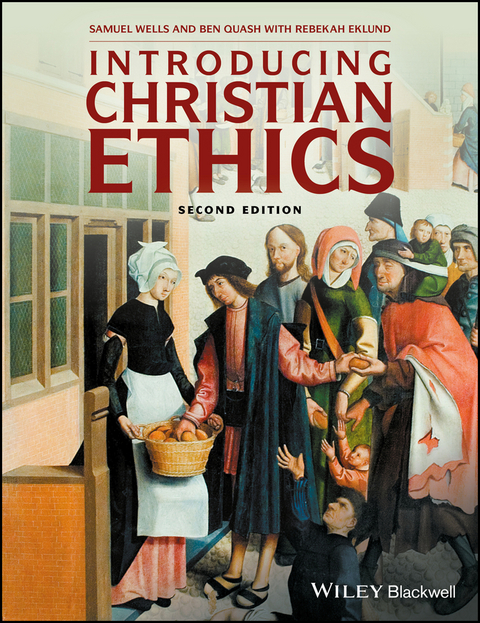
Introducing Christian Ethics (eBook)
John Wiley & Sons (Verlag)
978-1-119-15573-7 (ISBN)
Introducing Christian Ethics 2e, now thoroughly revised and updated, offers an unparalleled introduction to the study of Christian Ethics, mapping and exploring all the major ethical approaches, and offering thoughtful insights into the complex moral challenges facing people today.
- This highly successful text has been thoughtfully updated, based on considerable feedback, to include increased material on Catholic perspectives, further case studies and the augmented use of introductions and summaries
- Uniquely redefines the field of Christian ethics along three strands: universal (ethics for anyone), subversive (ethics for the excluded), and ecclesial (ethics for the church)
- Encompasses Christian ethics in its entirety, offering students a substantial overview by re-mapping the field and exploring the differences in various ethical approaches
- Provides a successful balance between description, analysis, and critique
- Structured so that it can be used alongside a companion volume, Christian Ethics: An Introductory Reader, which further illustrates and amplifies the diversity of material and arguments explored here
Samuel Wells is Vicar of St Martin-in-the-Fields, and a widely-known theologian, preacher, pastor, writer, and broadcaster. He is also Visiting Professor of Christian Ethics at King's College, London. He has published 25 books, including Improvisation, God's Companions, and A Nazareth Manifesto. He edited the partner book to this volume, Christian Ethics: An Introductory Reader (Oxford: Wiley-Blackwell, 2010).
Ben Quash is Professor of Christianity and the Arts at King's College London. He is the author of Theology and the Drama of History (2005), and is former Reviews Editor of Studies in Christian Ethics.
Rebekah Eklund is Assistant Professor of Theology at Loyola University Maryland in Baltimore, where she teaches theology, ethics, and Christian Scripture. She is the author of Jesus Wept: The Significance of Jesus' Laments in the New Testament (2015).
Introducing Christian Ethics 2e, now thoroughly revised and updated, offers an unparalleled introduction to the study of Christian Ethics, mapping and exploring all the major ethical approaches, and offering thoughtful insights into the complex moral challenges facing people today. This highly successful text has been thoughtfully updated, based on considerable feedback, to include increased material on Catholic perspectives, further case studies and the augmented use of introductions and summaries Uniquely redefines the field of Christian ethics along three strands: universal (ethics for anyone), subversive (ethics for the excluded), and ecclesial (ethics for the church) Encompasses Christian ethics in its entirety, offering students a substantial overview by re-mapping the field and exploring the differences in various ethical approaches Provides a successful balance between description, analysis, and critique Structured so that it can be used alongside a companion volume, Christian Ethics: An Introductory Reader, which further illustrates and amplifies the diversity of material and arguments explored here
Samuel Wells is Vicar of St Martin-in-the-Fields, and a widely-known theologian, preacher, pastor, writer, and broadcaster. He is also Visiting Professor of Christian Ethics at King's College, London. He has published 25 books, including Improvisation, God's Companions, and A Nazareth Manifesto. He edited the partner book to this volume, Christian Ethics: An Introductory Reader (Oxford: Wiley-Blackwell, 2010). Ben Quash is Professor of Christianity and the Arts at King's College London. He is the author of Theology and the Drama of History (2005), and is former Reviews Editor of Studies in Christian Ethics. Rebekah Eklund is Assistant Professor of Theology at Loyola University Maryland in Baltimore, where she teaches theology, ethics, and Christian Scripture. She is the author of Jesus Wept: The Significance of Jesus' Laments in the New Testament (2015).
Title Page 5
Copyright Page 6
Contents 9
Preface 10
Introduction 15
Part One The Story of Christian Ethics 17
Chapter One The Story of God 19
The People of God 22
Approaches 23
Characteristics 26
Themes 27
God in Person 29
Is Jesus Normative for Christian Ethics? 30
Following Jesus: The New Testament and Christian Ethics 36
The Ethics of Paul and his Followers 40
References and Further Reading 46
Chapter Two The Story of the Church 48
Minority Status 49
Christendom 58
The Church in Modernity 68
References and Further Reading 75
Chapter Three The Story of Ethics 78
Philosophical Ethics 78
Religious Ethics 84
Professional Ethics 91
References and Further Reading 101
Chapter Four The Story of Christian Ethics 104
Foundations 106
Revisions 113
Legacies of Division 117
References and Further Reading 132
Part Two The Questions Christian Ethics Asks 137
Chapter Five Universal Ethics 141
Right Actions 142
Right Outcomes 151
Right Relationships 159
References and Further Reading 169
Chapter Six Subversive Ethics 173
Class 174
Race 181
Gender 192
Age and Disability 204
References and Further Reading 209
Chapter Seven Ecclesial Ethics 214
Persuasive Narratives 215
A New Aristotelianism 228
The Christological Turn 236
Critiques and Future Promise 241
References and Further Reading 243
Three Part Three 247
Chapter Eight Good Order 249
The State 249
Justice and Punishment 263
War 271
References and Further Reading 281
Chapter Nine Good Life 284
Economics, Wealth, and Poverty 284
Work, Business, and Management 292
Media 302
References and Further Reading 313
Chapter Ten Good Relationships 317
Friendship 318
The Family, Marriage, and Sex 327
Same-Sex Relationships 341
References and Further Reading 353
Chapter Eleven Good Beginnings and Endings 357
Contraception, Assisted Conception, and Genetic Engineering 358
Abortion 367
Euthanasia and Suicide 374
References and Further Reading 381
Chapter Twelve Good Earth 383
Animals 385
Crops 390
Ecology 397
References and Further Reading 407
Timeline 410
Glossary of Names 412
Glossary of Terms 423
Subject Index 0
Name Index 431
EULA 443
| Erscheint lt. Verlag | 14.3.2017 |
|---|---|
| Co-Autor | Rebekah Eklund |
| Sprache | englisch |
| Themenwelt | Religion / Theologie ► Christentum ► Kirchengeschichte |
| Schlagworte | Abortion • Christentum • Christian Ethics • Christianity • ecclesial ethics • Ecological Ethics • euthanasia • Genetic Engineering • justice and punishment • Moraltheologie, christliche Ethik • Moral Theology • Moral Theology / Christian Ethics • Philosophical Ethics • Professional Ethics • Religion & Theology • Religion u. Theologie • right actions • right outcomes • right relationships • same-sex relationships • subversive ethics • Universal Ethics |
| ISBN-10 | 1-119-15573-8 / 1119155738 |
| ISBN-13 | 978-1-119-15573-7 / 9781119155737 |
| Informationen gemäß Produktsicherheitsverordnung (GPSR) | |
| Haben Sie eine Frage zum Produkt? |
 PDF (Adobe DRM)
Kopierschutz: Adobe-DRM
Adobe-DRM ist ein Kopierschutz, der das eBook vor Mißbrauch schützen soll. Dabei wird das eBook bereits beim Download auf Ihre persönliche Adobe-ID autorisiert. Lesen können Sie das eBook dann nur auf den Geräten, welche ebenfalls auf Ihre Adobe-ID registriert sind.
Details zum Adobe-DRM
Dateiformat: PDF (Portable Document Format)
Mit einem festen Seitenlayout eignet sich die PDF besonders für Fachbücher mit Spalten, Tabellen und Abbildungen. Eine PDF kann auf fast allen Geräten angezeigt werden, ist aber für kleine Displays (Smartphone, eReader) nur eingeschränkt geeignet.
Systemvoraussetzungen:
PC/Mac: Mit einem PC oder Mac können Sie dieses eBook lesen. Sie benötigen eine
eReader: Dieses eBook kann mit (fast) allen eBook-Readern gelesen werden. Mit dem amazon-Kindle ist es aber nicht kompatibel.
Smartphone/Tablet: Egal ob Apple oder Android, dieses eBook können Sie lesen. Sie benötigen eine
Geräteliste und zusätzliche Hinweise
Buying eBooks from abroad
For tax law reasons we can sell eBooks just within Germany and Switzerland. Regrettably we cannot fulfill eBook-orders from other countries.
aus dem Bereich