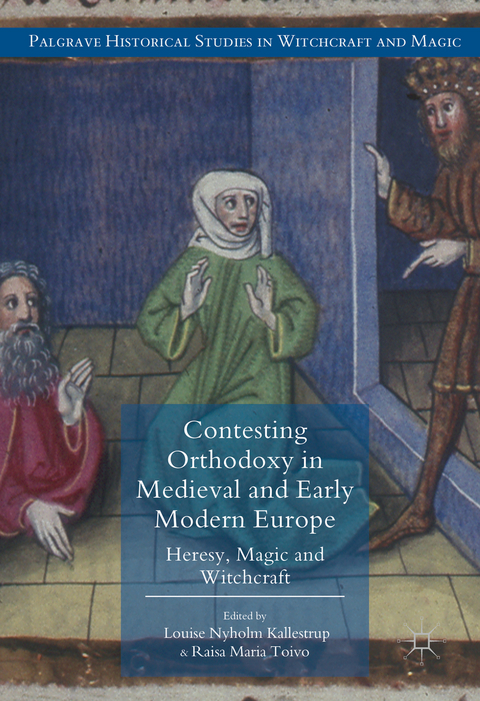
Contesting Orthodoxy in Medieval and Early Modern Europe (eBook)
XVII, 349 Seiten
Springer International Publishing (Verlag)
978-3-319-32385-5 (ISBN)
Louise Nyholm Kallestrup is Associate Professor in Early Modern History at the University of Southern Denmark. She has published widely on Danish and Italian witchcraft.
Raisa Maria Toivo is Senior Research Fellow at the University of Tampere, Finland. She has published widely on witchcraft, gender and the Reformation.
Louise Nyholm Kallestrup is Associate Professor in Early Modern History at the University of Southern Denmark. She has published widely on Danish and Italian witchcraft. Raisa Maria Toivo is Senior Research Fellow at the University of Tampere, Finland. She has published widely on witchcraft, gender and the Reformation.
Acknowledgements 6
Contents 7
Notes on Contributors 10
List of Figures 13
List of Table 15
Approaches to Magic, Heresy and Witchcraft in Time, Space and Faith 16
Witchcraft 19
Magic 22
Heresy 24
Notes 27
Part I: Heresy 29
‘Night is conceded to the dead’: Revenant Congregations in the Middle Ages 30
A Gathering of the Dead, or of Demons? 35
Marvelous, Ancient Sacrifices 38
Thinking with the Dead 42
Notes 43
Heresy and Heterodoxy in Medieval Scandinavia 47
Introduction 47
Terminology 50
Heresy in Medieval Scandinavia 52
Concluding Discussion 58
Notes 60
Caught Between Unorthodox Medicine and Unorthodox Religion: Revisiting the Case of Costantino Saccardini, Charlatan-Heretic 69
Notes 77
Part II: Magic 81
Angel Magic and the Cult of Angels in the Later Middle Ages 82
The Issues at Stake 83
Four Texts of Angel Magic from the Later Medieval West 86
Efforts to Regulate the Veneration of Angels 92
Devotion to Angels and Conceptions of Angels: The Scope of Toleration 96
The Hazards of Conjuration 103
Notes 108
Polyphony and Pragmatism in Scandinavian Spells c.1300–1600 122
Notes 137
The Divining Rod: Origins, Explanations and Uses in the Thirteenth to Eighteenth Centuries 138
Notes 151
Ignorant Superstition? Popular Education on Magic in Early Seventeenth-Century Confessionalist Finland: The Case of Mary and the Rosaries 155
Magic, Superstition and Witchcraft in Early Modern Finland 156
Idolatry and Lip Service vs Obedient Mary 158
Traces of the Cult of Mary in the Lutheran County of Satakunta 161
A Tradition of Catholic Reformation and Lutheran Superstition? 165
Early Seventeenth-Century Magic and Superstition as Ignorance 168
Notes 170
Part III: Witchcraft 174
The Witch of Endor Before the Witch Trials 175
Notes 194
Preaching on Witchcraft? The Sermons of Johannes Geiler of Kaysersberg (1445–1510) 200
Johannes Geiler of Kaysersberg (1445–1510): Some Introductory Remarks 200
No Place for Witches: Johannes Geiler of Kaysersberg and His Concept of Urban Reform 205
Superstition, Sorcery and Witchcraft in the Sermons of Johannes Geiler (Until 1509) 207
Johannes Geiler and His Concepts of Witchcraft (1509) 209
Conclusion 214
Notes 216
Law, Nature, Theology and Witchcraft in Ponzinibio’s De lamiis (1511) 223
Notes 234
The Infected and the Guilty: On Heresy and Witchcraft in Post-Reformation Denmark 239
The Concept of Heresy 240
First-Generation Reformers, Witchcraft and Heresy 242
The Admonitions of Niels Hemmingsen on Heresy and Witchcraft 245
Legislation on Witchcraft and Heresy 250
In Court 252
Conclusion 255
Notes 256
The Laughing Witch: Notes on the Relationship Between Literature and History in the Early Fifteenth Century 261
The centrepiece of this chapter is an early fifteenth-century play in the Dutch language, now known by the anachronistic name Die Hexe (The Witch), a name I will keep here for convenience sake. The main question I will pose here is how this play shou 261
A Farce 262
The Waning of the Middle Ages 264
Ascribed Witchcraft 268
Contemporary Concepts 270
A Popular Wizard 273
Fictional Witchcraft 276
Notes 278
Images, Representations and the Self-Perception of Magic among the Sami Shamans of Arctic Norway, 1592–1692 284
‘Nordmythos’ 285
The Septentrionale Region and the Big Dipper 289
Wind Knots and Weather Magic 291
The Sami and the Witch Trials 293
Sorcery Persecutions of the Sami 295
The Self-Perception of Magic among the Sami Shamans 298
Witchcraft Conspiracy at the Frontiers of European Civilization 299
Territorial Expansion, State-Building and Witchcraft 300
Notes 303
Bibliography 306
Archival (Unprinted) Sources 306
Sources and Bibliography Printed Before 1900 306
Sources and Bibliography Printed Since 1900 316
Index 350
| Erscheint lt. Verlag | 4.2.2017 |
|---|---|
| Reihe/Serie | Palgrave Historical Studies in Witchcraft and Magic | Palgrave Historical Studies in Witchcraft and Magic |
| Zusatzinfo | XVII, 349 p. 14 illus. in color. |
| Verlagsort | Cham |
| Sprache | englisch |
| Themenwelt | Geisteswissenschaften ► Geschichte ► Regional- / Ländergeschichte |
| Geisteswissenschaften ► Religion / Theologie | |
| Schlagworte | Christianity • heterodoxy • Popular beliefs • Reformation • Religion |
| ISBN-10 | 3-319-32385-7 / 3319323857 |
| ISBN-13 | 978-3-319-32385-5 / 9783319323855 |
| Informationen gemäß Produktsicherheitsverordnung (GPSR) | |
| Haben Sie eine Frage zum Produkt? |
 PDF (Wasserzeichen)
DRM: Digitales Wasserzeichen
Dieses eBook enthält ein digitales Wasserzeichen und ist damit für Sie personalisiert. Bei einer missbräuchlichen Weitergabe des eBooks an Dritte ist eine Rückverfolgung an die Quelle möglich.
Dateiformat: PDF (Portable Document Format)
Mit einem festen Seitenlayout eignet sich die PDF besonders für Fachbücher mit Spalten, Tabellen und Abbildungen. Eine PDF kann auf fast allen Geräten angezeigt werden, ist aber für kleine Displays (Smartphone, eReader) nur eingeschränkt geeignet.
Systemvoraussetzungen:
PC/Mac: Mit einem PC oder Mac können Sie dieses eBook lesen. Sie benötigen dafür einen PDF-Viewer - z.B. den Adobe Reader oder Adobe Digital Editions.
eReader: Dieses eBook kann mit (fast) allen eBook-Readern gelesen werden. Mit dem amazon-Kindle ist es aber nicht kompatibel.
Smartphone/Tablet: Egal ob Apple oder Android, dieses eBook können Sie lesen. Sie benötigen dafür einen PDF-Viewer - z.B. die kostenlose Adobe Digital Editions-App.
Buying eBooks from abroad
For tax law reasons we can sell eBooks just within Germany and Switzerland. Regrettably we cannot fulfill eBook-orders from other countries.
aus dem Bereich