


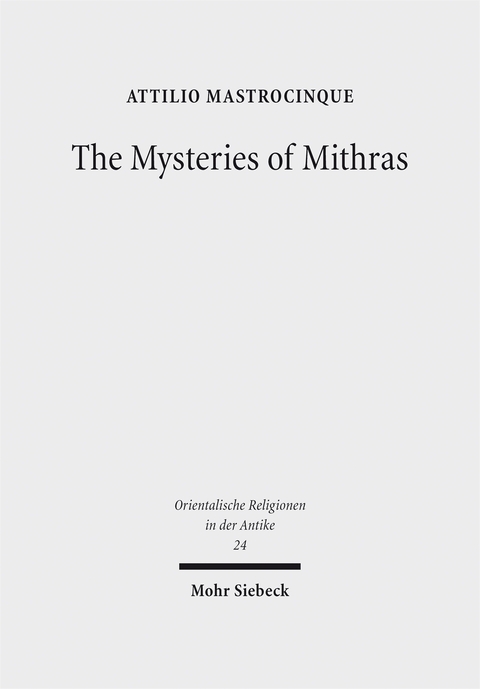
The Mysteries of Mithras
A Different Account
Seiten
Attilio Mastrocinque warnt in dieser Arbeit vor einer Annäherung an den Mithraismus basierend auf der Vorstellung, dass dieser mystische Kult dem Christentum ähnelt. Obwohl sowohl christliche als auch heidnische Autoren bezeugten, dass es mithrische Elemente übernommen hat, taten dies laut Attilio Mastrocinque nur einige gnostische Christen.
In this work, Attilio Mastrocinque cautions against an approach to Mithraism based on the belief that this mystic cult resembles Christianity. While both Christian and pagan authors testified that Mithraic elements were indeed borrowed, according to Attilio Mastrocinque this was only done by some gnostic Christians. He counters that Roman Empire ideology and religion provide better clues on how to approach the matter, contending too that Virgil proves to be more important than the Avesta in understanding Mithraic iconography. The meaning of the central scene - the Tauroctony - thus becomes clear when the Roman triumph's central act of bull sacrifice is thought of as just that, with Mithras playing the role of victor as author of this success. The episodes depicted on many reliefs relate to a prophecy known to Firmicus Maternus and other Christian polemists, and which foretold the coming of a saviour, i.e. the first emperor, when Saturn returns and Apollo-Mithras will rule.
In this work, Attilio Mastrocinque cautions against an approach to Mithraism based on the belief that this mystic cult resembles Christianity. While both Christian and pagan authors testified that Mithraic elements were indeed borrowed, according to Attilio Mastrocinque this was only done by some gnostic Christians. He counters that Roman Empire ideology and religion provide better clues on how to approach the matter, contending too that Virgil proves to be more important than the Avesta in understanding Mithraic iconography. The meaning of the central scene - the Tauroctony - thus becomes clear when the Roman triumph's central act of bull sacrifice is thought of as just that, with Mithras playing the role of victor as author of this success. The episodes depicted on many reliefs relate to a prophecy known to Firmicus Maternus and other Christian polemists, and which foretold the coming of a saviour, i.e. the first emperor, when Saturn returns and Apollo-Mithras will rule.
Born 1952; 1975 Master; since 2002 Full Professor of Roman History at the University of Verona; 2008-10 president of Cultural Heritage courses at the University of Verona; 2005-15 Director of the Archaeological Mission at Grumentum (Lucania).
| Erscheinungsdatum | 09.08.2017 |
|---|---|
| Reihe/Serie | Orientalische Religionen in der Antike |
| Verlagsort | Tübingen |
| Sprache | englisch |
| Maße | 178 x 245 mm |
| Gewicht | 820 g |
| Themenwelt | Geisteswissenschaften ► Archäologie |
| Geisteswissenschaften ► Religion / Theologie ► Christentum | |
| Schlagworte | Empire • Ideology • Ideology of the Roman Empire • Mazdaism • Mithras • Mysteries • Mysteries of Mithras • of • Religion • Roman • Roman Religion • Rom (Römisches Reich); Religion • the |
| ISBN-10 | 3-16-155112-5 / 3161551125 |
| ISBN-13 | 978-3-16-155112-3 / 9783161551123 |
| Zustand | Neuware |
| Informationen gemäß Produktsicherheitsverordnung (GPSR) | |
| Haben Sie eine Frage zum Produkt? |
Mehr entdecken
aus dem Bereich


aus dem Bereich
und was sie über die Kirche verraten
Buch | Hardcover (2024)
C.H.Beck (Verlag)
CHF 39,90


