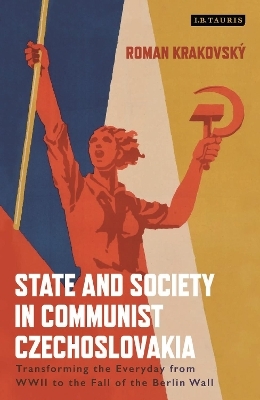
State and Society in Communist Czechoslovakia
I.B. Tauris (Verlag)
978-1-78453-914-6 (ISBN)
Across central and eastern Europe after World War II, the newly established communist regimes promised a drastic social revolution that would transform the world at great pace and pave the way to a socialist future. Although many aspects of this utopian project are well known - such as fast-paced industrialisation, collectivisation and urbanisation - the regimes even sought to transform the ways in which their citizens interacted with each other and the world around them. Using a unique analytical model based on an amalgam of anthropology, sociology, history and extensive archival research, award-winning scholar Roman Krakovsky here considers the Czechoslovakian attempt to 'reinvent the world' - 'time' and 'space' included - in this all-encompassing way. Ranging from WWII to the fall of the Berlin Wall, his innovative analysis variously considers the impact of Stakhanovism, the impossible-to-achieve production targets intended to assert socialism's future potential; the attempt to replace Sunday's Christian attributes with socialist ones; and the profound changes brought about to the public and private spheres, including the culture of informing and the ways this was circumvented.
Across a wide range of case studies Krakovsky demonstrates both the far-reaching extent of the communist vision and the inherent flaws and contradictions that gradually destabilised it. This in-depth perspective is vital reading for all scholars of twentieth century history and politics.
Roman Krakovsky is a lecturer at the University of Geneva. He received his PhD in 2012 from the Universite Paris-Sorbonne and won a number of awards for his doctoral thesis, among them the Prix d'histoire sociale and the Fraenkel Prize in Contemporary History.
Chapter 1. A country where tomorrow was here yesterday
– A new horizon for a new society
– Working to a new timetable
– Making the new timetable routine
Chapter 2. The Lord’s day, Worker’s day
– Breaking with conventions
– Giving a new focus to an established ritual
– The success of the project
Chapter 3. Building a notion of common good
– Relationships between public stakeholders
– The combination of public and private interests
– The merging of state and society
Chapter 4. Complaining and talking about yourself
– The socialist experience of living together
– A space to call one’s own
– Reclaiming the private sphere
Chapter 5. “One day, our streets will be one huge celebration!”
– Forming a socialist community
– Building social bonds
– The reliability of social linkage
Conclusion
| Erscheinungsdatum | 29.09.2018 |
|---|---|
| Zusatzinfo | 40 black and white illustrations |
| Sprache | englisch |
| Maße | 138 x 216 mm |
| Gewicht | 572 g |
| Themenwelt | Geschichte ► Allgemeine Geschichte ► Zeitgeschichte |
| Geisteswissenschaften ► Geschichte ► Regional- / Ländergeschichte | |
| Geschichte ► Teilgebiete der Geschichte ► Kulturgeschichte | |
| Geschichte ► Teilgebiete der Geschichte ► Sozialgeschichte | |
| Sozialwissenschaften ► Politik / Verwaltung ► Politische Systeme | |
| Sozialwissenschaften ► Politik / Verwaltung ► Politische Theorie | |
| Sozialwissenschaften ► Soziologie | |
| ISBN-10 | 1-78453-914-7 / 1784539147 |
| ISBN-13 | 978-1-78453-914-6 / 9781784539146 |
| Zustand | Neuware |
| Informationen gemäß Produktsicherheitsverordnung (GPSR) | |
| Haben Sie eine Frage zum Produkt? |
aus dem Bereich