


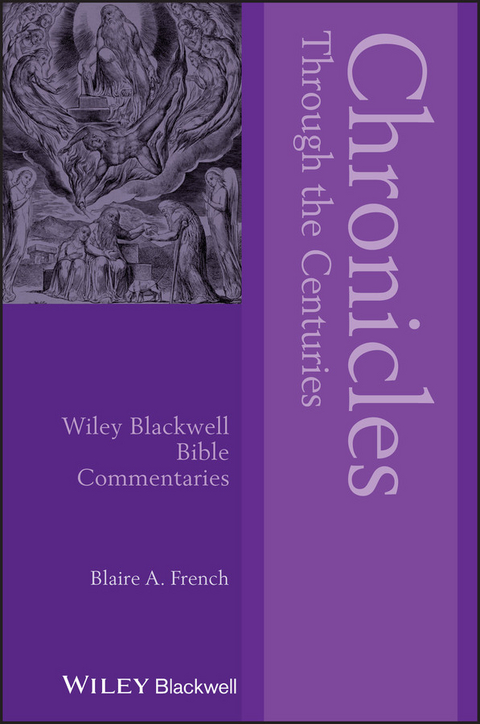
Chronicles Through the Centuries (eBook)
John Wiley & Sons (Verlag)
978-1-118-69007-9 (ISBN)
Offers a history of the interpretation of Chronicles in theology, worship, music, literature and art from the ancient period to the present day, demonstrating its foundational importance within the Old Testament
- Explores important differences between the same topics and stories that occur in Chronicles and other biblical books such as Genesis and Kings, including the pious depiction of David, the clear correlation between moral behavior and divine reward, and the elevation of music in worship
- Examines the reception of Chronicles among its interpreters, including rabbis of the Talmud, Jerome, Martin Luther, Johann Sebastian Bach, Cotton Mather, and others,
- Features broad yet comprehensive coverage that considers Jewish and Christian, ancient and modern, and secular and pop cultural interpretations
- Organizes discussions by verse to illuminate each one's changing meaning across the ages
Blaire A. French is an adjunct lecturer in Biblical Hebrew at the University of Virginia, USA. She holds a doctorate in Judaism and Christianity in Antiquity from the University of Virginia. She is the author of The Ticking Tenure Clock: An Academic Novel (1998) and The Presidential Press Conference: Its History and Role in the American Political System (1982).
Offers a history of the interpretation of Chronicles in theology, worship, music, literature and art from the ancient period to the present day, demonstrating its foundational importance within the Old Testament Explores important differences between the same topics and stories that occur in Chronicles and other biblical books such as Genesis and Kings, including the pious depiction of David, the clear correlation between moral behavior and divine reward, and the elevation of music in worship Examines the reception of Chronicles among its interpreters, including rabbis of the Talmud, Jerome, Martin Luther, Johann Sebastian Bach, Cotton Mather, and others, Features broad yet comprehensive coverage that considers Jewish and Christian, ancient and modern, and secular and pop cultural interpretations Organizes discussions by verse to illuminate each one s changing meaning across the ages
Blaire A. French is an adjunct lecturer in Biblical Hebrew at the University of Virginia, USA. She holds a doctorate in Judaism and Christianity in Antiquity from the University of Virginia. She is the author of The Ticking Tenure Clock: An Academic Novel (1998) and The Presidential Press Conference: Its History and Role in the American Political System (1982).
Acknowledgments ix
Introduction 1
Part 1: The Genealogies 13
1. The Genealogies 15
Part 2: The Reign of David 41
2. David's Reign from Election to Dynastic Promise 45
3. David's Reign from the Census to the Selection of the Temple Site 63
4. David's Reign from His Preparations for the Temple to His Death 82
Part 3: The Reigns of Solomon and the Kings of Judah 103
5. The Reigns of Solomon, Rehoboam, Abijah, and Asa 107
6. The Reigns of Jehoshaphat, Joash, Uzziah, and Ahaz 129
7. The Reigns of Hezekiah, Josiah, Jehoiakim, and Zedekiah 148
8. The Reign of Manasseh 166
Coda A 187
Coda B 190
Glossary of Names and Terms 193
Abbreviations 201
Bibliography 203
Author Index 219
Scriptural Index 223
Subject Index 231
Introduction
In May 1690, French soldiers and their Indian allies raided the Anglo‐American settlement in Casco Bay, Maine, brutally killing many of its inhabitants. The attack was one of many in King William’s War (1688–1697), a bitter struggle between France and England for sovereignty in the New World. Among the Abenaki Indians’ captives were Hannah Swarton, her three sons, and a daughter. Within two months, her eldest boy had been killed and the other children taken away. Swarton remained a prisoner, first of the Indians and then of the French, for five years. Following her release she provided an account of her ordeal, singling out the book of Chronicles as her main source of consolation:
And 2 Chron. 6.36, 37, 38, 39. was a precious Scripture to me,
in the Day of Evil. We have Read over, and Pray’d over, this
Scripture together, and Talk’d together of this Scripture, Margaret
[a fellow captive] and I; How the Lord hath Promised, Though they
were Scattered for their Sins, yet there should be a Return, if they did
Bethink themselves, and Turn, and Pray. So we did Bethink our selves
in the Land where we were Carried Captive, did Turn, did Pray,
and Endeavour to Return to God with all our Hearts: And, as they
were to Pray towards the Temple, I took it, that I should Pray
towards Christ; and accordingly did so, and hoped the Lord would
Hear, and He hath Heard from Heaven, His Dwelling Place, my
Prayer and Supplication, and mentained my Cause, and not Rejected
me, but Returned me.
(C. Mather 1697: 70–71)
Swarton found justification in Chronicles of her suffering as well as a roadmap for deliverance. Her testimonial circulated widely as an appendix to a published sermon by Cotton Mather (1663–1728), the leading Puritan minister of his time. In his homily, Mather also focused on Chronicles, referencing another verse that spoke of salvation through humiliation and repentance (2 Chr 12:7) (C. Mather 1697). Swarton’s account was added to reinforce a prominent theme of Chronicles: God rewards the true penitent.
While Chronicles’ distinctive offerings have attracted devoted readers like Swarton and Mather in every age, for many today the book is unfamiliar terrain. Some modern commentators go so far as to judge Chronicles to be one of the least influential and interesting books of the Bible. They cite in particular its opening nine chapters of genealogies as a major stumbling block, causing readers to give up the fight even before they begin, and further characterize its narrative as repetitious (duplicating large portions of Samuel and Kings) and overly pious. In Chronicles’ account, most of David’s wrongdoings are omitted, as are those of Solomon. Also missing are many colorful triumphs, including David’s contest with Goliath and Solomon’s legendary judgment on the baby claimed by two mothers. Rabbi Joseph Telushkin, author of the popular volume Biblical Literacy, declares that Chronicles is “the least read of the Bible’s historical books” (Telushkin 1997: 395), and the claim is not baseless. Anyone searching for selections from Chronicles in the Revised Common Lectionary – the three‐year cycle of weekly readings for Protestant churches – will seek in vain.
Yet Chronicles’ reception history demonstrates that it has commanded a highly attentive audience. Saint Jerome (c.347–420) was drawn to its succinct rendition of Israel’s past from Adam to the end of the Babylonian exile, and his admiration spawned its modern title. Jerome lauded the book for giving its readers “a chronicle of the whole of the sacred history” (Hieronymi Prologus Galeatus, NPNF2 6.490). For Jerome and countless other interpreters, up to and including the present, Chronicles’ offer of an alternative to the books of Samuel and Kings (primarily) is precisely what makes the book so significant. Its differences and deviations create interpretive opportunities for readers. In some cases, the variations can be dramatic. For instance, in Chronicles the prophet Oded admonishes his fellow Israelites of the Northern Kingdom to return their Judean prisoners, captured during Israel’s victory over King Ahaz. After clothing, feeding, and anointing their captives, the Israelites do so (2 Chr 28:8–15). This account, entirely absent from Kings, may have inspired the parable of the Good Samaritan in Luke’s Gospel (Lk 10:25–37).
Chronicles’ small and subtle shifts in tone or emphasis can be equally potent. The verses Swarton singled out (KJV 2 Chr 6:36–39) closely parallel Solomon’s dedication prayer in Kings (KJV 1 Kgs 8:46–50), but the wording is not quite identical. In Chronicles, Solomon implores God alone for relief, whereas in Kings he includes a plea for the compassion of Israel’s captors. In choosing Chronicles, Swarton kept the focus on God’s acceptance of repentance and a return from captivity, to the exclusion of everything else.
The history of Chronicles’ reception is largely shaped by interpreters who have opted to stray from the account of Israel contained in Genesis through Kings, what David Noel Freedman has well termed the “primary history” (1962). In these instances, Chronicles’ version of events takes the place of, or is read alongside, what have tended to be considered the “standard” biblical accounts of Samuel and Kings. Even when it is not obvious, Chronicles almost always stands in relation to other passages of Scripture.
Chronicles as a Work of Reception
In reception history, the reader, not the original author, is the focus of attention. Questions regarding the inception of biblical books – the historical critical concerns about who wrote what, where, when, and why – are subjects for another kind of inquiry. Chronicles, however, demands to be treated as an exception to this rule in that the Chronicler received and interpreted key texts that ultimately comprised part of the canon. Study of the reception history of Chronicles, therefore, needs to begin with consideration of the book itself as a work of reception.
Ancient and contemporary commentators agree that the Chronicler lived during the Second Temple period (530 BCE–70 CE) and that his writings postdate the Pentateuch and the Former Prophets. A saying from the tannatic period (c.70–200 CE) preserved in the Babylonian Talmud (compiled around 600 CE) ascribes the composition of the Pentateuch to Moses (with the exception of the record of his death, Dt 34:5–12), the book of Joshua (and Dt 34:5–12) to Joshua, the books of Judges and Samuel to Samuel, and the book of Kings to Jeremiah. As for Chronicles, the Babylonian Talmud holds that Ezra began the book and Nehemiah finished it (b. B. Bat. 14b‐15a). Their assumed authorship of Chronicles is most likely due to the duplicate verses relaying the edict of Cyrus that end Chronicles and open Ezra, joining one narrative to the other (2 Chr 36:22–23; cf. Ezr 1:1–3a).
Early Christian exegetes also considered Chronicles’ composition to be postexilic. Theodoret of Cyrus (393–460) explicitly classified Chronicles as a historical rather than a prophetic work and asserted that its contents proved it was written in the Second Temple era (Quaest. Reg. et Para. PG 80.857). Among modern biblical scholars, there is near universal agreement that the Chronicler drew on the Genesis–Kings narrative, and that the version he knew, whether through oral or written transmission, closely resembled what has come down to us in the Masoretic Text (MT, the standard text in Hebrew) (Kalimi 2005: 1–2; Knoppers 2003: 66; Schmid 2010: 287; Japhet 1993: 27).
The majority of the Chronicler’s material came (directly or indirectly) from Samuel and Kings, and he derived great portions from these books almost verbatim. Many of his narratives, however, have no parallel in Samuel or Kings and, as already noted, even in the parallel passages there are small but sometimes crucial differences. It is this exceptional material (Sondergut), special to Chronicles, that has drawn the attention of readers through the centuries.
Chronicles’ David
Chronicles is best known for its transformation of David from a gifted but imperfect king into a pious leader of the Temple cult. In Samuel/Kings, David has no role in the Temple’s construction or management (1 Kgs 5–8). In Chronicles, by contrast, David undertakes the preliminary work to lighten the burden on the young and inexperienced Solomon (1 Chr 22:5). He receives the building’s blueprint in writing from God (1 Chr 28:19) and arranges for the provision of the necessary materials for its construction (1 Chr 22:2–4, 14–15 29:1–5). Equally significantly, it is David who organizes the priests and assigns the Levites their functions (1 Chr 23:2–24:19; 2 Chr 8:14, 23:18, 29:25).
Another striking feature of Chronicles’ David is that he is a unifying political figure from the outset, acclaimed king by Judah and Israel, the north and the south, in one fell swoop (1 Chr 11:1–3). In Samuel, after David is anointed king in Judah, seven years pass before Israel finally accepts him (2 Sm 5:5), and even then...
| Erscheint lt. Verlag | 11.11.2016 |
|---|---|
| Reihe/Serie | Blackwell Bible Commentaries |
| Blackwell Bible Commentaries | Wiley Blackwell Bible Commentaries |
| Sprache | englisch |
| Themenwelt | Religion / Theologie ► Christentum ► Bibelausgaben / Bibelkommentare |
| Religion / Theologie ► Christentum ► Kirchengeschichte | |
| Schlagworte | Altes Testament • Bibelstudien • Bible history • biblical history • Biblical Studies • Jewish reception studies • Old Testament • reception studies • Religion • Religion & Theology • Religion u. Theologie |
| ISBN-10 | 1-118-69007-9 / 1118690079 |
| ISBN-13 | 978-1-118-69007-9 / 9781118690079 |
| Informationen gemäß Produktsicherheitsverordnung (GPSR) | |
| Haben Sie eine Frage zum Produkt? |
 EPUB (Adobe DRM)
Kopierschutz: Adobe-DRM
Adobe-DRM ist ein Kopierschutz, der das eBook vor Mißbrauch schützen soll. Dabei wird das eBook bereits beim Download auf Ihre persönliche Adobe-ID autorisiert. Lesen können Sie das eBook dann nur auf den Geräten, welche ebenfalls auf Ihre Adobe-ID registriert sind.
Details zum Adobe-DRM
Dateiformat: EPUB (Electronic Publication)
EPUB ist ein offener Standard für eBooks und eignet sich besonders zur Darstellung von Belletristik und Sachbüchern. Der Fließtext wird dynamisch an die Display- und Schriftgröße angepasst. Auch für mobile Lesegeräte ist EPUB daher gut geeignet.
Systemvoraussetzungen:
PC/Mac: Mit einem PC oder Mac können Sie dieses eBook lesen. Sie benötigen eine
eReader: Dieses eBook kann mit (fast) allen eBook-Readern gelesen werden. Mit dem amazon-Kindle ist es aber nicht kompatibel.
Smartphone/Tablet: Egal ob Apple oder Android, dieses eBook können Sie lesen. Sie benötigen eine
Geräteliste und zusätzliche Hinweise
Buying eBooks from abroad
For tax law reasons we can sell eBooks just within Germany and Switzerland. Regrettably we cannot fulfill eBook-orders from other countries.
aus dem Bereich


