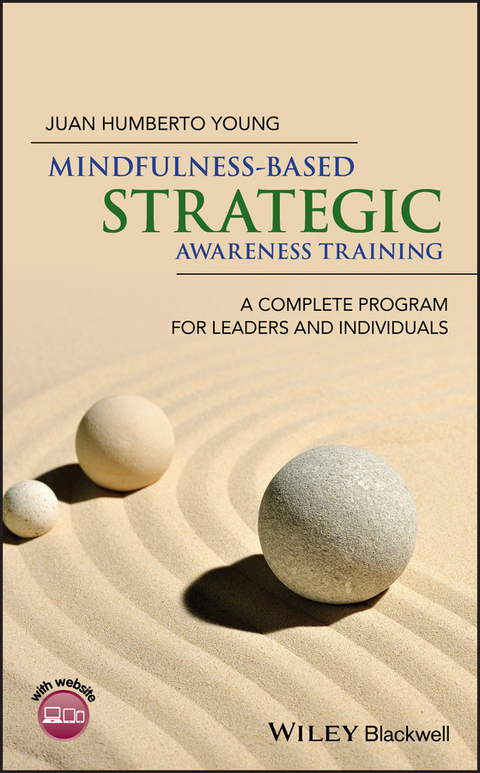
Mindfulness-Based Strategic Awareness Training (eBook)
John Wiley & Sons (Verlag)
978-1-118-93799-0 (ISBN)
Juan Humberto Young is Professor of Positive Leadership, Strategy, and Finance at IE University and Business School, Madrid. He is a recognized pioneer in designing and delivering services that apply mindfulness and positive psychology to management, and has several decades of experience in consulting and management including board and senior level management positions with UBS, KPMG, and a Swiss electro-engineering fi rm. His academic credentials include a doctorate in Management from Case Western Reserve University, a Master of Applied Positive Psychology from the University of Pennsylvania, a Master of Mindfulness-Based Cognitive Therapy from Oxford University and Masters degrees in Management including an MBA from the University of Chicago and Harvard. He is currently the owner of a positive strategy consultancy company and academic director of the Executive Master in Positive Leadership and Strategy at IE University, Madrid.
"This book is important for all who seek to lead organizations, showing how mindfulness can be combined with the findings from positive psychology for the benefit of all. The book is not just good theory. It also provides a step-by-step practical program to cultivate a balance between motivation for outcomes on the one hand, and compassion toward self and others on the other. Here are skills that can be learned; skills that can truly inspire and sustain wise leadership."
--Mark Williams, Emeritus Professor of Clinical Psychology, University of Oxford, was also the Founding Director of the Oxford Mindfulness Centre. Now Senior Research Fellow at the Department of Psychiatry of Oxford University; author of Mindfulness: An Eight week Plan for Finding Peace in a Frantic World, Co-author with Zindel V. Segal and John Teasdale of Mindfulness-Based Cognitive Therapy for Depression and author and co-author of a series other standard works in the field of mindfulness
"In today's disruptive times, it is happy and loyal customers that count. This rich and practical book provides an exceptionally smart learning tool to help consumers make mindful decisions that lead to happiness. And for any leader and manager it is a key reading for making wise business and marketing decisions that create value."
--Bernd Schmitt, Ph.D., Professor, Columbia Business School, New York; author of Experiential Marketing: How to Get Consumers to Sense, Fell, Think and Act, Relate to your Company and Brands and Happy Customers Everywhere: How Your Business Can Profit from the Insights of Positive Psychology
"Juan Humberto Young is the first to integrate positive psychology and mindfulness with a results-oriented focus on business strategy. In today's ever-changing organizations, leaders need clarity and flexibility to adapt and succeed. Built on leading-edge science, this book offers a step-by-step program that will light your path not only to greater strategic awareness but also to greater well-being."
--Barbara L. Fredrickson, Ph.D., Kenan, Distinguished Professor of Psychology and Neuroscience, University of North Carolina at Chapel Hill; author of the two bestsellers Positivity: Top-Notch Research Reveals the Upward Spiral That Will Change Your Life and Love 2.0: Finding Happiness and Health in Moments of Connection
"Juan Humberto Young integrates mindfulness practices, positive psychology, and extensive business experience to design a practical training program that improves personal and professional decision-making. This book offers tools to make decisions that increase subjective well-being because the sources of much unhappiness are poor decisions. For business leaders, lawyers, negotiators, and everyone who wants to improve their quality of life, this book presents a path to achieve the capacity of strategic awareness, consisting of mental lucidity, emotional clarity, and bodily awareness, which results in skillful decision-making. This book provides readers an ideal way to find happiness, personal balance, and professional success."
--Peter H. Huang, J.D. Ph.D., Professor and DeMuth Chair of Business Law, University of Colorado Law School; author of numerous articles integrating Positive Psychology, Mindfulness and Law
Preface
The idea of writing a book originates from people I appreciate and admire. One of the first was my doctoral thesis advisor, Professor John Aram. At the time we were jointly teaching a master level course on leadership at Weatherhead School of Management, Case Western Reserve University, Cleveland, Ohio. John thought I had a gift for simplifying complex theories and integrating diverse disciplines in a coherent, easy to understand, way. Over the years collaborators at work, students, and clients have confirmed John’s view and exhorted me to put my reflections down in writing.
At the University of Saint Gallen, Switzerland, my classes on strategies to improve people’s and leaders’ decision skills leading to happiness stirred keen interest from the students and were always overbooked. Based on this experience I designed a one‐year Executive Master program for positive leadership and strategy with positive psychology and mindfulness as the foundations of the curriculum. It is currently running in its fourth year at IE University, Madrid, one of the world’s top business schools. The consistent application of positive psychology and mindfulness throughout the program makes it a unique training opportunity for professionals from a wide array of fields and industries. It is taught within a faculty that is composed of the best specialists in their respective fields, all pioneers in implementing positive and mindful approaches.
During studies at Oxford University for a Master’s degree in mindfulness‐based cognitive therapy it occurred to me that there was a need for shorter training formats like the well‐recognized 8‐week training protocols common to most mindfulness training courses. Maybe it was time to contemplate writing a book and make the material that I had accumulated over many years into a series of personal journals accessible to people outside academia—not a book about personal exploits, much less an autobiography, but a practical book enriched with human‐centered, anecdotal data and with authentic stories that could illustrate abstract concepts and give them a human face. The drive to overcome my doubts and reservations and start writing comes from what I see occurring in the world around me, and I’m not alone in my observations.
In a recent article MIT professors E. Brynjolfsson and A. McAfee, together with M. Spence of NYU, a Nobel laureate in economics, suggest that one of the key challenges in the future will be assuring an acceptable standard of living for the mass of people being squeezed out of the labor market by the forces of technology. Researchers at Oxford University estimate that in the future 45% of US jobs will be computerized, drastically reducing the workforce. Scientists such as Stephen Hawking also warn about the possible negative effects on social life that will result from a trend towards robots in the workplace that will threaten jobs on a massive scale. While writing these lines the Anglo‐American mining company announced its intention to shed 85,000 jobs. At the same time huge numbers of immigrants pour into the more industrialized economies in search of better lives, although these countries are already under strain both socially and economically.
There are other troubles emerging, too. We watch in consternation the developments at FIFA, the Football Association, with its new costly head office in Zurich only minutes away from my home, as reports of corrupt behavior and arrests make news. We learn also how companies engage in deceptive policies such as VW with its diesel emissions scandal. Daily we witness, and hear about, the effect of climate change and its devastating consequences for the ecology of the planet.
These and other problems are already weighing on people’s well‐being and are likely to impact it even more in the future. An inevitable challenge for us all will be how we can confront these issues and work towards solutions. Some people may place their faith in institutions (government and business organizations) hoping that they will come up with appropriate solutions. My personal optimism is not with institutional solutions given the numerous conflicts of interest and the highly polarized context in which they operate. They rarely seem to get things implemented. My preference is for a personal, entrepreneurial approach, one that places responsibility for well‐being directly on the individual. No‐one can take the need for a person’s happiness and well‐being more seriously than the person themselves. Individuals and leaders will be required to develop inner abilities to help them to navigate through these demanding times that are increasingly being defined as volatile, uncertain, complex, and ambiguous (VUCA). This is the central thrust of this book.
I see a great need for individuals to cultivate mental, emotional, and behavioral qualities that allow them to make clear decisions during these turbulent times while maintaining a decent level of personal well‐being for themselves and their families. For leaders there is the need to cultivate an awareness that allows them to create real value for many: not only shareholder value but also value for clients with good and healthy products and services; value for their employees so that their jobs are protected and new jobs created; value for society by making the appropriate fiscal decisions and contributions. This is a very big call but it is one that is required from post‐modern leaders. Individuals able to attain these goals will be sought after and they will be worth the enormous payouts that accompany these positions. Especially in light of the poor record of managers and leaders investigated by Candido and Santos (2015, p. 237) “one of the most challenging and unresolved problems in this area (business strategy) is the apparently high percentage of organizational strategies that fail, with some authors estimating a rate of failure between 50 to 90%. By failure we mean either a new strategy was formulated but not implemented or it was implemented with poor results.”
Today there are too many overpaid mediocre leaders with a flawed view of value who are only capable of reducing the workforce to boost profits or making shortcuts compromising the quality of their products and services in order to save costs when what is really needed is job creation and genuine products. In short they manage the profit and loss (P&L) statements of their business mostly from the short‐term cost side instead of generating long‐term sustainable, organic growth based on a strategy of revenue generation.
The ability to generate genuine value for multiple stakeholders requires a panoramic awareness that I call “strategic awareness”. It implies an open awareness infused with clarity of the mind, positive emotionality, friendliness, practical wisdom (in the sense of finding the right way to do the right things), and skillful responses to our socially constructed reality. It is the kind of awareness that allows for decisions that foster personal and social well‐being while avoiding two of the most common errors in decision making:
- Errors in forecasting future personal outcomes of decisions taken today (for example, after being overjoyed with the promotion to country manager in Panama feeling unhappy with the suffocating heat and heavy traffic of Panama City).
- Lack of foresight regarding side effects or unintended consequences of their decisions (for example VW’s decisions that led to the emission scandal now affecting many other parties including the second‐generation VW representative who lives next to me and his employees who are suffering a dramatic collapse in sales).
Mindfulness‐based strategic awareness training (MBSAT) is designed to cultivate an open, panoramic awareness using mindfulness and positive psychology as its foundation and behavioral economics, cognitive therapy, finance, risk management, and system dynamics as supporting disciplines. Mindfulness, a millennium old technology of human development, has recently been receiving much attention as one possible way to help individuals cope with the challenges of postmodernity.
J. Sachs, the acclaimed Columbia University professor, speaks of eight dimensions in people’s lives that require mindfulness: mindfulness of self, mindfulness of work, mindfulness of knowledge, mindfulness of others, mindfulness of nature, mindfulness of the future, mindfulness of politics, and mindfulness of the world.
Positive psychology, the second pillar of MBSAT, is an already well‐established applied science of well‐being. It has developed proven interventions for assisting individuals to increase their levels of subjective well‐being. In combination with the other disciplines mentioned above MBSAT forms a robust, comprehensive 8‐week program that, if followed by the participants, can significantly improve the quality of their lives.
Considerable effort and care has been made to design MBSAT so that it delivers what it intends to do and doesn’t become one more program of what critics call “mindfulness McDonaldization” interventions, simplified approaches with promises of fast results, a kind of fast food for the soul.
The author of this book, besides having several years of mindfulness practice, spent two years learning how to design and teach mindfulness interventions at Oxford University and worked for more than a decade with applied positive psychology approaches to human development in various industries. Together with my many years of experience in...
| Erscheint lt. Verlag | 19.9.2016 |
|---|---|
| Sprache | englisch |
| Themenwelt | Geisteswissenschaften ► Psychologie |
| Wirtschaft ► Betriebswirtschaft / Management ► Unternehmensführung / Management | |
| Schlagworte | Achtsamkeit • Arbeitspsychologie • Beta • Business & Management • Decision-Making • Experiential Learning • Führung • Führung • Leadership • Management • Management f. Führungskräfte • Management f. Führungskräfte • Management / Leadership • MBSAT • Mindfulness • mindfulness training • mindful real options • Organizational & Industrial Psychology • positive Emotion • positive psychology • Psychologie • Psychologie i. d. Arbeitswelt • Psychology • Resilience • results • strategic awareness • Strategic Management • Strategy • strengths-based • well-being • Wirtschaft u. Management |
| ISBN-10 | 1-118-93799-6 / 1118937996 |
| ISBN-13 | 978-1-118-93799-0 / 9781118937990 |
| Informationen gemäß Produktsicherheitsverordnung (GPSR) | |
| Haben Sie eine Frage zum Produkt? |
 EPUB (Adobe DRM)
Kopierschutz: Adobe-DRM
Adobe-DRM ist ein Kopierschutz, der das eBook vor Mißbrauch schützen soll. Dabei wird das eBook bereits beim Download auf Ihre persönliche Adobe-ID autorisiert. Lesen können Sie das eBook dann nur auf den Geräten, welche ebenfalls auf Ihre Adobe-ID registriert sind.
Details zum Adobe-DRM
Dateiformat: EPUB (Electronic Publication)
EPUB ist ein offener Standard für eBooks und eignet sich besonders zur Darstellung von Belletristik und Sachbüchern. Der Fließtext wird dynamisch an die Display- und Schriftgröße angepasst. Auch für mobile Lesegeräte ist EPUB daher gut geeignet.
Systemvoraussetzungen:
PC/Mac: Mit einem PC oder Mac können Sie dieses eBook lesen. Sie benötigen eine
eReader: Dieses eBook kann mit (fast) allen eBook-Readern gelesen werden. Mit dem amazon-Kindle ist es aber nicht kompatibel.
Smartphone/Tablet: Egal ob Apple oder Android, dieses eBook können Sie lesen. Sie benötigen eine
Geräteliste und zusätzliche Hinweise
Buying eBooks from abroad
For tax law reasons we can sell eBooks just within Germany and Switzerland. Regrettably we cannot fulfill eBook-orders from other countries.
aus dem Bereich