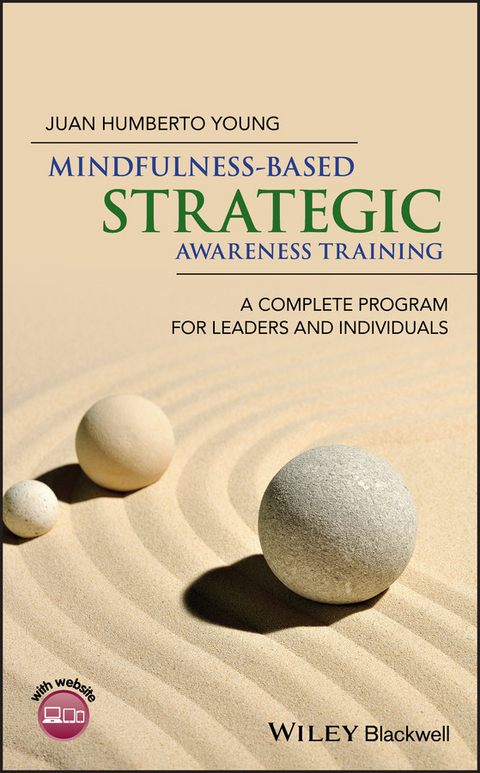
Mindfulness-Based Strategic Awareness Training (eBook)
John Wiley & Sons (Verlag)
978-1-118-93798-3 (ISBN)
- Sets out a complete program in Mindfulness-based Strategic Awareness Training (MBSAT), a new form of strengths-based business mindfulness training which enhances participants' ability to perceive opportunities, adapt and grow
- Draws on research from neuroscience, positive psychology, behavioural finance and management to show how leaders, managers and individuals can build and maintain more resonant relationships and adapt to constant change
- Includes real-life vignettes, specific instructions and a wealth of resources designed to guide experiential learning including background information, exercises, guidelines, hand-outs, graphics, and guided audio meditations
- Mindfulness training is increasingly used in organizational contexts - the author is a pioneer in designing and delivering training that applies mindfulness and positive psychology to the strategic challenges of management and business
Reviews by Experts
This book is important for all who seek to lead organizations, showing how mindfulness can be combined with the findings from positive psychology for the benefit of all. The book is not just good theory. It also provides a step-by-step practical program to cultivate a balance between motivation for outcomes on the one hand, and compassion toward self and others on the other. Here are skills that can be learned; skills that can truly inspire and sustain wise leadership. -Mark Williams, Emeritus Professor of Clinical Psychology, University of Oxford, was also the Founding Director of the Oxford Mindfulness Centre. Now Senior Research Fellow at the Department of Psychiatry of Oxford University. Author of 'Mindfulness: An Eight week Plan for Finding Peace in a Frantic World', Co-author with Zindel V. Segal and John Teasdale of 'Mindfulness-Based Cognitive Therapy for Depression'.
In today's disruptive times, it is happy and loyal customers that count. This rich and practical book provides an exceptionally smart learning tool to help consumers make mindful decisions that lead to happiness. And for any leader and manager it is a key reading for making wise business and marketing decisions that create value.-Bernd Schmitt, Ph.D., Professor, Columbia Business School, New York. Author of 'Experiential Marketing: How to Get Consumers to Sense, Fell, Think and Act, Relate to your Company and Brands' and 'Happy Customers Everywhere: How Your Business Can Profit from the Insights of Positive Psychology.'
Juan Humberto Young is the first to integrate positive psychology and mindfulness with a results-oriented focus on business strategy. In today's ever-changing organizations, leaders need clarity and flexibility to adapt and succeed. Built on leading-edge science, this book offers a step-by-step program that will light your path not only to greater strategic awareness but also to greater well-being.-Barbara L. Fredrickson, Ph.D., Kenan, Distinguished Professor of Psychology and Neuroscience, University of North Carolina at Chapel Hill. Author of the two bestsellers 'Positivity: Top-Notch Research Reveals the Upward Spiral That Will Change Your Life' and 'Love 2.0: Finding Happiness and Health in Moments of Connection'.
Juan Humberto Young integrates mindfulness practices, positive psychology, and extensive business experience to design a practical training program that improves personal and professional decision-making. This book offers tools to make decisions that increase subjective well-being because the sources of much unhappiness are poor decisions. For business le
Juan Humberto Young is Professor of Positive Leadership, Strategy, and Finance at IE University and Business School, Madrid. He is a recognized pioneer in designing and delivering services that apply mindfulness and positive psychology to management, and has several decades of experience in consulting and management including board and senior level management positions with UBS, KPMG, and a Swiss electro-engineering fi rm. His academic credentials include a doctorate in Management from Case Western Reserve University, a Master of Applied Positive Psychology from the University of Pennsylvania, a Master of Mindfulness-Based Cognitive Therapy from Oxford University and Masters degrees in Management including an MBA from the University of Chicago and Harvard. He is currently the owner of a positive strategy consultancy company and academic director of the Executive Master in Positive Leadership and Strategy at IE University, Madrid.
Mindfulness-Based Strategic Awareness Training: A Complete Program for Leaders and Individuals is the first book to link mindfulness training and positive psychology to the leadership, strategy and management issues faced by individuals and organizations. Sets out a complete program in Mindfulness-based Strategic Awareness Training (MBSAT), a new form of strengths-based business mindfulness training which enhances participants ability to perceive opportunities, adapt and grow Draws on research from neuroscience, positive psychology, behavioural finance and management to show how leaders, managers and individuals can build and maintain more resonant relationships and adapt to constant change Includes real-life vignettes, specific instructions and a wealth of resources designed to guide experiential learning including background information, exercises, guidelines, hand-outs, graphics, and guided audio meditations Mindfulness training is increasingly used in organizational contexts the author is a pioneer in designing and delivering training that applies mindfulness and positive psychology to the strategic challenges of management and business Reviews by Experts This book is important for all who seek to lead organizations, showing how mindfulness can be combined with the findings from positive psychology for the benefit of all. The book is not just good theory. It also provides a step-by-step practical program to cultivate a balance between motivation for outcomes on the one hand, and compassion toward self and others on the other. Here are skills that can be learned; skills that can truly inspire and sustain wise leadership. Mark Williams, Emeritus Professor of Clinical Psychology, University of Oxford, was also the Founding Director of the Oxford Mindfulness Centre. Now Senior Research Fellow at the Department of Psychiatry of Oxford University. Author of "e;Mindfulness: An Eight week Plan for Finding Peace in a Frantic World"e;, Co-author with Zindel V. Segal and John Teasdale of "e;Mindfulness-Based Cognitive Therapy for Depression"e;. In today's disruptive times, it is happy and loyal customers that count. This rich and practical book provides an exceptionally smart learning tool to help consumers make mindful decisions that lead to happiness. And for any leader and manager it is a key reading for making wise business and marketing decisions that create value. Bernd Schmitt, Ph.D., Professor, Columbia Business School, New York. Author of "e;Experiential Marketing: How to Get Consumers to Sense, Fell, Think and Act, Relate to your Company and Brands"e; and "e;Happy Customers Everywhere: How Your Business Can Profit from the Insights of Positive Psychology."e; Juan Humberto Young is the first to integrate positive psychology and mindfulness with a results-oriented focus on business strategy. In today's ever-changing organizations, leaders need clarity and flexibility to adapt and succeed. Built on leading-edge science, this book offers a step-by-step program that will light your path not only to greater strategic awareness but also to greater well-being. Barbara L. Fredrickson, Ph.D., Kenan, Distinguished Professor of Psychology and Neuroscience, University of North Carolina at Chapel Hill. Author of the two bestsellers "e;Positivity: Top-Notch Research Reveals the Upward Spiral That Will Change Your Life"e; and "e;Love 2.0: Finding Happiness and Health in Moments of Connection"e;. Juan Humberto Young integrates mindfulness practices, positive psychology, and extensive business experience to design a practical training program that improves personal and professional decision-making. This book offers tools to make decisions that increase subjective well-being because the sources of much unhappiness are poor decisions. For business leaders, lawyers, negotiators, and everyone who wants to improve their quality of life, this book presents a path to achieve the capacity of strategic awareness, consisting of mental lucidity, emotional clarity, and bodily awareness, which results in skillful decision-making. This book provides readers an ideal way to find happiness, personal balance, and professional success. Peter H. Huang, J.D. Ph.D., Professor and DeMuth Chair of Business Law, University of Colorado Law School. Author of numerous articles integrating Positive Psychology, Mindfulness and Law.
Juan Humberto Young is Professor of Positive Leadership, Strategy, and Finance at IE University and Business School, Madrid. He is a recognized pioneer in designing and delivering services that apply mindfulness and positive psychology to management, and has several decades of experience in consulting and management including board and senior level management positions with UBS, KPMG, and a Swiss electro-engineering fi rm. His academic credentials include a doctorate in Management from Case Western Reserve University, a Master of Applied Positive Psychology from the University of Pennsylvania, a Master of Mindfulness-Based Cognitive Therapy from Oxford University and Masters degrees in Management including an MBA from the University of Chicago and Harvard. He is currently the owner of a positive strategy consultancy company and academic director of the Executive Master in Positive Leadership and Strategy at IE University, Madrid.
Title Page 5
Copyright Page 6
Contents 7
Boxes, Tables and Figures 12
Preface 15
About the Companion Website 19
Part 1 Foundations for Mindful, Positive Leadership and a Constructive Way of Life 21
Chapter 1 The Quest for a Model of Mindful, Positive Leadership and a Constructive Way of Life 23
1.1 Groundwork for Models of Leading and Living 23
1.2 In Pursuit of Answers to Intriguing Questions 25
1.3 Two Discoveries and their Importance for Good Leadership and Living 26
1.4 From Groundwork to a Model for Mindful, Positive Leadership and a Constructive Way of Life 34
Chapter 2 What is Positive Psychology? 35
2.1 Birth of a New Discipline 35
2.2 Positive Emotions: The Cornerstone of Positive Psychology 37
2.3 Engagement and Flow 41
2.4 Relationships: The “R” in PERMA 44
2.5 Meaning in Life 45
2.6 Positive Accomplishment: Fifth and Last Element of PERMA 46
2.7 Hindrances to Subjective Well-being 47
2.8 Positive Psychology Interventions (PPIs): The Instruments for Increasing Happiness 50
2.9 Summarizing Remarks and Outlook 52
Chapter 3 What is Mindfulness? 53
3.1 Rediscovering Personal Practice 53
3.2 Defining Mindfulness 54
3.3 Some Open Issues of Mindfulness 57
3.4 Operating Mechanisms of Mindfulness 58
3.5 Benefits from Mindfulness Practice 60
3.6 Mindfulness-based Interventions (MBIs) 64
Chapter 4 Strategic Awareness: The Key to Well-Being 68
4.1 The Importance of Strategy 68
4.2 The Future—Not the Past, Not even the Present—As Key to Well?Being 71
4.3 Strategic Awareness 74
Part 2 Mindfulness-Based Strategic Awareness Training (MBSAT) 85
Chapter 5 MBSAT: The Program 87
5.1 Its Origin and Goals 87
5.2 MBSAT: A Decision?Making Approach 88
5.3 MBSAT Principles 91
5.4 MBSAT Mindfulness Components 99
5.5 The Locus of MBSAT Practices—Minding BETA 100
Chapter 6 MBSAT: The Program Design 102
6.1 Defining Needs: Understanding Afflictions in the Workplace and in Life 102
6.2 The Format of MBSAT 106
6.3 The Content of MBSAT: An Overview 107
6.4 Expected Benefits from MBSAT 110
6.5 A Finance View of MBSAT Benefits 112
6.6 The Characteristics of Participants and Related Risks 115
6.7 Getting Started: Group Composition and Presession Interviews 118
6.8 Teaching MBSAT 120
6.9 The Importance of Inquiry in Sessions 122
6.10 Homework Assignments 126
6.11 Annex to Chapter 6: MBSAT Precourse Interview Template 128
Chapter 7 Session 1: Robotic Living—Automatic Pilot 131
7.1 Introduction 131
7.2 Session Organization, Coverage, and Sequence 133
7.3 Exercises and Practices of Session 1 134
Chapter 8 Session 2: Living Above the Neck 142
8.1 Introduction 142
8.2 Session Organization, Coverage, and Sequence 145
8.3 Exercises and Practices of Session 2 146
Chapter 9 Session 3: Recollecting Our Mind 153
9.1 Introduction 153
9.2 Session Organization, Coverage, and Sequence 158
9.3 Exercises and Practices of Session 3 159
9.4 Annex to Chapter 9: Body Scan: Recognizing Emotions and Sensations in the Body 165
Chapter 10 Session 4: The Construction of Experience—Like and Dislike (Our Worried and Anxious Mind) 168
10.1 Introduction 168
10.2 Session Organization, Coverage, and Sequence 171
10.3 Exercises and Practices of Session 4 171
Chapter 11 Session 5: Strategic Awareness I—Mindful Real Options (MROs) 179
11.1 Introduction 179
11.2 Session Organization, Coverage, and Sequence 187
11.3 Exercises and Practices of Session 5 188
Chapter 12 Session 6: Strategic Awareness II—From POMO (Powerful Money) to MIMO (Mindful Money) 192
12.1 Introduction 192
12.2 Session Organization, Coverage, and Sequence 201
12.3 Exercises and Practices of Session 6 201
Chapter 13 Session 7: Strategic Awareness III—Friendliness: Opening the Heart 209
13.1 Introduction 209
13.2 Session Organization, Coverage, and Sequence 220
13.3 Exercises and Practices of Session 7 221
Chapter 14 Session 8: Minding Your BETA 233
14.1 Introduction 233
14.2 Session Organization, Coverage, and Sequence 234
14.3 Exercises and Practices of Session 8 235
Session 1 250
Note 1: The Raisin Exercise 250
Note 2: The Body Scan 252
Handout 1 of Session 1: Foundations 255
Handout 2 of Session 1: Building the Formal Mindfulness Practice Habit 255
Handout 3 of Session 1: Home Practice for the Week Following Session 1 257
Handout 4 of Session 1: Optional Reading 257
Handout 5 of Session 1: Home Practice Record Form 258
Session 2 259
Note 3: The BETA Exercise 259
Note 4: Three Good Things (TGT) Exercise 261
Note 5: Mindfulness of the Breath Practice 262
Handout 1 of Session 2: Content of Home Practice and Practical Considerations 264
Handout 2 of Session 2: Home Practice for the Week Following Session 2 265
Handout 3 of Session 2: Optional Material 266
Session 3 267
Note 6: Breath and Body Sitting Mediation 267
Note 7: 3-Minutes Breathing Space—3MBS 269
Note 8: Mindful Stretching and Mindful Salsa 272
Note 9: Positive BETA Reframing Exercise 278
Handout 1 of Session 3: Positive BETA Reframing Part 1 and 2 280
Handout 2 of Session 3: Home Practice for the Week Following Session 3 281
Session 4 282
Note 10: Sitting Meditation on Breath, Body, Sounds, Thoughts, and Open Awareness 282
Note 11: Exercise to Define the Territory of Worry and Anxiety (TWA) 284
Note 12: 3-Minutes Breathing Space on Strengths—3MBSS 287
Note 13: Mindful Walking 289
Handout 1 of Session 4: Some of the Ways that Worry Can Affect You 290
Handout 2 of Session 4: The Self-Reinforcing Dynamics of Worry and Anxiety 291
Handout 3 of Session 4: Home Practice for the Week Following Session 4 291
Session 5 294
Note 14: Irimi Meditation: Awareness of Breath and Body Introducing a Difficulty 294
Note 15: 3-Minutes Breathing Space on Worry (3MBS-Worry) 297
Note 16: Mindful Positive Self (MPS) Portrait: The Launch 298
Handout 1 of Session 5: Irimi Meditation on Difficulty 299
Handout 2 of Session 5: The First Steps of Mindful Positive Self (MPS) Portrait 300
Handout 3 of Session 5: Home Practice for the Week following Session 5 302
Handout 4 of Session 5: “Guest House” by Rumi 304
Session 6 305
Note 17: POMO Meditation 305
Note 18: Exercise on Money and Opportunity Costs (MOC) 308
Note 19: 3-Minutes Breathing Space on Money Worry (3MBS-Money Worry) 310
Note 20: Easterlin Paradox and Kahneman–Deaton Happiness Benchmark: Two Mini-Lectures (Optional) 312
Note 21: Mindful Positive Self (MPS): Second Take 319
Handout 1 of Session 6: POMO Meditation 321
Handout 2 of Session 6: Gross Domestic Product (GDP) and Happiness 322
Handout 3 of Session 6: High Incomes Improves Evaluation of Life but not Emotional Well-Being 323
Handout 4 of Session 6: 3-Minutes Breathing Space on Money Worry (3MBS-Money Worry) 324
Handout 5 of Session 6: Mindful Positive Self (MPS): Second Take 324
Handout 6 of Session 6: Example of a Master Student’s Mindful, Positive Self-Portrait (MPS) 326
Session 7 332
Note 22: Meditation on Friendliness 332
Note 23: Active Constructive Responding: A Positive Communication Approach 337
Note 24: Albert Einstein: Is the Universe Friendly? 338
Note 25: Strengths, Opportunities, and Positive Action—SOPA Part I 338
Note 26: 3-Minutes Breathing Space on Friendliness (3MBS-Friendliness) 341
Note 27: How to Acquire Talented People 343
Handout 1 of Session 7: Active Constructive Responding: Connecting a Friendly Heart with a Friendly Tongue 343
Handout 2 of Session 7: Albert Einstein: Is the Universe Friendly? 344
Handout 3 of Session 7: How to Acquire Talented People: A Sixteenth-Century Samurai Tale 344
Handout 4 of Session 7: Strengths, Opportunities, and Positive Action: SOPA Part I 345
Handout 5 of Session 7: Strengths, Opportunities, and Positive Actions: SOPA Part I 346
Handout 6: Strengths, Opportunities, and Positive Actions: SOPA Part I 347
Handout 7: Strengths, Opportunities, and Positive Actions: SOPA Part I 348
Handout 8 of Session 7: Home Practice for the Week Following Session 7 349
Session 8 352
Handout 1 of Session 8: Strengths, Opportunities, and Positive Actions: SOPA Part II 352
Handout 2 of Session 8: Review of the 8-week MBSAT Program 357
Handout 3: The Living Zone of the Mindful, Positive Individual 359
Handout 4 of Session 8: A Tale of Equanimity and Open Mindset 361
Handout 5 of Session 8: Course Evaluation 362
Handout 6 of Session 8: The Overall Goal of MBSAT: From VUCA to WECO 363
Final Words and Acknowledgments 364
References 366
Further Reading 374
Index 389
EULA 403
"This book is important for all who seek to lead organizations, showing how mindfulness can be combined with the findings from positive psychology for the benefit of all. The book is not just good theory. It also provides a step-by-step practical program to cultivate a balance between motivation for outcomes on the one hand, and compassion toward self and others on the other. Here are skills that can be learned; skills that can truly inspire and sustain wise leadership."
--Mark Williams, Emeritus Professor of Clinical Psychology, University of Oxford, was also the Founding Director of the Oxford Mindfulness Centre. Now Senior Research Fellow at the Department of Psychiatry of Oxford University; author of Mindfulness: An Eight week Plan for Finding Peace in a Frantic World, Co-author with Zindel V. Segal and John Teasdale of Mindfulness-Based Cognitive Therapy for Depression and author and co-author of a series other standard works in the field of mindfulness
"In today's disruptive times, it is happy and loyal customers that count. This rich and practical book provides an exceptionally smart learning tool to help consumers make mindful decisions that lead to happiness. And for any leader and manager it is a key reading for making wise business and marketing decisions that create value."
--Bernd Schmitt, Ph.D., Professor, Columbia Business School, New York; author of Experiential Marketing: How to Get Consumers to Sense, Fell, Think and Act, Relate to your Company and Brands and Happy Customers Everywhere: How Your Business Can Profit from the Insights of Positive Psychology
"Juan Humberto Young is the first to integrate positive psychology and mindfulness with a results-oriented focus on business strategy. In today's ever-changing organizations, leaders need clarity and flexibility to adapt and succeed. Built on leading-edge science, this book offers a step-by-step program that will light your path not only to greater strategic awareness but also to greater well-being."
--Barbara L. Fredrickson, Ph.D., Kenan, Distinguished Professor of Psychology and Neuroscience, University of North Carolina at Chapel Hill; author of the two bestsellers Positivity: Top-Notch Research Reveals the Upward Spiral That Will Change Your Life and Love 2.0: Finding Happiness and Health in Moments of Connection
"Juan Humberto Young integrates mindfulness practices, positive psychology, and extensive business experience to design a practical training program that improves personal and professional decision-making. This book offers tools to make decisions that increase subjective well-being because the sources of much unhappiness are poor decisions. For business leaders, lawyers, negotiators, and everyone who wants to improve their quality of life, this book presents a path to achieve the capacity of strategic awareness, consisting of mental lucidity, emotional clarity, and bodily awareness, which results in skillful decision-making. This book provides readers an ideal way to find happiness, personal balance, and professional success."
--Peter H. Huang, J.D. Ph.D., Professor and DeMuth Chair of Business Law, University of Colorado Law School; author of numerous articles integrating Positive Psychology, Mindfulness and Law
| Erscheint lt. Verlag | 19.9.2016 |
|---|---|
| Sprache | englisch |
| Themenwelt | Geisteswissenschaften ► Psychologie |
| Wirtschaft ► Betriebswirtschaft / Management ► Unternehmensführung / Management | |
| Schlagworte | Achtsamkeit • Arbeitspsychologie • Beta • Business & Management • Decision-Making • Experiential Learning • Führung • Führung • Leadership • Management • Management f. Führungskräfte • Management f. Führungskräfte • Management / Leadership • MBSAT • Mindfulness • mindfulness training • mindful real options • Organizational & Industrial Psychology • positive Emotion • positive psychology • Psychologie • Psychologie i. d. Arbeitswelt • Psychology • Resilience • results • strategic awareness • Strategic Management • Strategy • strengths-based • well-being • Wirtschaft u. Management |
| ISBN-10 | 1-118-93798-8 / 1118937988 |
| ISBN-13 | 978-1-118-93798-3 / 9781118937983 |
| Informationen gemäß Produktsicherheitsverordnung (GPSR) | |
| Haben Sie eine Frage zum Produkt? |
 PDF (Adobe DRM)
Kopierschutz: Adobe-DRM
Adobe-DRM ist ein Kopierschutz, der das eBook vor Mißbrauch schützen soll. Dabei wird das eBook bereits beim Download auf Ihre persönliche Adobe-ID autorisiert. Lesen können Sie das eBook dann nur auf den Geräten, welche ebenfalls auf Ihre Adobe-ID registriert sind.
Details zum Adobe-DRM
Dateiformat: PDF (Portable Document Format)
Mit einem festen Seitenlayout eignet sich die PDF besonders für Fachbücher mit Spalten, Tabellen und Abbildungen. Eine PDF kann auf fast allen Geräten angezeigt werden, ist aber für kleine Displays (Smartphone, eReader) nur eingeschränkt geeignet.
Systemvoraussetzungen:
PC/Mac: Mit einem PC oder Mac können Sie dieses eBook lesen. Sie benötigen eine
eReader: Dieses eBook kann mit (fast) allen eBook-Readern gelesen werden. Mit dem amazon-Kindle ist es aber nicht kompatibel.
Smartphone/Tablet: Egal ob Apple oder Android, dieses eBook können Sie lesen. Sie benötigen eine
Geräteliste und zusätzliche Hinweise
Buying eBooks from abroad
For tax law reasons we can sell eBooks just within Germany and Switzerland. Regrettably we cannot fulfill eBook-orders from other countries.
aus dem Bereich