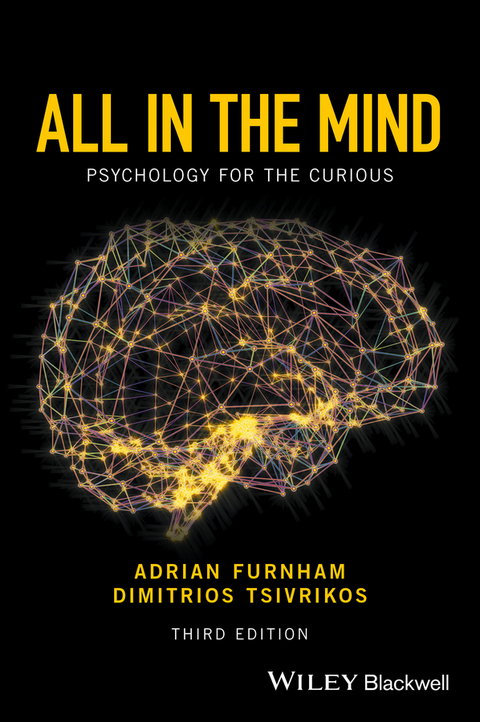
All in the Mind (eBook)
John Wiley & Sons (Verlag)
978-1-119-16166-0 (ISBN)
All in the Mind: Psychology for the Curious, Third Edition covers important, topical, and sometimes controversial subjects in the field of Psychology in an engaging alternative or supplement to traditional student textbooks. The third edition of a successful and uniquely readable textbook - includes more than two thirds brand new material, with all retained material thoroughly revised and updated. All in the Mind, 3rd Edition offers a new and engaging way to consider key theories and approaches in psychology; providing an original alternative or supplement to traditional teaching textbooks.
Adrian Furnham is Professor of Psychology at University College London, UK. He has lectured widely around the world, has held scholarships and visiting professorships at a large number of universities, and has written over 1000 scientific papers and 80 books. He is a Fellow of the British Psychological Society, and past President of the International Society for the Study of Individual Differences.
Dimitrios Tsivrikos is a Consumer and Business Psychologist at University College London, UK. His research, teaching and consultancy work specialize in Business Consumer/Branding and Occupational Psychology. He has held a number of international research fellowships and has published widely on psychology and business orientated subjects. He is a leading commentator on consumer psychology.
All in the Mind: Psychology for the Curious, Third Edition covers important, topical, and sometimes controversial subjects in the field of Psychology in an engaging alternative or supplement to traditional student textbooks. The third edition of a successful and uniquely readable textbook includes more than two thirds brand new material, with all retained material thoroughly revised and updated. All in the Mind, 3rd Edition offers a new and engaging way to consider key theories and approaches in psychology; providing an original alternative or supplement to traditional teaching textbooks.
Adrian Furnham is Professor of Psychology at University College London, UK. He has lectured widely around the world, has held scholarships and visiting professorships at a large number of universities, and has written over 1000 scientific papers and 80 books. He is a Fellow of the British Psychological Society, and past President of the International Society for the Study of Individual Differences. Dimitrios Tsivrikos is a Consumer and Business Psychologist at University College London, UK. His research, teaching and consultancy work specialize in Business Consumer/Branding and Occupational Psychology. He has held a number of international research fellowships and has published widely on psychology and business orientated subjects. He is a leading commentator on consumer psychology.
Title Page 5
Copyright Page 6
Contents 7
Chapter Descriptions 8
Preface to the Third Edition 10
Acknowledgments 11
Some Quirky Quotes About Psychology 12
Chapter 1 Introduction: Public Beliefs About Psychology 15
1.1 Introduction 15
1.2 Public Ignorance About Psychology 16
1.3 Tackling Student Skepticism About Psychology 19
Myth 1: Psychology is merely common sense 20
Myth 2: Psychology is not a real science 20
Myth 3: Psychology is not useful to society 20
Myth 4: Psychologists and psychotherapists are the same 21
Myth 5: Psychology is pretty useless – it cannot make good predictions 21
Myth 6: Psychology is pretty useless – everyone is unique, so how can it predict behavior? 22
General teaching tip 23
1.4 Psychology and Control 23
1.5 How People Get Tricked 26
How to be believable 26
How to limit and thwart the controls 26
How to perform seeming miracles 27
What to do in case something goes wrong 27
How to distort memories 28
1.6 Conclusion 28
Chapter 2 “Untangling” Myths and Psychological Realities 29
2.1 Popular Myths 29
2.2 Mind and Brain Myths 29
The brain 29
Body energy 30
Brain boosters 31
2.3 Myths about Happiness 33
2.4 Modern Myths of Popular Psychology 35
50 great myths and why they are false 36
Myths about interpersonal behavior 47
2.5 Conclusion 59
Chapter 3 The Names and Dates That Shaped Psychology’s History and Development 60
3.1 Introduction 60
3.2 The Psychology Thinkers and Their Ideas 61
Behaviorists 61
Developmentalists 63
Cognitivists 65
Emotion psychology 68
Social psychologists 68
The computationalists on intelligence 71
The biopsychologists 72
The perception psychologists 73
The personologists 75
The psychoanalysts and therapists 76
The psychopathologists 79
3.3 Conclusion 79
Chapter 4 Science, Pseudo-Science, and Conspiracy Theories 80
4.1 Introduction 80
4.2 Maxims for Distinguishing Science From Non-Science 82
Becoming a psychic or a fortune teller: 13 secrets 83
4.3 Superstition vs. Science 86
4.4 Common Sense 88
4.5 Beware the Fortune Cookie 93
4.6 Conspiracies and Cover-Ups 100
4.7 Conclusion 109
Chapter 5 The Man Called Freud 110
5.1 Knowledge of Psychoanalysis 110
5.2 Quizzes 113
5.3 The Basics 114
5.4 The Dynamics of Personality 115
5.5 The Structure of Personality 116
5.6 The Development of Personality 118
The Oedipus quiz (Osborne 1993) 120
5.7 Dreaming 123
5.8 Critiques 126
5.9 Freud and Falsifiability 131
5.10 Freud Today 132
Chapter 6 A Guide Into Abnormal Psychology 134
6.1 Introduction 134
6.2 Being Sane in an Insane Place 137
6.3 Mental Illnesses 139
Schizophrenia 139
Psychopathy 144
6.4 How Good Are You? 148
6.5 Conclusion 153
Chapter 7 Psychology and Work 154
7.1 Introduction 154
7.2 Management and Common Sense 155
7.3 Psychologists as Business Consultants 160
Diagnostic 160
Measurement 160
Instruction 161
Process 162
Systems 162
7.4 The Hawthorne Effect 163
7.5 Money, Motivation, and Happiness 166
7.6 Stress at Work 170
Theories and models 171
Three components 172
7.7 Conclusion 178
Chapter 8 Do Looks Matter? 179
8.1 Introduction 179
8.2 Defining Attractiveness 180
8.3 Are Attractive People More Intelligent? 180
Unfair, stereotypic, and warranting intervention 181
An evolutionary fact and reality 181
An association that develops 181
8.4 Why do we Find Particular Physical Characteristics Attractive? 182
8.5 What Are the Key Factors? 185
1. The waist-to-hip ratio 185
2. Body weight 187
3. Temporal and situational factors 188
4. Individual differences 189
5. Proximity and similarity 190
8.6 Physical Characteristics and Personality 192
8.7 Attractive Personalities 192
Extraversion 192
Neuroticism 194
Openness 194
Agreeableness 194
Conscientiousness 195
8.8 Attractiveness at Work 195
Beauty: general attractiveness 198
Facial attractiveness and confidence 198
Hair color 199
Weight 199
Height 200
Intelligence 200
Masculinity 200
Weight-based discrimination 200
Monetary advantages 201
Recruitment advantages 202
Promotional advantages 202
Sales advantages 202
8.9 Conclusion 203
Chapter 9 Judging and Nudging 204
9.1 Introduction 204
Cognitive dissonance 204
9.2 Cognitive Biases 206
1. Social influence and groups 207
2. Framing 208
3. Number and probability 209
4. Change 211
5. Why do we keep making excuses? 212
6. Don’t be a superstitious pigeon 213
7. Illusion or delusion? 214
8. Procrastination 215
9. Knowledge 215
10. Emotion and affection 216
9.3 Behavioral Economics 217
9.4 Conclusion 224
Chapter 10 A Psychologist in the Marketplace 225
10.1 Introduction 225
10.2 The Consumer as an Individual 226
10.3 Children and Advertising 227
10.4 Vulnerability 229
Comprehension vulnerability 229
Financial vulnerability 231
Assertiveness vulnerability 232
10.5 Consumer Decision Making 233
Reciprocity 235
Commitment and consistency 235
10.6 The Social Consumer 236
10.7 Services and Products 239
Brand identity 240
Does sex sell? 242
10.8 Ethics and Consumer Well?Being 243
Consumer well-being 243
Health risk perception 244
Self-image issues 245
Consumer activism 247
10.9 Conclusion 248
References 249
Further Reading 257
Index 273
EULA 289
| Erscheint lt. Verlag | 30.8.2016 |
|---|---|
| Sprache | englisch |
| Themenwelt | Geisteswissenschaften ► Philosophie ► Allgemeines / Lexika |
| Geisteswissenschaften ► Psychologie ► Allgemeines / Lexika | |
| Geisteswissenschaften ► Psychologie ► Allgemeine Psychologie | |
| Schlagworte | Abnormal Psychology • A-rationality • Brains • Burnout • Consumer psychology • Development of psychology • Freud • History of psychology • irrationality</p> • <p>Psychology • mental health conditions • Mental Illness • pseudo-science • Psychological Myths • psychological theorizing • psychological truths • Psychologie • Psychologiestudium • Psychology • psychology and decision making • psychology and work • Science • Stress |
| ISBN-10 | 1-119-16166-5 / 1119161665 |
| ISBN-13 | 978-1-119-16166-0 / 9781119161660 |
| Informationen gemäß Produktsicherheitsverordnung (GPSR) | |
| Haben Sie eine Frage zum Produkt? |
 PDF (Adobe DRM)
Kopierschutz: Adobe-DRM
Adobe-DRM ist ein Kopierschutz, der das eBook vor Mißbrauch schützen soll. Dabei wird das eBook bereits beim Download auf Ihre persönliche Adobe-ID autorisiert. Lesen können Sie das eBook dann nur auf den Geräten, welche ebenfalls auf Ihre Adobe-ID registriert sind.
Details zum Adobe-DRM
Dateiformat: PDF (Portable Document Format)
Mit einem festen Seitenlayout eignet sich die PDF besonders für Fachbücher mit Spalten, Tabellen und Abbildungen. Eine PDF kann auf fast allen Geräten angezeigt werden, ist aber für kleine Displays (Smartphone, eReader) nur eingeschränkt geeignet.
Systemvoraussetzungen:
PC/Mac: Mit einem PC oder Mac können Sie dieses eBook lesen. Sie benötigen eine
eReader: Dieses eBook kann mit (fast) allen eBook-Readern gelesen werden. Mit dem amazon-Kindle ist es aber nicht kompatibel.
Smartphone/Tablet: Egal ob Apple oder Android, dieses eBook können Sie lesen. Sie benötigen eine
Geräteliste und zusätzliche Hinweise
Buying eBooks from abroad
For tax law reasons we can sell eBooks just within Germany and Switzerland. Regrettably we cannot fulfill eBook-orders from other countries.
aus dem Bereich