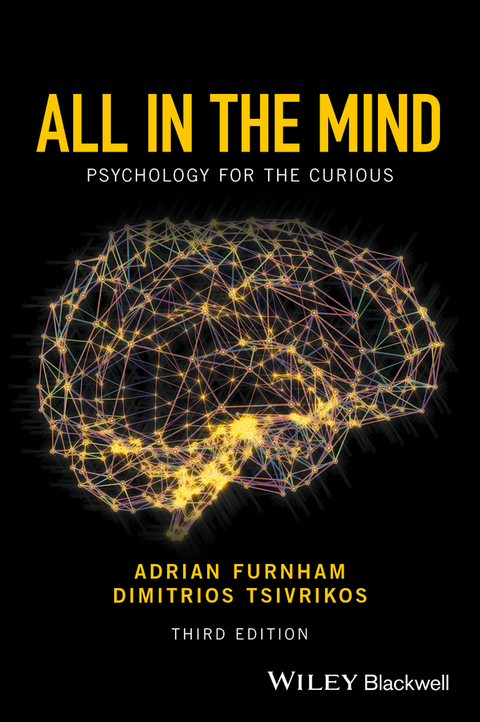
All in the Mind (eBook)
John Wiley & Sons (Verlag)
978-1-119-16167-7 (ISBN)
Adrian Furnham is Professor of Psychology at University College London, UK. He has lectured widely around the world, has held scholarships and visiting professorships at a large number of universities, and has written over 1000 scientific papers and 80 books. He is a Fellow of the British Psychological Society, and past President of the International Society for the Study of Individual Differences. Dimitrios Tsivrikos is a Consumer and Business Psychologist at University College London, UK. His research, teaching and consultancy work specialize in Business Consumer/Branding and Occupational Psychology. He has held a number of international research fellowships and has published widely on psychology and business orientated subjects. He is a leading commentator on consumer psychology.
Chapter Descriptions vi
Preface to the Third Edition viii
Acknowledgments ix
Some Quirky Quotes About Psychology x
1. Introduction: Public Beliefs About Psychology 1
2. "Untangling" Myths and Psychological Realities 15
3. The Names and Dates That Shaped Psychology's History and Development 46
4. Science, Pseudo?]Science, and Conspiracy Theories 66
5. The Man Called Freud 96
6. A Guide Into Abnormal Psychology 120
7. Psychology and Work 140
8. Do Looks Matter? 165
9. Judging and Nudging 190
10. A Psychologist in the Marketplace 211
References 235
Further Reading 243
Index 259
1
Introduction: Public Beliefs About Psychology
1.1 Introduction
Psychology is a new science – barely 140 years old. It has an official “birth date” of the 1880s in Germany. With new methods and discoveries we understand more and more about such things as how the brain operates, why people behave the way they do, and the causes of human unhappiness. In fact psychology looks as if it is on the edge of some great discoveries thanks to developments in neuroscience, statistics, and data gathering.
What people who study psychology often say is that it gives you an “aha” experience. “Aha” is the expression of surprised happiness that comes with insight. “Aha” experiences often occur when psychology can offer explanations for seemingly bizarre or irrational behavior: why people spend money when depressed; why anorexics starve themselves; why clever people make such bad decisions.
Psychology provides a rich vocabulary through which it can describe and explain behavior. Psychological terms like passive‐aggressive, obsessive‐compulsive, and self‐actualization are part of many individuals’ vocabulary.
There is a joke about “psychobabble,” which is the misuse or overuse of psychological language and concepts, but this usually occurs only in the popular press and by non‐psychologists. Some psychological theories are counterintuitive – that is, a number of the theories are not what common sense suggests. Some theories are quite commonsensical but there are also several that are not. Nevertheless, many skeptics and some cynics have continued to maintain that all the findings in psychology are really only a form of common sense.
One way to discover the reality of human nature is, according to most psychologists, through scientific experimentation and observation, but lay people do not use scientific evidence when forming their ideas about their fellows. Many believe in superstitions and old wives’ tales that have been perpetuated, but never tested, over the generations.
1.2 Public Ignorance About Psychology
It is paradoxical that, with so much media attention on psychological issues, the general public remains so ignorant about a topic. Certainly they seem unable to independently evaluate claims about many pseudo‐scientific pursuits like graphology, psychic surgery, subliminal advertising, and the like. So many myths of popular psychology are held by people despite considerable evidence to the contrary. These include: “It is better to express anger than hold it in”; “Low self‐esteem is the cause of nearly all psychological problems”; “People of opposite personality type are attracted to one another.”
Fortunately there is evidence that if people take courses in psychology they become less likely to hold myths and misconceptions and more critical and skeptical in their thinking (Kowalski & Taylor, 2009; Standing & Huber, 2003).
Many studies have looked at very specific areas to try to understand why people have so many misconceptions. Thus Aamodt (2008) looked at criminal psychology and came to the conclusion that myths were held for various specific reasons.
Figure 1.1 Possible reasons for holding myths.
There are three reasons for public ignorance:
- Media The media often favors sensationalistic rather than factual reporting of science. Further, the media has a “let all flowers bloom” and “anything goes” philosophy aimed at entertainment, not education.
- Pseudo‐science A lot of pseudo and bogus science is behind multi‐million dollar industries that depend on keeping the public poorly informed about their claims and the fact that they may have been shown to be fraudulent.
- Psychologists When appearing in the media, they are persuaded to favor “sexy soundbites” rather than useful explanations. If they insist on the latter they tend to be edited out of the transmission.
Thus the lay person is presented with confused, contradictory, exaggerated, incomplete, and naïve findings and theories. It is no wonder that some believe that psychology is either just common sense or a matter of opinion.
Stop a hundred people in the street and ask them to name all the psychologists they have ever heard of. The likelihood is that 90% will nominate Freud and about a third Jung. Asked if they can name a living psychologist, only about 5% probably can. This galls modern psychologists because although many are impressed by Freud’s insights, intuition, and learning, they see little development in psychoanalysis and are skeptical about total reliance on clinical interviews. More importantly, many have no truck with the pretentiousness of a field that shuns empirical disconfirmation.
Many people cannot distinguish between a psychologist, a psychiatrist, a psychoanalyst or a psychiatric social worker. Some use the work “shrink” or “head doctor” or even “psycho‐the‐rapist” (Gadon & Johnson, 2009).
Psychology is an amazingly diverse discipline. So diverse that any two psychologists have almost nothing in common. Psychology is an archipelago, not an island. And some think it is drifting apart near to collapse.
Developmental psychologists may join educational departments; social and organizational psychologists may be happier in business schools; physiological psychologists could happily work in a biology department; and even clinical psychologists could be embraced by psychiatrists. This makes things difficult for the lay person, who often thinks psychology is little more than clinical psychology or a discipline whose primary aim is to help people.
Many disciplines study human behavior – sociology, economics, anthropology, history, and so forth – but what makes psychology unique is its scope and methodology. Psychology studies the full range of human (and non‐human) behavior from the micro to the macro level.
Second, psychologists use scientific methodology to test their theories. It is the data‐based scientific study of behavior (see Figure 1.1). It is a young science and the record of progress is mixed. As Stanovich (1998, p. 21) notes, psychology is an immensely diverse discipline covering a range of subjects that are not tied together by common content. Instead, what unifies the discipline is that it uses scientific methods to understand behavior. The scientific method is not a strict set of rules; instead it is defined by some very general principles. Three of the most important are shown in Figure 1.2.
Figure 1.2 General principles of science.
Psychology still has an image problem for various reasons (Stanovich, 1998). These include:
- Guilt by association. Because psychologists have been interested in testing claims in various pseudo‐sciences (clairvoyance, psychic surgery), psychology has been associated with them! Psychologists are in a trap: If they refuse to investigate certain problems for fear of being confused with them, they are not true scientists. But if they research issues dispassionately and show pseudo‐scientists to be writing nonsense, this association may be seen as confirmation that psychology itself is a pseudo‐science.
- Self‐help books that commercialize psychotherapy create an inaccurate impression of the aims, methods, and knowledge in psychology. These books are characterized by unrepresentative but vivid case studies, endorsements, and miraculous personal testimonies. Further, they propagate “recipe” knowledge – they show how to follow various steps without explaining why they should work.
- Media psychologists are self‐selected, have a poor reputation with academic peers, and respond to the media’s love of news, drama, and certainty as opposed to fact. Further, whereas television, radio, and quality newspapers have trained writers in the fields of physics, economics, and medicine, they do not employ trained psychologists. Again, psychologists are often trapped: When they refuse or fail to give glib, simplistic answers to complex problems, they are criticized and devalued, but if they do give such answers they are often misleading.
- The terms “psychologist” and “psychology” are often very loosely used. Often the work of physiological psychologists is mistaken for biology; cognitive psychology for computer science or ergonomics; and health psychology for medicine. Thus, in the eyes of the public, psychology is reduced to counseling and clinical psychology.
- Unscientific attitudes within psychology itself. Psychologists can also rightly be accused of unprofessional behavior and unclear thinking. Further, professional organizations are much more concerned with chartering and licensing than with scientific behaviors. They look more like trade unions than scientific societies. Thus rigorous scientific psychologists and pseudo‐scientific speculative commentators sit side by side.
- Everybody is a psychologist. Some believe they have a special, more profound, and perceptive insight into human nature.
- Finally, some people imply that psychology diminishes or dehumanizes psychology. This is a moral or metaphysical objection based on the idea that trying to uncover fundamental mechanisms and processes...
| Erscheint lt. Verlag | 30.8.2016 |
|---|---|
| Sprache | englisch |
| Themenwelt | Geisteswissenschaften ► Philosophie ► Allgemeines / Lexika |
| Geisteswissenschaften ► Psychologie ► Allgemeines / Lexika | |
| Geisteswissenschaften ► Psychologie ► Allgemeine Psychologie | |
| Schlagworte | Abnormal Psychology • A-rationality • Brains • Burnout • Consumer psychology • Development of psychology • Freud • History of psychology • irrationality</p> • <p>Psychology • mental health conditions • Mental Illness • pseudo-science • Psychological Myths • psychological theorizing • psychological truths • Psychologie • Psychologiestudium • Psychology • psychology and decision making • psychology and work • Science • Stress |
| ISBN-10 | 1-119-16167-3 / 1119161673 |
| ISBN-13 | 978-1-119-16167-7 / 9781119161677 |
| Informationen gemäß Produktsicherheitsverordnung (GPSR) | |
| Haben Sie eine Frage zum Produkt? |
 EPUB (Adobe DRM)
Kopierschutz: Adobe-DRM
Adobe-DRM ist ein Kopierschutz, der das eBook vor Mißbrauch schützen soll. Dabei wird das eBook bereits beim Download auf Ihre persönliche Adobe-ID autorisiert. Lesen können Sie das eBook dann nur auf den Geräten, welche ebenfalls auf Ihre Adobe-ID registriert sind.
Details zum Adobe-DRM
Dateiformat: EPUB (Electronic Publication)
EPUB ist ein offener Standard für eBooks und eignet sich besonders zur Darstellung von Belletristik und Sachbüchern. Der Fließtext wird dynamisch an die Display- und Schriftgröße angepasst. Auch für mobile Lesegeräte ist EPUB daher gut geeignet.
Systemvoraussetzungen:
PC/Mac: Mit einem PC oder Mac können Sie dieses eBook lesen. Sie benötigen eine
eReader: Dieses eBook kann mit (fast) allen eBook-Readern gelesen werden. Mit dem amazon-Kindle ist es aber nicht kompatibel.
Smartphone/Tablet: Egal ob Apple oder Android, dieses eBook können Sie lesen. Sie benötigen eine
Geräteliste und zusätzliche Hinweise
Buying eBooks from abroad
For tax law reasons we can sell eBooks just within Germany and Switzerland. Regrettably we cannot fulfill eBook-orders from other countries.
aus dem Bereich