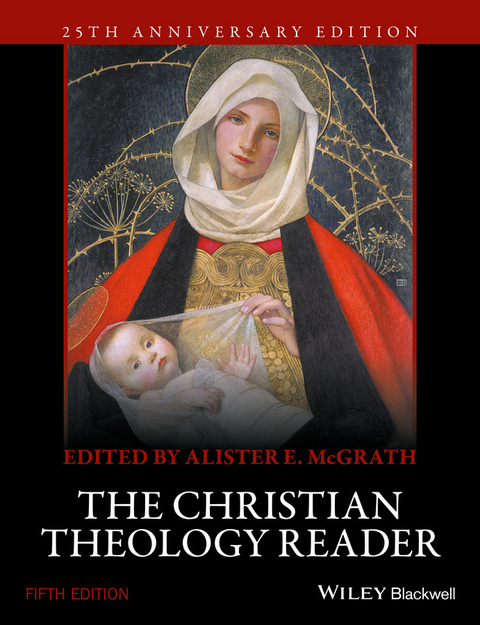
The Christian Theology Reader (eBook)
John Wiley & Sons (Verlag)
978-1-118-87436-3 (ISBN)
Regarded as the leading text in Christian theology for the last 25 years, Alister E. McGrath's The Christian Theology Reader is now available in a new 5th edition featuring completely revised and updated content.
- Brings together more than 350 readings from over 200 sources that chart 2,000 years of Christian history
- Situates each reading within the appropriate historical and theological context with its own introduction, commentary, and study questions
- Includes new readings on world Christianity and feminist, liberation, and postcolonial theologies, as well as more selections by female theologians and theologians from the developing world
- Contains additional pedagogical features, such as new discussion questions and case studies, and a robust website with new videos by the author to aid student learning
- Designed to function as a stand-alone volume, or as a companion to Christian Theology: An Introduction, 6th edition, for a complete overview of the subject
Alister E. McGrath is Andreas Idreos Professor of Science and Religion at Oxford University, UK. He is regarded as one of the world's leading theologians and is the author of some of the world's most widely used theological textbooks, including the bestselling Christian Theology: An Introduction (Wiley Blackwell, 2016), now in its sixth edition. He is in constant demand as a speaker at conferences throughout the world. In addition to major academic works and textbooks, he is the author of the highly acclaimed award winning biography, C. S. Lewis: A Life (2013), and The Big Question: Why Can't We Stop Talking about Science, Faith, and God (2015), nominated by Library Journal as one of the best religious books of 2015.
Regarded as the leading text in Christian theology for the last 25 years, Alister E. McGrath s The Christian Theology Reader is now available in a new 5th edition featuring completely revised and updated content. Brings together more than 350 readings from over 200 sources that chart 2,000 years of Christian history Situates each reading within the appropriate historical and theological context with its own introduction, commentary, and study questions Includes new readings on world Christianity and feminist, liberation, and postcolonial theologies, as well as more selections by female theologians and theologians from the developing world Contains additional pedagogical features, such as new discussion questions and case studies, and a robust website with new videos by the author to aid student learning Designed to function as a stand-alone volume, or as a companion to Christian Theology: An Introduction, 6th edition, for a complete overview of the subject
Alister E. McGrath is Andreas Idreos Professor of Science and Religion at Oxford University, UK. He is regarded as one of the world's leading theologians and is the author of some of the world's most widely used theological textbooks, including the bestselling Christian Theology: An Introduction (Wiley Blackwell, 2016), now in its sixth edition. He is in constant demand as a speaker at conferences throughout the world. In addition to major academic works and textbooks, he is the author of the highly acclaimed award winning biography, C. S. Lewis: A Life (2013), and The Big Question: Why Can't We Stop Talking about Science, Faith, and God (2015), nominated by Library Journal as one of the best religious books of 2015.
The Christian Theology Reader 1
Contents 7
Preface 17
Approaching the Readings 19
To the Student: How to Use This Book 21
To the Teacher: How to Use This Book 23
Video Resources for This Textbook 25
The Development of Christian Theology: An Historical Overview 27
Acknowledgments 33
1: Getting Started: Preliminaries 35
Introduction 36
1 Can God’s existence be proved? 36
2 The relationship between faith and reason 37
3 The patristic debates over the relationships between culture, philosophy, and theology 37
4 The status of theological language 38
5 The nature of dogma 38
1.1 Justin Martyr on Philosophy and Theology 39
1.2 Clement of Alexandria on Philosophy and Theology 40
1.3 Tertullian on the Relationship between Philosophy and Heresy 41
1.4 Augustine of Hippo on Philosophy and Theology 43
1.5 The Nicene Creed 44
1.6 The Apostles’ Creed 46
1.7 Anselm of Canterbury’s Proof for the Existence of God 47
1.8 Gaunilo’s Reply to Anselm’s Argument 48
1.9 Thomas Aquinas on Proofs for the Existence of God 50
1.10 Thomas Aquinas on the Principle of Analogy 53
1.11 William of Ockham on Proofs for the Existence of God 55
1.12 Martin Luther on the Theology of the Cross 57
1.13 John Calvin on the Nature of Faith 58
1.14 The Heidelberg Catechism on Images of God 60
1.15 John Locke on the Formation of the Concept of God 61
1.16 René Descartes on the Existence of God 62
1.17 Blaise Pascal on Proofs for the Existence of God 63
1.18 Blaise Pascal on the Hiddenness of God 65
1.19 Immanuel Kant on Anselm’s Ontological Argument 66
1.20 Søren Kierkegaard on the Subjectivity of Truth 67
1.21 The First Vatican Council on Faith and Reason 68
1.22 John Henry Newman on the Grounds of Faith 70
1.23 Adolf von Harnack on the Origins of Dogma 72
1.24 Karl Barth on the Nature and Task of Theology 73
1.25 Ludwig Wittgenstein on Analogy 75
1.26 Ludwig Wittgenstein on Proofs for the Existence of God 76
1.27 Vladimir Lossky on Apophatic Approaches to Theology 77
1.28 Dietrich Bonhoeffer on God in a Secular World 79
1.29 Paul Tillich on the Method of Correlation 81
1.30 Ian T. Ramsey on the Language of Christian Doctrine 83
1.31 Sallie McFague on Metaphor in Theology 84
1.32 Gustavo Gutiérrez on Theology as Critical Reflection 86
1.33 Brian A. Gerrish on Accommodation in Calvin’s Theology 88
1.34 George Lindbeck on Postliberal Approaches to Doctrine 89
1.35 Dumitru Stãniloae on the Nature of Dogma 92
1.36 Kevin Vanhoozer on the Challenge of Postmodernity for Theology 94
1.37 John Polkinghorne on Motivated Belief in Theology 96
1.38 Pope Francis on Faith and Truth in Theology and the Church 98
For Further Reading 100
2: The Sources of Theology 101
Introduction 102
1 The authority of the Bible 102
2 The interpretation of the Bible 103
3 The relationship between tradition and the Bible 103
4 The nature of revelation 104
5 Revelation in nature 104
2.1 Melito of Sardis on Typology and Old Testament Interpretation 105
2.2 Irenaeus of Lyons on the Role of Tradition 107
2.3 Hippolytus on Typological Interpretation of Scripture 108
2.4 Clement of Alexandria on the Fourfold Interpretation of Scripture 109
2.5 Tertullian on Tradition and Apostolic Succession 110
2.6 Origen on the Three Ways of Reading Scripture 111
2.7 Cyril of Jerusalem on the Role of Creeds 112
2.8 Augustine of Hippo on the Literal and Allegorical Senses of Scripture 113
2.9 Jerome on the Role of Scripture 114
2.10 Vincent of Lérins on the Role of Tradition 116
2.11 Bernard of Clairvaux on the Allegorical Sense of Scripture 117
2.12 Stephen Langton on the Moral Sense of Scripture 118
2.13 Ludolf of Saxony on Reading Scripture Imaginatively 119
2.14 Jacques Lefèvre d’Etaples on the Senses of Scripture 120
2.15 Martin Luther on the Fourfold Sense of Scripture 122
2.16 Martin Luther on Revelation in Christ 123
2.17 John Calvin on the Natural Knowledge of God 125
2.18 John Calvin on the Relationship Between the Old and New Testaments 126
2.19 The Council of Trent on Scripture and Tradition 127
2.20 The Gallic Confession on the Canon of Scripture 128
2.21 The Belgic Confession on the Book of Nature 130
2.22 Melchior Cano on the Church as an Interpreter of Scripture 131
2.23 The Formula of Concord on Scripture and the Theologians 132
2.24 Robert Bellarmine on Protestant Biblical Interpretation 133
2.25 The King James Translators on Biblical Translation 134
2.26 Sir Thomas Browne on the Two Books of Revelation 136
2.27 Francis White on Scripture and Tradition 138
2.28 Jonathan Edwards on the Beauty of Creation 139
2.29 William Paley on the Wisdom of the Creation 140
2.30 Johann Adam Möhler on Living Tradition 142
2.31 John Henry Newman on the Role of Tradition 144
2.32 Charles Hodge on the Inspiration of Scripture 147
2.33 Gerard Manley Hopkins on God’s Grandeur in Nature 148
2.34 Charles Gore on the Relationship Between Dogma and the New Testament 149
2.35 James Orr on the Centrality of Revelation for Christianity 151
2.36 Wilhelm Herrmann on the Nature of Revelation 152
2.37 Karl Barth on Revelation as God’s Self-Disclosure 155
2.38 Emil Brunner on the Personal Nature of Revelation 157
2.39 Rudolf Bultmann on Demythologization and Biblical Interpretation 158
2.40 Pope Pius XII on the Authority of the Vulgate Translation of the Bible 160
2.41 Austin Farrer on Demythologization, History, and Biblical Interpretation 161
2.42 Gerhard Von Rad on Typology and Biblical Interpretation 163
2.43 Karl Rahner on the Authority of Scripture 165
2.44 Brevard S. Childs on the Canonical Interpretation of Scripture 167
2.45 Phyllis Trible on Feminist Biblical Interpretation 168
2.46 John Meyendorff on Living Tradition 171
2.47 James I. Packer on the Nature of Revelation 172
2.48 Thomas F. Torrance on Karl Barth’s Criticism of Natural Theology 174
2.49 The Catechism of the Catholic Church on Scripture and Tradition 177
2.50 N. T. Wright on the Authority of Biblical Narratives 179
2.51 Alister E. McGrath on a Christian Approach to Natural?Theology 181
For Further Reading 182
3: The Doctrine of God 184
Introduction 185
1 The doctrine of the Trinity 185
2 Can God suffer 186
3 God and evil 186
4 The Holy Spirit 187
5 The “maleness” of God? 187
3.1 Athenagoras of Athens on the Christian God 189
3.2 Irenaeus of Lyons on the Origin of Evil 190
3.3 Irenaeus of Lyons on the Trinity 191
3.4 Tertullian on Creation from Preexistent Matter 192
3.5 Origen on Creation from Preexistent Matter 193
3.6 Origen on the Relationship Between God and Evil 194
3.7 Gregory of Nyssa on Human Analogies of the Trinity 195
3.8 Basil of Caesarea on the Work of the Holy Spirit 197
3.9 Gregory of Nazianzus on the Gradual Revelation of the Trinity 199
3.10 Athanasius of Alexandria on the Holy Spirit and the Trinity 200
3.11 Hilary of Poitiers on the Trinity 201
3.12 Augustine of Hippo on the Trinity 202
3.13 Augustine of Hippo on the Relationship Between God and Evil 206
3.14 Epiphanius of Constantia on Sabellianism 207
3.15 Cyril of Alexandria on the Role of the Holy Spirit 208
3.16 John of Damascus on the Holy Spirit 209
3.17 The Eleventh Council of Toledo on the Trinity 210
3.18 Anselm of Canterbury on the Compassion of God 211
3.19 Richard of St. Victor on Love within the Trinity 212
3.20 Alexander of Hales on the Suffering of God in Christ 214
3.21 Thomas Aquinas on Divine Omnipotence 215
3.22 Bonaventure of Bagnoregio on the Origin of Evil 216
3.23 Julian of Norwich on God as Our Mother 217
3.24 William of Ockham on the Two Powers of God 218
3.25 Thomas à Kempis on the Limits of Trinitarian Speculation 219
3.26 John Calvin on the Providence of God 220
3.27 Benedict Spinoza on the Impassibility of God 222
3.28 F. D. E. Schleiermacher on the Trinity 223
3.29 Karl Barth on the “Otherness” of God 224
3.30 Jürgen Moltmann on the Suffering of God 225
3.31 Hans Urs Von Balthasar on the Glory of God 227
3.32 Leonardo Boff on the Trinity as Good News for the Poor 229
3.33 Robert Jenson on the Trinity 231
3.34 Hans Küng on the Immutability of God 234
3.35 Eberhard Jüngel on the Crucified God 236
3.36 Jacques Ellul on the Theology of Icons 237
3.37 Walter Kasper on the Rationality of the Trinity 239
3.38 Paul Jewett on Noninclusive Language and the Trinity 241
3.39 John Milbank on the Trinity in a Postmodern Age 243
3.40 Elizabeth A. Johnson on Male and Female Images of God 245
3.41 Anne Carr on Feminism and the Maleness of God 247
3.42 Sarah Coakley on Social Models of the Trinity 249
3.43 David Bentley Hart on God and Evil 251
For Further Reading 253
4: The Person of Christ 255
Introduction 256
1 Patristic debates about the identity of Christ 257
2 Faith and history: the quest for the “historical Jesus” 257
3 The concept of the incarnation 258
4.1 Ignatius of Antioch on Docetism 259
4.2 Irenaeus of Lyons on Gnosticism in Christology 260
4.3 Tertullian on Patripassianism 261
4.4 Tertullian on the Incarnation 261
4.5 Novatian on the Divinity of Christ 263
4.6 Origen on the Two Natures of Christ 264
4.7 Arius on the Status of Christ 265
4.8 Athanasius of Alexandria on the Two Natures of Christ 266
4.9 Apollinarius of Laodicea on the Person of Christ 267
4.10 Gregory of Nazianzus on Apollinarianism 268
4.11 Theodore of Mopsuestia on the “Union of Good Pleasure” 269
4.12 Nestorius on the Term Theotokos 270
4.13 Cyril of Alexandria on the Incarnation 272
4.14 Pope Leo the Great on the Two Natures of Christ 273
4.15 The Chalcedonian Definition of the Christian Faith 275
4.16 John of Damascus on the Incarnation and Icons 277
4.17 Honorius of Autun on the Cause of the Incarnation 278
4.18 Thomas Aquinas on the Necessity of the Incarnation 279
4.19 Gregory Palamas on the Divine Condescension in the Incarnation 280
4.20 Martin Luther’s Critique of Nestorianism 281
4.21 François Turrettini on the Threefold Office of Christ 283
4.22 Gotthold Ephraim Lessing on the Ditch of History 284
4.23 F. D. E. Schleiermacher on the “Natural Heresies” of Christianity 286
4.24 Martin Kähler on the Historical Jesus 288
4.25 George Tyrrell on the Christ of Liberal Protestantism 291
4.26 Albert Schweitzer on the Failure of the “Quest of the Historical Jesus” 293
4.27 G. K. Chesterton on the Incarnation, Myth, and Reason 294
4.28 P. T. Forsyth on the Person of Christ 296
4.29 Dorothy L. Sayers on Christology and Dogma 297
4.30 Paul Tillich on the Dispensability of the Historical Jesus 298
4.31 Wolfhart Pannenberg on the Indispensability of the Historical Jesus 300
4.32 Thomas F. Torrance on the Incarnation and Soteriology 302
4.33 Rosemary Radford Ruether on the Maleness of Christ 304
4.34 Morna D. Hooker on Chalcedon and the New Testament 307
4.35 N. T. Wright on History and Christology 309
4.36 Janet Martin Soskice on Christ’s Significance for Women 312
For Further Reading 314
5: Salvation in Christ 315
Introduction 316
1 The relationship between Christology and soteriology 316
2 Models of atonement 317
3 Violence and atonement 317
5.1 Irenaeus of Lyons on the “Ransom” Theory of the Atonement 319
5.2 Irenaeus of Lyons on “Recapitulation” in Christ 320
5.3 Clement of Alexandria on Christ’s Death as an Example of Love 321
5.4 Athanasius of Alexandria on the Death of Christ 322
5.5 Athanasius of Alexandria on the Relationship Between Christology and Soteriology 323
5.6 Pseudo-Hippolytus on the Cosmic Dimensions of the Cross 324
5.7 Rufinus of Aquileia on the “Fish-Hook” Theory of the Atonement 325
5.8 An Ancient Liturgy on Christ’s Descent into Hell 325
5.9 Theodoret of Cyrrhus on the Death of Christ 326
5.10 Augustine of Hippo on Redemption in Christ 327
5.11 Maximus the Confessor on the Economy of Salvation 328
5.12 Simeon the New Theologian on Salvation as Deification 330
5.13 Anselm of Canterbury on the Atonement 330
5.14 Peter Abelard on the Love of Christ in Redemption 333
5.15 Hugh of St. Victor on the Death of Christ 334
5.16 Rupert of Deutz on the Incarnation as God’s Response to Sin 335
5.17 Thomas Aquinas on the Satisfaction of Christ 336
5.18 Nicolas Cabasilas on the Death of Christ 337
5.19 John Calvin on the Grounds of Redemption 338
5.20 The Socinian Critique of the Idea of Satisfaction 339
5.21 John Donne on the Work of Christ 341
5.22 George Herbert on the Death of Christ and Redemption 342
5.23 Charles Wesley on Salvation in Christ 342
5.24 F. D. E. Schleiermacher on Christ as a Charismatic Leader 343
5.25 F. D. E. Schleiermacher on Christology and Soteriology 346
5.26 Charles Gore on the Relationship Between Christology and Soteriology 347
5.27 Hastings Rashdall on Christ as a Moral Example 348
5.28 Gustaf Aulén on the Classic Theory of the Atonement 350
5.29 Vladimir Lossky on Redemption as Deification 353
5.30 Bernard Lonergan on the Intelligibility of Redemption 354
5.31 Wolfhart Pannenberg on Soteriological Approaches to Christology 356
5.32 James I. Packer on Penal Substitution 358
5.33 Dorothee Sölle on Suffering and Redemption 359
5.34 Colin E. Gunton on the Language of Atonement 361
5.35 The Catechism of the Catholic Church on the Sacrifice of Christ 363
5.36 Miroslav Volf on the Cross of Christ and Human Violence 364
5.37 Rosemary Radford Ruether on Suffering and Redemption 366
5.38 J. Denny Weaver on Violence in Traditional Approaches to the Atonement 368
For Further Reading 370
6: Human Nature, Sin, and Grace 372
Introduction 373
1 Created in the “image of God” 373
2 The origin and nature of sin 374
3 The Pelagian controversy 374
4 The Reformation debates over grace 375
5 Debates over predestination 375
6.1 Irenaeus of Lyons on Human Progress 376
6.2 Tertullian on Inherited Guilt 376
6.3 Origen on the Image of God 377
6.4 Lactantius on Political Aspects of the Image of God 378
6.5 Ambrose on the Unmerited Character of Salvation 379
6.6 Ambrosiaster on Original Sin 380
6.7 Gregory of Nyssa on Human Longing for God 381
6.8 Augustine of Hippo on the Nature of Predestination 382
6.9 Augustine of Hippo on Fallen Human Nature 383
6.10 Pelagius on Human Responsibility 384
6.11 Pelagius on Human Freedom 385
6.12 The Council of Carthage on Grace 386
6.13 The Second Council of Orange on Grace and Freedom 387
6.14 Hildegard of Bingen on the Creation of Man and Woman 389
6.15 Alan of Lille on Penitence as a Cause of Grace 390
6.16 Francis of Assisi on the Creation 391
6.17 Thomas Aquinas on the Nature of Grace 392
6.18 Mechthild of Magdeburg on Humanity’s Longing for God 394
6.19 Duns Scotus on the Immaculate Conception of Mary 395
6.20 Gregory of Rimini on Predestination 396
6.21 Gabriel Biel on Merit and Justification 396
6.22 Giovanni Pico Della Mirandola on Human Nature 398
6.23 Martin Luther on Justifying Faith 399
6.24 Martin Luther on Sin and Grace 400
6.25 Philip Melanchthon on Justification by Faith 402
6.26 John Calvin on Predestination 403
6.27 John Calvin on the Concept of Justification 405
6.28 The Council of Trent on Justification 406
6.29 Theodore Beza on the Causes of Predestination 406
6.30 John Donne on the Bondage of the Human Will 408
6.31 The Westminster Confession of Faith on Predestination 409
6.32 Jonathan Edwards on Original Sin 409
6.33 John Wesley on Justification 411
6.34 John Henry Newman on Original Sin 412
6.35 Karl Barth on Election in Christ 414
6.36 Emil Brunner on Barth’s Doctrine of Election 416
6.37 Reinhold Niebuhr on Original Sin 417
6.38 Valerie C. Saiving on Feminist Approaches to Sin 419
6.39 The Second Vatican Council on Human Nature 421
6.40 Mary Hayter on Human Sexuality and the Image of God 423
6.41 Pope Benedict XVI on the Identity of Humanity 426
For Further Reading 428
7: The Church 429
Introduction 430
1 What does it mean to say that the church is “holy”? 430
2 What does it mean to say that the church is “catholic”? 430
3 The relationship between church and state 431
4 Clergy and laity in the church 431
7.1 Irenaeus of Lyons on the Function of the Church 433
7.2 Origen on the Church and Salvation 433
7.3 Cyprian of Carthage on the Unity of the Church 434
7.4 Cyril of Jerusalem on the Catholicity of the Church 436
7.5 Petilian of Cirta on the Purity of Ministers 437
7.6 Augustine of Hippo on the Mixed Nature of the Church 438
7.7 Pope Leo the Great on Ministry within the Church 439
7.8 Pope Innocent III on the Church and State 440
7.9 Thomas Aquinas on the Catholicity of the Church 440
7.10 Pope Boniface VIII on Papal Primacy 441
7.11 Jan Hus on the Church 443
7.12 Martin Luther on the Marks of the Church 444
7.13 Martin Luther on Priests and Laity 446
7.14 Philip Melanchthon on the Nature of Catholicity 447
7.15 Sebastian Franck on the True Church 448
7.16 The First Helvetic Confession on the Nature of the Church 449
7.17 John Calvin on the Marks of the Church 450
7.18 Richard Hooker on the Purity of the Church 451
7.19 The Westminster Confession of Faith on the Church 452
7.20 Roger Williams on the Separation of the Church from the World 453
7.21 F. D. E. Schleiermacher on the Church as a Fellowship of Believers 454
7.22 The First Vatican Council on Papal Primacy in the Church 456
7.23 Henry Barclay Swete on the Apostolicity of the Church 458
7.24 The Barmen Confession on the Identity of the Church 461
7.25 Stephen Charles Neill on Holiness and the Mission of the Church 462
7.26 Yves Congar on the Hierarchy of the Church 463
7.27 The Second Vatican Council on the Nature of the Church 465
7.28 John D. Zizioulas on Local and Universal Churches 467
7.29 Avery Dulles on the Meanings of “Catholicity” 468
7.30 Stanley Hauerwas on the Church and the Story of Faith 469
7.31 George Dragas on the Orthodox Concept of the Church 471
7.32 Pope John Paul II on the Laity and Mission 472
7.33 John Webster on the Church and the Gospel 474
For Further Reading 476
8: The Sacraments 477
Introduction 478
1 What is a sacrament? 478
2 The purpose and place of baptism 479
3 The nature of the real presence 479
8.1 Clement of Alexandria on Faith as Feeding on Christ 481
8.2 Tertullian on the Significance of Water in Baptism 481
8.3 Cyprian of Carthage on Heretical Baptism 483
8.4 Cyril of Jerusalem on the Meaning of Baptism 483
8.5 Cyril of Jerusalem on the Body and Blood of Christ 485
8.6 Hilary of Poitiers on the Effects of Baptism 485
8.7 Gregory of Nazianzus on the Symbolism of Baptism 486
8.8 Augustine of Hippo on Donatist Approaches to the Sacraments 487
8.9 Augustine of Hippo on the “Right to Baptize” 488
8.10 John of Damascus on the Holy Spirit and the Eucharist 489
8.11 Paschasius Radbertus on the Real Presence 490
8.12 Ratramnus of Corbie on the Real Presence 491
8.13 Candidus of Fulda on “This is My Body” 492
8.14 Lanfranc of Bec on the Mystery of the Sacraments 493
8.15 Hugh of St. Victor on the Definition of a Sacrament 494
8.16 Peter Lombard on the Definition of a Sacrament 495
8.17 The Fourth Lateran Council on Baptism and the Eucharist 496
8.18 Thomas Aquinas on Transubstantiation 498
8.19 Martin Luther on the Doctrine of Transubstantiation 499
8.20 Martin Luther on the Bread and Wine as a Testament 500
8.21 Huldrych Zwingli on “This is My Body” 502
8.22 Huldrych Zwingli on the Nature of Sacraments 504
8.23 John Calvin on the Nature of Sacraments 506
8.24 The Council of Trent on Transubstantiation 507
8.25 John Wesley on the Eucharist and Salvation 508
8.26 John Henry Newman on Infant Baptism 509
8.27 The Second Vatican Council on the Eucharist 511
8.28 Edward Schillebeeckx on the Real Presence 513
8.29 The World Council of Churches on Baptism 515
8.30 Alexander Schmemann on the Eucharist 517
8.31 Rowan Williams on the Nature of a Sacrament 519
8.32 Pope John Paul II on the Eucharist as a Sign of Hope 521
For Further Reading 522
9: Christianity and Other Religions 524
Introduction 525
9.1 Justin Martyr on Christianity and Judaism 527
9.2 Ludwig Feuerbach on the Human Origins of Religion 528
9.3 Karl Marx on Feuerbach’s Views on Religion 529
9.4 Karl Barth on Christianity and Religion 530
9.5 C. S. Lewis on Myth in Christianity and Other Faiths 532
9.6 Karl Rahner on Christianity and the Non-Christian Religions 534
9.7 The Second Vatican Council on Non-Christian Religions 537
9.8 Clark Pinnock on Pluralists and Christology 540
9.9 John Hick on Complementary Pluralism 543
9.10 John B. Cobb Jr. on Religious Pluralism 547
9.11 Lesslie Newbigin on the Gospel in a Pluralist Culture 550
9.12 Gavin D’Costa on the Self-Contradictions of Pluralism 553
9.13 Herbert Mccabe on Christianity and the Abolition of the Gods 556
9.14 David Ford on Scriptural Reasoning and Interreligious Dialogue 557
9.15 Pope Francis on Evangelism and Interreligious Dialogue 560
For Further Reading 562
10: The Last Things 563
Introduction 564
1 The Christian hope 564
2 The nature of the resurrection body 564
3 Purgatory 565
10.1 Irenaeus of Lyons on the Final Restoration of Creation 566
10.2 Theophilus of Antioch on Conditional Immortality 567
10.3 Tertullian on Hell and Heaven 568
10.4 Tertullian on the Millennium 568
10.5 Origen on the Resurrection Body 569
10.6 Cyprian of Carthage on Paradise as the Christian Homeland 570
10.7 Methodius of Olympus on the Resurrection 571
10.8 Cyril of Jerusalem on Prayers for the Dead 572
10.9 Gregory of Nyssa on the Resurrection Body 573
10.10 John Chrysostom on Prayers for the Dead 574
10.11 Augustine of Hippo on the Christian Hope 574
10.12 Gregory the Great on Purgatory 575
10.13 Peter Lombard on the Appearance of Humanity in Heaven 576
10.14 Pope Benedict XII on Seeing God in Heaven 577
10.15 Catherine of Genoa on Purgatory 578
10.16 John Donne on the Resurrection 579
10.17 Jeremy Taylor on Death and Heaven 580
10.18 Jonathan Edwards on the Reality of Hell 581
10.19 John Wesley on Universal Restoration 583
10.20 C. S. Lewis on the Hope of Heaven 584
10.21 Rudolf Bultmann on the Existential Interpretation of Eschatology 586
10.22 Helmut Thielicke on Ethics and Eschatology 588
10.23 Richard Bauckham on Jürgen Moltmann’s Eschatology 590
10.24 Hans Urs Von Balthasar on Hell 592
10.25 The Catechism of the Catholic Church on Heaven 593
10.26 Kathryn Tanner on Eternal Life 595
For Further Reading 597
A Glossary of Theological Terms 599
Sources of Readings 606
For Further Study: Additional Collections of Readings 617
Index 619
End User License Agreement 629
The Christian Theology Reader is an indispensable resource for teachers and students in the study of the Christian faith. Best used with Christian Theology: An Introduction. Ideal in both theological schools and departments of religion."
Noel Leo Erskine, Candler School of Theology, Emory University
| Erscheint lt. Verlag | 4.8.2016 |
|---|---|
| Sprache | englisch |
| Themenwelt | Religion / Theologie ► Christentum ► Kirchengeschichte |
| Schlagworte | Christian Church • Christian History • Christianity • contemporary theology • doctrine</p> • Grace • Human nature • <p>Salvation • Religion & Theology • Religion u. Theologie • Sacraments • Sin • theologians • Theologie • Theology • World Religion |
| ISBN-10 | 1-118-87436-6 / 1118874366 |
| ISBN-13 | 978-1-118-87436-3 / 9781118874363 |
| Informationen gemäß Produktsicherheitsverordnung (GPSR) | |
| Haben Sie eine Frage zum Produkt? |
 PDF (Adobe DRM)
Kopierschutz: Adobe-DRM
Adobe-DRM ist ein Kopierschutz, der das eBook vor Mißbrauch schützen soll. Dabei wird das eBook bereits beim Download auf Ihre persönliche Adobe-ID autorisiert. Lesen können Sie das eBook dann nur auf den Geräten, welche ebenfalls auf Ihre Adobe-ID registriert sind.
Details zum Adobe-DRM
Dateiformat: PDF (Portable Document Format)
Mit einem festen Seitenlayout eignet sich die PDF besonders für Fachbücher mit Spalten, Tabellen und Abbildungen. Eine PDF kann auf fast allen Geräten angezeigt werden, ist aber für kleine Displays (Smartphone, eReader) nur eingeschränkt geeignet.
Systemvoraussetzungen:
PC/Mac: Mit einem PC oder Mac können Sie dieses eBook lesen. Sie benötigen eine
eReader: Dieses eBook kann mit (fast) allen eBook-Readern gelesen werden. Mit dem amazon-Kindle ist es aber nicht kompatibel.
Smartphone/Tablet: Egal ob Apple oder Android, dieses eBook können Sie lesen. Sie benötigen eine
Geräteliste und zusätzliche Hinweise
Buying eBooks from abroad
For tax law reasons we can sell eBooks just within Germany and Switzerland. Regrettably we cannot fulfill eBook-orders from other countries.
aus dem Bereich