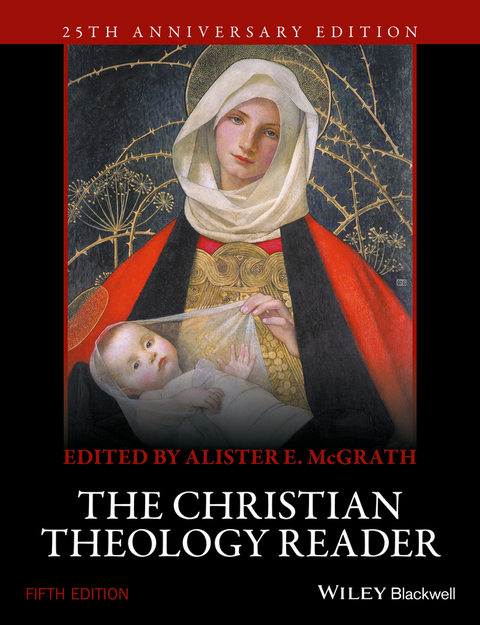
The Christian Theology Reader (eBook)
John Wiley & Sons (Verlag)
978-1-118-87437-0 (ISBN)
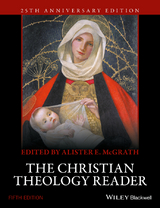
Regarded as the leading text in Christian theology for the last 25 years, Alister E. McGrath's The Christian Theology Reader is now available in a new 5th edition featuring completely revised and updated content.
- Brings together more than 350 readings from over 200 sources that chart 2,000 years of Christian history
- Situates each reading within the appropriate historical and theological context with its own introduction, commentary, and study questions
- Includes new readings on world Christianity and feminist, liberation, and postcolonial theologies, as well as more selections by female theologians and theologians from the developing world
- Contains additional pedagogical features, such as new discussion questions and case studies, and a robust website with new videos by the author to aid student learning
- Designed to function as a stand-alone volume, or as a companion to Christian Theology: An Introduction, 6th edition, for a complete overview of the subject
Alister E. McGrath is Andreas Idreos Professor of Science and Religion at Oxford University, UK. He is regarded as one of the world's leading theologians and is the author of some of the world's most widely used theological textbooks, including the bestselling Christian Theology: An Introduction (Wiley Blackwell, 2016), now in its sixth edition. He is in constant demand as a speaker at conferences throughout the world. In addition to major academic works and textbooks, he is the author of the highly acclaimed award winning biography, C. S. Lewis: A Life (2013), and The Big Question: Why Can't We Stop Talking about Science, Faith, and God (2015), nominated by Library Journal as one of the best religious books of 2015.
Regarded as the leading text in Christian theology for the last 25 years, Alister E. McGrath s The Christian Theology Reader is now available in a new 5th edition featuring completely revised and updated content. Brings together more than 350 readings from over 200 sources that chart 2,000 years of Christian history Situates each reading within the appropriate historical and theological context with its own introduction, commentary, and study questions Includes new readings on world Christianity and feminist, liberation, and postcolonial theologies, as well as more selections by female theologians and theologians from the developing world Contains additional pedagogical features, such as new discussion questions and case studies, and a robust website with new videos by the author to aid student learning Designed to function as a stand-alone volume, or as a companion to Christian Theology: An Introduction, 6th edition, for a complete overview of the subject
Alister E. McGrath is Andreas Idreos Professor of Science and Religion at Oxford University, UK. He is regarded as one of the world's leading theologians and is the author of some of the world's most widely used theological textbooks, including the bestselling Christian Theology: An Introduction (Wiley Blackwell, 2016), now in its sixth edition. He is in constant demand as a speaker at conferences throughout the world. In addition to major academic works and textbooks, he is the author of the highly acclaimed award winning biography, C. S. Lewis: A Life (2013), and The Big Question: Why Can't We Stop Talking about Science, Faith, and God (2015), nominated by Library Journal as one of the best religious books of 2015.
The Development of Christian Theology
An Historical Overview
This Reader brings together a substantial number of readings drawn from the first two thousand years of Christian theology. Theology is “talk about God”; Christian theology is “talk about God” from a Christian perspective. Engaging with these readings is one of the best ways of understanding how Christians have tried to express their faith, develop Christianity's ideas, and weave Christianity's themes together into a systematic whole. Each reading is accompanied by an introduction, a comment, and questions for study, designed to make this process of engagement as straightforward, interesting, and profitable as possible.
To get the most out of these readings, however, it is important to have an overview of the main features of the development of Christian theology. If you are using this reader alongside its companion volume, Christian Theology: An Introduction, you will find that this provides you with a detailed road map which will allow you to get the most from this collection of readings. It will help you make much more sense of what you read, and allow you to appreciate the context in which the readings were written. The four introductory chapters provide a survey of historical theology. The following four chapters deal with issues of sources and interpretation, dealing with material covered in the first two chapters of this reader. The remaining ten chapters present a detailed engagement with the major themes of Christian theology, thus providing an in-depth introduction to this collection of readings.
However, not all will want to make use of this specific introduction to Christian theology. For those not using this companion volume, this brief section will give something of a panoramic view of the main landmarks of this process of development, and identify readings that will help you understand some of its features. (Note that readings will be referred to by number only.) While this brief section can do little more than highlight some of the many themes of Christian theology (passing over many topics, debates, schools of thought, and topics that fully deserve discussion), it will nevertheless help readers to get their bearings in the midst of this vast landscape of ideas.
For the sake of convenience, historians of Christian thought tend to break the religion's first two thousand years down into more manageable sections. While everyone has their own views about how best to divide Christian history, many use a framework which looks something like this.
The Apostolic Period
The first hundred years is often referred to as the apostolic period. This was the period during which the works now included in the New Testament were written. During this time, Christianity was spreading throughout the Mediterranean region and beyond. The missionary journeys of Saint Paul, described in the Acts of the Apostles, are an excellent example of this activity. This Reader does not include readings from the New Testament, as this document is so readily accessible.
The Patristic Period
The apostolic period was followed by what is still generally known as the patristic period (some now prefer to refer to this as the “period of the early church”), which is usually held to have begun about the year 100. There is no firm agreement about when this period ended: some scholars suggest it ended in the fifth century while others extend it by at least two centuries. The Council of Chalcedon (451) marked a landmark in Christian thinking, especially over the identity of Jesus Christ, and is seen by many writers as bringing this important period of theological development to a close. The unusual word “patristic” derives from the Greek word pater (“father”) and designates a group of writers who are often collectively known as the “fathers of the church.” (Sadly, there were very few women among them.) The readings include selections from all the major writers of this period – such as Irenaeus of Lyons, Clement of Alexandria, Origen, the Cappadocian fathers, Athanasius of Alexandria, and Augustine of Hippo.
The patristic period witnessed important theological explorations of the relationship between faith and classical culture, clarifying the place of the Bible in Christian theology (including establishing the New Testament canon), the identity of Jesus Christ, the doctrine of God (including the Trinity), the doctrine of the church, and the relationship between grace and free will. All of these are well represented in this Reader. In what follows, we will look at each of them in a little more detail.
Faith and classical culture
As Christianity expanded in its first centuries, it moved from a Palestinian context into the Greek-speaking world of the eastern Mediterranean, establishing a presence in the great cities of Alexandria and Antioch. It also began to grow in the western Latin-speaking Roman empire, including North Africa. This raised the question of how Christianity related to ideas already present in this region – for example, classical philosophy (1.1–4).
The place of the Bible
One of the most important achievements of the patristic period was establishing which books dating from the apostolic period were to be regarded as “canonical” or “biblical.” Considerable attention was also paid to the question of how the Bible was to be interpreted (2.3–4, 2.8), and especially the role of tradition in combating unorthodox interpretations of the Bible (2.2, 2.5, 2.7, 2.10). During this period, “creeds” began to emerge as communally accepted and authorized summaries of the Christian faith (1.5–6, 2.7).
The identity of Jesus Christ
The patristic period saw clarification of the identity and significance of Jesus as being of the utmost importance. Where was he to be placed on a theological map? The period witnessed growing acceptance of the “two natures” doctrine, along with exploration of how best to make sense of Jesus Christ being both divine and human. The Arian and Nestorian debates were of particular importance in clarifying this matter. These debates are widely regarded as being of critical importance, and they are represented in this collection (4.1–16).
The doctrine of God
Classical Greek philosophy already had its ideas about what “God” was like. One of the most important tasks of Christian theology was to distinguish the Christian idea of God from that of its pagan and philosophical rivals (3.1). Many early debates concentrated on what it meant to say that God was creator (3.4–5), the role of the Holy Spirit (3.8, 3.10, 3.15–16), or how the existence of evil was consistent with a good God (3.2, 3.6, 3.13). However, the most significant discussions concerned the doctrine of the Trinity – the distinctively Christian idea of one God in three persons. How was this to be understood (3.3, 3.7–8, 3.10–12, 3.14, 3.17)?
The doctrine of the church
Patristic writers initially paid relatively little attention to the doctrine of the church (7.1–4), tending to focus attention on developing a coherent understanding of the sacraments (8.1–7). The Donatist controversy of the fourth century forced the western church to reconsider the nature of the church (7.5–6), and who was authorized to administer the sacraments (8.8–9). These debates would break out once more during the Reformation period.
The doctrine of grace
Although the Greek-speaking church made significant contributions to early Christian reflections on human nature and grace (6.1, 6.3, 6.7), the most sustained engagement with these issues took place within the western church, largely as a result of the Pelagian controversy (6.8–13), between Pelagius and Augustine of Hippo.
The Middle Ages
The Middle Ages, or medieval period, is regarded as extending from the end of the patristic era to about the year 1500. This long period was immensely creative culturally, and productive theologically, producing theological classics such as Peter Lombard's Four Books of the Sentences and Thomas Aquinas's great thirteenth-century work the Summa theologiae (“The Totality of Theology”). Peter Lombard's medieval theological textbook was the subject of many commentaries, which used its material to develop increasingly sophisticated theological ideas. This Reader includes selections from Peter Lombard's classic text (8.16, 10.13) as well as some of the major commentaries on its themes (6.19–21). A number of extended extracts from Aquinas's Summa theologiae will help readers understand and appreciate its distinctive style (1.9–10, 3.21, 4.18, 5.17). The readings include extracts from all the major theological writers of this period – such as Anselm of Canterbury, Thomas Aquinas, Bonaventure, Duns Scotus, and William of Ockham.
Among the many issues to be explored in detail during this period were the relationship between faith and reason, how to interpret the Bible, and the theology of the sacraments. Alongside this, there was continuing exploration of issues debated during the patristic period, such as the relationship between grace and free will.
Faith and reason
The Middle Ages saw new attention being given to a whole range of issues concerning the relationships between faith and reason and between theology and philosophy....
| Erscheint lt. Verlag | 5.8.2016 |
|---|---|
| Sprache | englisch |
| Themenwelt | Religion / Theologie ► Christentum ► Kirchengeschichte |
| Schlagworte | Christian Church • Christian History • Christianity • contemporary theology • doctrine</p> • Grace • Human nature • <p>Salvation • Religion & Theology • Religion u. Theologie • Sacraments • Sin • theologians • Theologie • Theology • World Religion |
| ISBN-10 | 1-118-87437-4 / 1118874374 |
| ISBN-13 | 978-1-118-87437-0 / 9781118874370 |
| Informationen gemäß Produktsicherheitsverordnung (GPSR) | |
| Haben Sie eine Frage zum Produkt? |
 EPUB (Adobe DRM)
Kopierschutz: Adobe-DRM
Adobe-DRM ist ein Kopierschutz, der das eBook vor Mißbrauch schützen soll. Dabei wird das eBook bereits beim Download auf Ihre persönliche Adobe-ID autorisiert. Lesen können Sie das eBook dann nur auf den Geräten, welche ebenfalls auf Ihre Adobe-ID registriert sind.
Details zum Adobe-DRM
Dateiformat: EPUB (Electronic Publication)
EPUB ist ein offener Standard für eBooks und eignet sich besonders zur Darstellung von Belletristik und Sachbüchern. Der Fließtext wird dynamisch an die Display- und Schriftgröße angepasst. Auch für mobile Lesegeräte ist EPUB daher gut geeignet.
Systemvoraussetzungen:
PC/Mac: Mit einem PC oder Mac können Sie dieses eBook lesen. Sie benötigen eine
eReader: Dieses eBook kann mit (fast) allen eBook-Readern gelesen werden. Mit dem amazon-Kindle ist es aber nicht kompatibel.
Smartphone/Tablet: Egal ob Apple oder Android, dieses eBook können Sie lesen. Sie benötigen eine
Geräteliste und zusätzliche Hinweise
Buying eBooks from abroad
For tax law reasons we can sell eBooks just within Germany and Switzerland. Regrettably we cannot fulfill eBook-orders from other countries.
aus dem Bereich