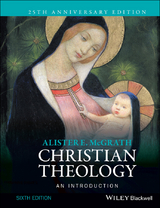
Christian Theology (eBook)
John Wiley & Sons (Verlag)
978-1-118-86956-7 (ISBN)
'The genius of Alister E. McGrath is his remarkable ability to write in a clear, concise, and lucid manner that draws both teachers and students to participate with the great thinkers of the Christian tradition, past and present. Education and illumination are the abundant fruits of this massive, well-organized text, which is sure to appeal to a wide range of Protestant, Catholic, and Orthodox audiences. For this we are indebted to the author.'
Dennis Ngien, Professor of Systematic Theology, Tyndale University College and Seminary, Toronto, Canada
'For sheer comprehensiveness, clarity, and coherence, Alister McGrath has produced the definitive textbook. Always accurate and engaging, students are gently introduced to the gift of Theology in a memorable way.'
Ian S. Markham, Dean and President of Virginia Theological Seminary
Praise for the fifth edition
'Alister McGrath has proven himself a master at engagingly and simply introducing Christian theology in all of its contested complexity. All who work at the critical appropriation of the theological tradition stand in debt to McGrath.'
M. Douglas Meeks, Cal Turner Chancellor Professor of Theology and Wesleyan Studies, Vanderbilt University Divinity School
Now celebrating its 25th year of publication, Christian Theology is one of the most internationally acclaimed textbooks in this area today. Completely rewritten for the sixth edition, it remains the ideal introduction to the beliefs and interpretation of Christianity. It is specifically designed for students with no prior knowledge, presenting the primary themes and debates of Christian theology with clarity and historical context.
This new edition retains all the elements that have made it so successful while also including significant additions and developments. There is an increased discussion of contemporary theology to complement the excellent coverage of historical material. Important new information has also been added, in areas such as the Holy Spirit, contemporary non-Western theologies, and feminist voices in Christian theology. The text is rich in pedagogy to encourage student learning, featuring a two colour design, glossary, end-of-chapter discussion questions, and much more. Written by renowned theologian Alister E. McGrath, this classic text is a clear, lively and concise introduction that provides instructors with the tools they need to engage with their students on Christian theology.
ALISTER E. McGRATH is currently Andreas Idreos Professor of Science and Religion at the University of Oxford; he was previously Professor of Theology and Education at King's College, London. He is regarded as one of the world's leading Protestant theologians and is the author of some of the world's most widely used theological textbooks, including the bestselling The Christian Theology Reader (5th edition, Wiley Blackwell, 2016), Christianity (Wiley Blackwell, 2015), and Science and Religion (Wiley Blackwell, 2010). He is in constant demand as a speaker at conferences throughout the world.
ALISTER E. McGRATH is currently Andreas Idreos Professor of Science and Religion at the University of Oxford; he was previously Professor of Theology and Education at King's College, London. He is regarded as one of the world's leading Protestant theologians and is the author of some of the world's most widely used theological textbooks, including the bestselling The Christian Theology Reader (5th edition, Wiley Blackwell, 2016), Christianity (Wiley Blackwell, 2015), and Science and Religion (Wiley Blackwell, 2010). He is in constant demand as a speaker at conferences throughout the world.
List of Illustrations xxi
Preface xxiii
To the Student: How to Use This Book xxvii
To the Teacher: How to Use This Book xxix
The Structure of the Book: The Fifth and Sixth Editions Compared xxxiii
Video and Audio Resources xxxv
PART I LANDMARKS: PERIODS, THEMES, AND PERSONALITIES OF CHRISTIAN THEOLOGY 1
Introduction 3
1 The Patristic Period, c.100-c.700 5
2 The Middle Ages and the Renaissance, c.700-c.1500 21
3 The Age of Reformation, c.1500-c.1750 38
4 The Modern Period, c.1750 to the Present 57
PART II SOURCES AND METHODS 81
5 Getting Started: Preliminaries 83
6 The Sources of Theology 104
7 Knowledge of God: Natural and Revealed 135
8 Philosophy and Theology: Dialogue and Debate 152
PART III CHRISTIAN THEOLOGY 173
9 The Doctrine of God 175
10 The Person of Jesus Christ 207
11 The Nature and Basis of Salvation 246
12 The Holy Spirit 280
13 The Trinity 299
14 Human Nature, Sin, and Grace 327
15 The Church 354
16 The Sacraments 381
17 Christianity and the World Religions 405
18 Last Things: The Christian Hope 426
Jargon-Busting: A Glossary of Theological Terms 449
Sources of Citations 456
Acknowledgments 465
Index 466
1
The Patristic Period, c.100–c.700
Christianity has its origins in Palestine – more specifically, the region of Judea, especially the city of Jerusalem – in the first century. Christianity saw itself as a continuation and development of Judaism, and initially flourished in regions with which Judaism was traditionally associated, supremely Palestine itself. However, it rapidly spread to neighboring regions, partially through the efforts of early Christian evangelists such as Paul of Tarsus.
The Early Centers of Theological Activity
By the end of the first century AD, Christianity had become established throughout the eastern Mediterranean world and had even gained a significant presence in the city of Rome, the capital of the Roman empire. As the church at Rome became increasingly powerful, tensions began to develop between the Christian leadership at Rome and at the great cities of the eastern Roman empire, such as Alexandria and Antioch. By the fourth century, the Roman empire had effectively split in two. The western empire was now ruled from Rome, and the eastern from the great new imperial city of Constantinople. This foreshadowed the later schism between the western and eastern churches, centered on these respective seats of power.
In the course of this expansion, a number of regions emerged as significant centers of theological debate. Three may be singled out as having especial importance, the first two of which were Greek-speaking and the third Latin-speaking.
- The city of Alexandria, in modern-day Egypt, which emerged as a center of Christian theological education. A distinctive style of theology came to be associated with this city, reflecting its long-standing association with the Platonic tradition. The student will find reference to “Alexandrian” approaches in areas such as Christology (the area of theology dealing with the identity and significance of Jesus Christ) and biblical interpretation (see pp. 115–16, 220–1), reflecting both the importance and the distinctiveness of the style of Christianity associated with the area.
- The city of Antioch and the surrounding region of Cappadocia, in modern-day Turkey. A strong Christian presence came to be established in this northern region of the eastern Mediterranean at an early stage. Some of Paul's missionary journeys took him into this region, and Antioch features significantly at several points in the history of the very early church, as recorded in the Acts of the Apostles. Antioch itself soon became a leading center of Christian thought. Like Alexandria, it became associated with particular approaches to Christology and biblical interpretation. The term “Antiochene” is often used to designate this distinct theological style (see pp. 115–16, 200–1). The “Cappadocian fathers” were also an important theological presence in this region in the fourth century, notable especially for their contribution to the doctrine of the Trinity.
- Western North Africa, especially the areas of modern-day Algeria and Tunisia. In the classical period, this was the site of Carthage, a major Mediterranean city and at one time a political rival to Rome for dominance in the region. During the period when Christianity expanded in this region, it was a Roman colony. Major writers of the region include Tertullian (c.160–c.220), Cyprian of Carthage (died 258), and Augustine of Hippo (354–430).
Map 1.1 The Roman empire and the church in the fourth century.
Figure 1.1 The ancient city of Carthage.
Source: photo © WitR / Shutterstock.
With the passing of time, some other cities around the Mediterranean – such as Rome, Constantinople, Milan, and Jerusalem – also became significant centers of Christian life and thought.
An Overview of the Patristic Period
The patristic period was one of the most exciting and creative periods in the history of Christian thought. This period is also of importance for theological reasons. Every mainstream Christian body – including the Catholic, Orthodox, Anglican, Lutheran, and Reformed churches – regards the patristic period as a definitive landmark in the development of Christian doctrine. Each of these churches regards itself as continuing, extending, and, where necessary, criticizing the views of the early church writers. For example, the leading seventeenth-century Anglican writer Lancelot Andrewes (1555–1626) declared that mainstream Christianity was based upon one canon, two testaments, three creeds, four “general councils,” and the first five centuries of Christian history.
A Clarification of Terms
The term “patristic” comes from the Latin word pater, “father,” and designates both the period of the church fathers and the distinctive ideas that came to develop within this period. The term is noninclusive; no generally acceptable inclusive term has yet to emerge in the literature. For this reason, some prefer to talk about “early church theologians” rather than “patristic theologians.” We shall retain the term “patristic” in this work, as it is still widely used to refer to the theology of this formative period. The following related terms are still frequently encountered, and should be noted.
- The patristic period: This is a vaguely defined entity, often taken to be the period from the closing of the New Testament writings (c.100) to the definitive Council of Chalcedon (451).
- Patristics: This term is usually understood to mean the branch of theological study which deals with the study of “the fathers” (patres).
- Patrology: This term once literally meant “the study of the fathers,” in much the same way as “theology” meant “the study of God” (theos). In recent years, however, the word has shifted its meaning. It now refers to a manual of patristic literature, such as that of the noted German scholar Johannes Quasten (1900–87), which allows its readers easy access to the leading ideas of patristic writers and to some of the problems of interpretation associated with them.
The Theological Agenda of the Period
The patristic period was of major importance in clarifying a number of issues. One issue that had to be sorted out at an early stage was the relationship between Christianity and Judaism. The letters of Paul in the New Testament point to the importance of this question in the first century of Christian history, as a series of doctrinal and practical issues came under consideration. Since circumcision was obligatory for Jews, should Gentile (that is, non-Jewish) Christians be obliged to be circumcised? Did Christians have to observe Jewish food laws? And how was the Old Testament to be correctly interpreted?
However, other issues soon came to the fore. One which was of especial importance in the second century was that of apologetics – the reasoned defense and justification of the Christian faith against its critics. During the first period of Christian history, the church was often persecuted by the state and people were forced to worship secretly, often in private homes. Apologists such as Justin Martyr (c.100–c.165) tried to explain and defend the beliefs and practices of Christianity to a hostile pagan public. Although this early period produced some outstanding theologians – such as Irenaeus of Lyons (c.130–c.202) in the west and Origen (c.185–c.254) in the east – serious theological debate really began once the church had ceased to be persecuted.
Figure 1.2 The Roman emperor Constantine (272–337; reigned 306–37).
Source: photo: akg-images.
These conditions became possible during the fourth century, with the conversion of Constantine (272–337; reigned 306–37), who went on to become Roman emperor. During his period as emperor (306–37), Constantine succeeded in reconciling church and empire, with the result that the church no longer existed under a siege mentality. In 321, he decreed that Sundays should become public holidays. As a result of Constantine's influence on the empire, constructive theological debate became a public affair. Apart from a brief period of uncertainty during the reign of Julian the Apostate (330–63; reigned 361–3), the church could now count upon the support of the state.
Theology now emerged from the hidden world of secret church meetings to become a matter of public interest and concern throughout the Roman empire. Increasingly, doctrinal debates became a matter of both political and theological importance. Constantine wished to have a united church throughout his empire, and was thus concerned that doctrinal differences should be debated and settled as a matter of priority. One of the most important outcomes of this was the convening of the Council of Nicea (325) to resolve potentially divisive debates within the church over the best way of express the identity and significance of Jesus Christ.
As a result, the later patristic period (from about 310 to 451) may be regarded as a high-water mark in the history of Christian theology. Theologians now enjoyed the freedom to work without the threat of persecution and were able to address a series of issues of major importance to the...
| Erscheint lt. Verlag | 5.8.2016 |
|---|---|
| Sprache | englisch |
| Themenwelt | Religion / Theologie ► Christentum ► Kirchengeschichte |
| Schlagworte | Christentum • Christianity • Religion & Theology • Religion u. Theologie • Theologie • Theology |
| ISBN-10 | 1-118-86956-7 / 1118869567 |
| ISBN-13 | 978-1-118-86956-7 / 9781118869567 |
| Informationen gemäß Produktsicherheitsverordnung (GPSR) | |
| Haben Sie eine Frage zum Produkt? |
 EPUB (Adobe DRM)
Kopierschutz: Adobe-DRM
Adobe-DRM ist ein Kopierschutz, der das eBook vor Mißbrauch schützen soll. Dabei wird das eBook bereits beim Download auf Ihre persönliche Adobe-ID autorisiert. Lesen können Sie das eBook dann nur auf den Geräten, welche ebenfalls auf Ihre Adobe-ID registriert sind.
Details zum Adobe-DRM
Dateiformat: EPUB (Electronic Publication)
EPUB ist ein offener Standard für eBooks und eignet sich besonders zur Darstellung von Belletristik und Sachbüchern. Der Fließtext wird dynamisch an die Display- und Schriftgröße angepasst. Auch für mobile Lesegeräte ist EPUB daher gut geeignet.
Systemvoraussetzungen:
PC/Mac: Mit einem PC oder Mac können Sie dieses eBook lesen. Sie benötigen eine
eReader: Dieses eBook kann mit (fast) allen eBook-Readern gelesen werden. Mit dem amazon-Kindle ist es aber nicht kompatibel.
Smartphone/Tablet: Egal ob Apple oder Android, dieses eBook können Sie lesen. Sie benötigen eine
Geräteliste und zusätzliche Hinweise
Buying eBooks from abroad
For tax law reasons we can sell eBooks just within Germany and Switzerland. Regrettably we cannot fulfill eBook-orders from other countries.
aus dem Bereich