


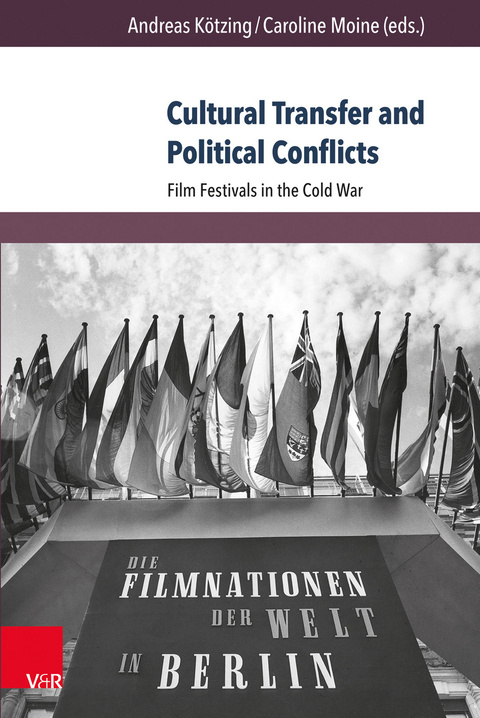
Cultural Transfer and Political Conflicts
Film Festivals in the Cold War
Seiten
Political or cultural conflicts in the context of film festivals
Film festivals during the Cold War were fraught with the political and social tensions that dominated the world at the time. While film was becoming an increasingly powerful medium, the European festivals in particular established themselves as showcases for filmmakers and their perceptions of reality. At the same time, their prestigious, international character attracted the interest of states and private players. The history of these festivals thus sheds light not only on the films they made available to various publics, but on the cultural policies and political processes that informed their operations. Presenting new research by an international group of younger scholars, Cultural Transfer and Political Conflicts critically investigates postwar history in the context of film festivals reconstructing not only their social background and international dispensation, but also their centrality for cultural transfers between the East, the West and the South during the Cold War.
Film festivals during the Cold War were fraught with the political and social tensions that dominated the world at the time. While film was becoming an increasingly powerful medium, the European festivals in particular established themselves as showcases for filmmakers and their perceptions of reality. At the same time, their prestigious, international character attracted the interest of states and private players. The history of these festivals thus sheds light not only on the films they made available to various publics, but on the cultural policies and political processes that informed their operations. Presenting new research by an international group of younger scholars, Cultural Transfer and Political Conflicts critically investigates postwar history in the context of film festivals reconstructing not only their social background and international dispensation, but also their centrality for cultural transfers between the East, the West and the South during the Cold War.
Prof. Dr. Maria A. Stassinopoulou lehrt am Institut für Byzantinistik und Neogräzistik der Universität Wien.
Dr. Caroline Moine ist Assistenzprofessorin an der Universität Versailles Saint-Quentin-en-Yvelines und Vize-Direktorin des Centre d'histoire culturelle des sociétés contemporaines.
Dr. Andreas Kötzing ist Lehrbeauftragter an der Universität Leipzig und Wissenschaftlicher Mitarbeiter am Hannah-Arendt-Institut für Totalitarismusforschung in Dresden.
| Erscheinungsdatum | 18.07.2017 |
|---|---|
| Reihe/Serie | Berichte und Studien ; Band 072 |
| Co-Autor | Maria Stassinopoulou, Dunja Jelenkovic, John Wäfler, Anne Bruch, Dragan Batancev, Tobias Ebbrecht-Hartmann, Stefano Pisu, Regina Camara, Caroline Moine, Yulia Yurtaeva, Andreas Kötzing |
| Verlagsort | Göttingen |
| Sprache | englisch |
| Maße | 155 x 232 mm |
| Gewicht | 268 g |
| Themenwelt | Geschichte ► Allgemeine Geschichte ► Zeitgeschichte |
| Schlagworte | Aussenpolitik • Europa /Kultur, Künste • Festival • Film • Kalter Krieg • Kulturbeziehung • Kulturbeziehungen • Kulturtransfer • Nachkriegszeit |
| ISBN-10 | 3-8471-0588-4 / 3847105884 |
| ISBN-13 | 978-3-8471-0588-6 / 9783847105886 |
| Zustand | Neuware |
| Informationen gemäß Produktsicherheitsverordnung (GPSR) | |
| Haben Sie eine Frage zum Produkt? |
Mehr entdecken
aus dem Bereich
aus dem Bereich
die großen Jahre der Soziologie 1949-1969
Buch | Hardcover (2025)
Klett-Cotta (Verlag)
CHF 39,20
eine Deutschlandreise im Jahr 1958
Buch | Hardcover (2024)
C.H.Beck (Verlag)
CHF 29,90


