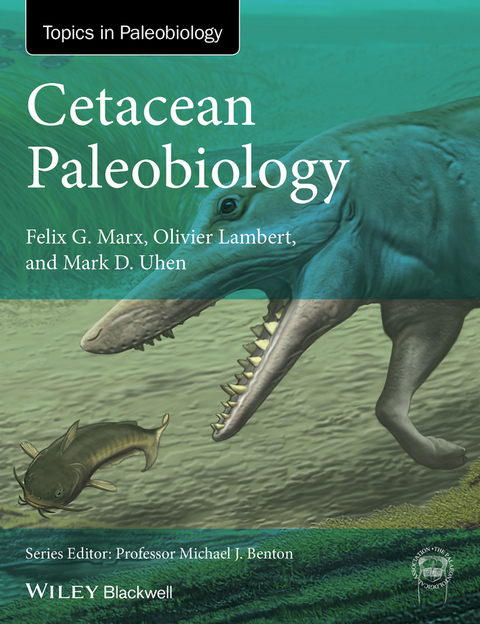
Cetacean Paleobiology (eBook)
John Wiley & Sons (Verlag)
978-1-118-56136-2 (ISBN)
Felix G. Marx is a postdoctoral research fellow at the Institut royal des Sciences naturelles de Belgique (Brussels), currently on secondment to Monash University and Museum Victoria in Melbourne, Australia. After obtaining his PhD in New Zealand, he spent two years as a postdoctoral fellow at the National Museum of Nature and Science of Japan, where he wrote most of his contributions to this book. His research focuses primarily on the origins, phylogeny, feeding ecology and macroevolution of living and extinct baleen whales, based on specimens from around the globe.
Dr Olivier Lambert is a vertebrate palaeontologist at the Institut royal des Sciences naturelles de Belgique, Brussels. Interested in the secondary adaptations of mammals to the marine environment, Dr Lambert studies fossil cetaceans from many geological ages and localities in the world. Most of his publications focus on extinct echolocating toothed whales, especially from the North Atlantic and South-East Pacific realms.
Dr Mark D. Uhen is an Assistant Professor of Geology at George Mason University. Dr Uhen's research focuses on the origin and evolution of cetaceans (whales and dolphins), and other marine mammals. He has conducted field work around the world, developed exhibits and lessons on cetacean evolution for museums, and published on his work in journals, and books. Dr Uhen is also a leader of the Paleobiology Database, an on-line open resource that documents every fossil occurrence on the planet.
Cetaceans (whales, dolphins, and porpoises) have fascinated and bewildered humans throughout history. Their mammalian affinities have been long recognized, but exactly which group of terrestrial mammals they descend from has, until recently, remained in the dark. Recent decades have produced a flurry of new fossil cetaceans, extending their fossil history to over 50 million years ago. Along with new insights from genetics and developmental studies, these discoveries have helped to clarify the place of cetaceans among mammals, and enriched our understanding of their unique adaptations for feeding, locomotion and sensory systems. Their continuously improving fossil record and successive transformation into highly specialized marine mammals have made cetaceans a textbook case of evolution - as iconic in its own way as the origin of birds from dinosaurs. This book aims to summarize our current understanding of cetacean evolution for the serious student and interested amateur using photographs, drawings, charts and illustrations.
Felix G. Marx is Curator Vertebrates at the Museum of New Zealand Te Papa Tongarewa, where he primarily looks after the marine mammal collection. Prior to becoming a curator, he spent several years as a postdoctoral fellow in Australia, Belgium and Japan. He specialises in the evolution of baleen whales, but has worked on a broad variety of topics, from macroevolution to feeding ecology, biogeography, and behaviour. Dr Olivier Lambert is a vertebrate palaeontologist at the Institut royal des Sciences naturelles de Belgique, Brussels. Interested in the secondary adaptations of mammals to the marine environment, Dr Lambert studies fossil cetaceans from many geological ages and localities in the world. Most of his publications focus on extinct echolocating toothed whales, especially from the North Atlantic and South-East Pacific realms. Dr Mark D. Uhen is an Assistant Professor of Geology at George Mason University. Dr Uhen s research focuses on the origin and evolution of cetaceans (whales and dolphins), and other marine mammals. He has conducted field work around the world, developed exhibits and lessons on cetacean evolution for museums, and published on his work in journals, and books. Dr Uhen is also a leader of the Paleobiology Database, an on-line open resource that documents every fossil occurrence on the planet.
| Erscheint lt. Verlag | 29.3.2016 |
|---|---|
| Reihe/Serie | TOPA Topics in Paleobiology | TOPA Topics in Paleobiology |
| Sprache | englisch |
| Themenwelt | Geisteswissenschaften ► Archäologie |
| Geschichte ► Allgemeine Geschichte ► Vor- und Frühgeschichte | |
| Naturwissenschaften ► Biologie ► Zoologie | |
| Naturwissenschaften ► Geowissenschaften ► Mineralogie / Paläontologie | |
| Technik | |
| Schlagworte | Biowissenschaften • cetacean • Earth History • earth science • earth sciences • Ecology • Environmental Science • Evolution • evolutionary biology • evolutionary studies • Evolutionsbiologie • Geobiology • Geowissenschaften • Life Sciences • Paläontologie, Paläobiologie u. Geobiologie • Paläontologie, Paläobiologie u. Geobiologie • paleobiology • paleontology • Paleontology, Paleobiology & Geobiology |
| ISBN-10 | 1-118-56136-8 / 1118561368 |
| ISBN-13 | 978-1-118-56136-2 / 9781118561362 |
| Informationen gemäß Produktsicherheitsverordnung (GPSR) | |
| Haben Sie eine Frage zum Produkt? |
 PDF (Adobe DRM)
Kopierschutz: Adobe-DRM
Adobe-DRM ist ein Kopierschutz, der das eBook vor Mißbrauch schützen soll. Dabei wird das eBook bereits beim Download auf Ihre persönliche Adobe-ID autorisiert. Lesen können Sie das eBook dann nur auf den Geräten, welche ebenfalls auf Ihre Adobe-ID registriert sind.
Details zum Adobe-DRM
Dateiformat: PDF (Portable Document Format)
Mit einem festen Seitenlayout eignet sich die PDF besonders für Fachbücher mit Spalten, Tabellen und Abbildungen. Eine PDF kann auf fast allen Geräten angezeigt werden, ist aber für kleine Displays (Smartphone, eReader) nur eingeschränkt geeignet.
Systemvoraussetzungen:
PC/Mac: Mit einem PC oder Mac können Sie dieses eBook lesen. Sie benötigen eine
eReader: Dieses eBook kann mit (fast) allen eBook-Readern gelesen werden. Mit dem amazon-Kindle ist es aber nicht kompatibel.
Smartphone/Tablet: Egal ob Apple oder Android, dieses eBook können Sie lesen. Sie benötigen eine
Geräteliste und zusätzliche Hinweise
Buying eBooks from abroad
For tax law reasons we can sell eBooks just within Germany and Switzerland. Regrettably we cannot fulfill eBook-orders from other countries.
aus dem Bereich