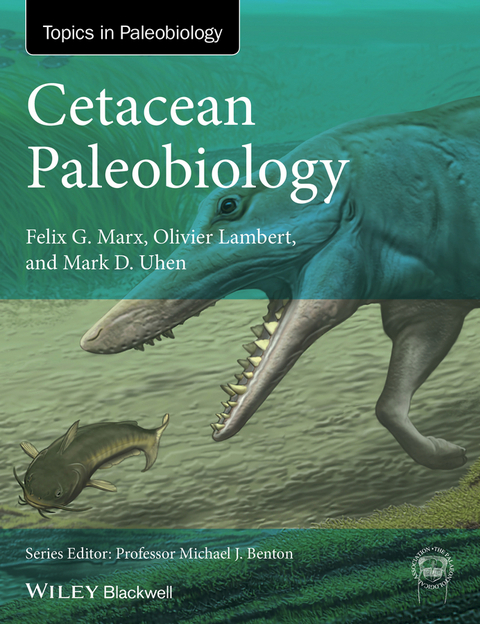
Cetacean Paleobiology (eBook)
John Wiley & Sons (Verlag)
978-1-118-56155-3 (ISBN)
Felix G. Marx is a postdoctoral research fellow at the Institut royal des Sciences naturelles de Belgique (Brussels), currently on secondment to Monash University and Museum Victoria in Melbourne, Australia. After obtaining his PhD in New Zealand, he spent two years as a postdoctoral fellow at the National Museum of Nature and Science of Japan, where he wrote most of his contributions to this book. His research focuses primarily on the origins, phylogeny, feeding ecology and macroevolution of living and extinct baleen whales, based on specimens from around the globe.
Dr Olivier Lambert is a vertebrate palaeontologist at the Institut royal des Sciences naturelles de Belgique, Brussels. Interested in the secondary adaptations of mammals to the marine environment, Dr Lambert studies fossil cetaceans from many geological ages and localities in the world. Most of his publications focus on extinct echolocating toothed whales, especially from the North Atlantic and South-East Pacific realms.
Dr Mark D. Uhen is an Assistant Professor of Geology at George Mason University. Dr Uhen's research focuses on the origin and evolution of cetaceans (whales and dolphins), and other marine mammals. He has conducted field work around the world, developed exhibits and lessons on cetacean evolution for museums, and published on his work in journals, and books. Dr Uhen is also a leader of the Paleobiology Database, an on-line open resource that documents every fossil occurrence on the planet.
Cetaceans (whales, dolphins, and porpoises) have fascinated and bewildered humans throughout history. Their mammalian affinities have been long recognized, but exactly which group of terrestrial mammals they descend from has, until recently, remained in the dark. Recent decades have produced a flurry of new fossil cetaceans, extending their fossil history to over 50 million years ago. Along with new insights from genetics and developmental studies, these discoveries have helped to clarify the place of cetaceans among mammals, and enriched our understanding of their unique adaptations for feeding, locomotion and sensory systems. Their continuously improving fossil record and successive transformation into highly specialized marine mammals have made cetaceans a textbook case of evolution - as iconic in its own way as the origin of birds from dinosaurs. This book aims to summarize our current understanding of cetacean evolution for the serious student and interested amateur using photographs, drawings, charts and illustrations.
Felix G. Marx is Curator Vertebrates at the Museum of New Zealand Te Papa Tongarewa, where he primarily looks after the marine mammal collection. Prior to becoming a curator, he spent several years as a postdoctoral fellow in Australia, Belgium and Japan. He specialises in the evolution of baleen whales, but has worked on a broad variety of topics, from macroevolution to feeding ecology, biogeography, and behaviour. Dr Olivier Lambert is a vertebrate palaeontologist at the Institut royal des Sciences naturelles de Belgique, Brussels. Interested in the secondary adaptations of mammals to the marine environment, Dr Lambert studies fossil cetaceans from many geological ages and localities in the world. Most of his publications focus on extinct echolocating toothed whales, especially from the North Atlantic and South-East Pacific realms. Dr Mark D. Uhen is an Assistant Professor of Geology at George Mason University. Dr Uhen s research focuses on the origin and evolution of cetaceans (whales and dolphins), and other marine mammals. He has conducted field work around the world, developed exhibits and lessons on cetacean evolution for museums, and published on his work in journals, and books. Dr Uhen is also a leader of the Paleobiology Database, an on-line open resource that documents every fossil occurrence on the planet.
1
Cetaceans, Past and Present
1.1 Introduction and scope of the book
Cetaceans (whales, dolphins, and porpoises) are some of the most iconic inhabitants of the modern ocean. They are, however, also one of its most unlikely. This point was beautifully made by the famous paleontologist George Gaylord Simpson when he described cetaceans as “on the whole, the most peculiar and aberrant of mammals” (Simpson, 1945: p. 213). Living cetaceans are the result of more than 50 million years of evolution, which transformed a group of small, four-legged landlubbers into the ocean-going leviathans of today. As far back as the fourth century BC, the Greek philosopher Aristotle recognized in his Historia Animalium that whales and dolphins breathe air, give birth to live offspring, show parental care, and suckle their young. Along with their warm-bloodedness, these traits betray the terrestrial mammalian ancestry of cetaceans, and often present them with a considerable challenge. Put into water, most land mammals would struggle to swim for any length of time, breathe, cope with ingested saltwater, or maintain their body temperature. Yet cetaceans have managed to clear all of these hurdles, alongside many others. They can find prey even in murky water where eyes cannot see. Their air-breathing calves are born underwater, yet do not drown. They move around fast in three dimensions, yet avoid becoming dizzy. They dive deep beneath the surface, yet do not suffer from the bends.
For a long time, the story of how cetaceans managed to leave behind the shore and adapt so completely to life in the sea remained largely in the dark. Fossils of ancient cetaceans have been known since the early 19th century, but most of them were too fragmentary, or too similar to the living forms, to illuminate the morphological and ecological transition back into the water. This all changed in the early 1990s, when the first of a string of spectacular new fossil finds started to rewrite our understanding of how, when, and where the first cetaceans evolved. Over the following 25 years, further discoveries coincided with the emergence of an ever-more sophisticated array of analysis techniques, such as molecular phylogenetics, stable isotope analysis, computed tomography (CT) scanning, and molecular divergence time estimation. Together, these developments allowed unprecedented insights into not only the origin and evolutionary relationships of cetaceans, but also their ecology and functional biology.
In this book, we aim to provide an overview of the study of cetacean evolution from their first appearance to the present day. We start with a description of basic principles, including a brief summary of the ecology of living whales and dolphins, cetacean taxonomy, and an explanation of the main techniques and concepts used to study extinct species (Chapter 1). This is followed by more detailed summaries of the cetacean fossil record (Chapter 2) and a description of their anatomy, phylogenetic relationships, and diversity (Chapters 3 and 4). Finally, Chapters 5–8 are devoted to particular topics and case studies of cetacean paleoecology, functional biology, development, and macroevolution.
1.2 What is a whale?
Whales and dolphins are the only mammals besides sea cows (sirenians) that have completely adapted to life in the ocean. Unlike the other major group of marine mammals, the pinnipeds (seals, sea lions, and walruses), cetaceans sleep, mate, give birth, and suckle their young in the water. Instead of hair, they rely on a thick layer of insulating blubber to maintain their body temperature. Their overall shape is extremely streamlined, with no external projections such as ears or genitals that could produce drag. Their forelimbs have turned into flippers and, having all but lost their original function in locomotion, are merely used for steering. To propel themselves through the water, they instead rhythmically beat their massive tail, which ends in a pair of characteristic horizontal flukes.
Given their distinctive anatomy, the question of how to define a cetacean may seem obvious to the modern observer. However, the issue becomes more vexed when fossils are taken into account. Taxonomically, cetaceans fall into three major groups: ancient whales (archaeocetes), baleen whales (Mysticeti), and toothed whales (Odontoceti), each of which comprises a range of families (Chapter 4). Broadly speaking, archaeocetes are defined by their retention of archaic morphologies, such as (1) well-developed hind limbs; (2) a small number of morphologically differentiated (heterodont) teeth, which are replaced once during life (diphyodonty); and (3) relatively close ties to land (e.g., to rest or give birth) (Figure 1.1). By contrast, mysticetes and odontocetes are completely aquatic, with no trace of an external hind limb, and they are unable to move or support their weight on land. Both groups furthermore underwent a pronounced reorganization of their facial bones—a process commonly known as telescoping—to facilitate breathing (section 3.2). Besides these shared features, modern odontocetes in particular are recognizable by (1) having a single blowhole; (2) having a variable but often large number of greatly simplified, conical teeth (i.e., they are both polydont and homodont); and (3) their ability to echolochate (i.e., use sound to navigate and detect prey). In contrast, mysticetes (1) are often extremely large, (2) have lost any trace of teeth as adults, and (3) possess a series of keratinous, sieve-like baleen plates suspended in two rows from their upper jaw (section 5.2.1). Incidentally, note that the term whale carries little biological meaning in this context, except when understood to mean all cetaceans. In common parlance, the word is usually applied only to large-sized species and their (presumed) relatives—including, ironically, some members of the dolphin family (e.g., the killer whale, Orcinus orca).
Figure 1.1 Overview of the three main subdivisions of Cetacea: (a) archaeocetes (archaic whales), (b) Mysticeti (baleen whales), and (c) Odontoceti (toothed whales, including dolphins).
Life reconstructions © C. Buell.
The morphological similarity of the oldest whales to terrestrial mammals can make it difficult to recognize their true evolutionary affinities. Potentially diagnostic features mostly relate to details of the morphology of the skull, such as incipient telescoping and the shape and arrangement of the teeth—in particular, the anteroposterior alignment of the tooth row and the absence of crushing basins on the check teeth (Thewissen et al., 2007; Uhen, 2010). However, many of these are difficult to recognize across Cetacea as a whole or also occur in other, non-cetacean mammals. The clearest trait uniting all cetaceans is a marked increase in the thickness and density (pachyosteosclerosis) of the medial wall of the tympanic bulla, one of the two main ear bones located at the base of the skull (Figure 1.2) (section 3.2.5). A pachyosteosclerotic bulla was long thought to be unique to cetaceans, until a similar morphology was described for a group of extinct artiodactyls (even-toed ungulates) known as raoellids (Thewissen et al., 2007). This wider distribution is, however, largely unproblematic, since raoellids are now known to be more closely related to cetaceans than to any other extant or extinct artiodactyls and, although never formalized as such, could therefore be seen as de facto cetaceans (sections 4.1 and 5.1.1) (Geisler and Theodor, 2009; Thewissen et al., 2007).
Figure 1.2 The pachyosteosclerotic tympanic bulla (highlighted in gray) characteristic of all cetaceans, as developed in (a) the early archaeocete Pakicetus and (b) the archaic mysticete Aetiocetus.
Drawing of Pakicetus adapted from Gingerich et al. (1983) and Luo and Gingerich (1999).
1.3 Diversity, distribution, and ecology of modern cetaceans
Modern whales and dolphins form an essential part of the ocean ecosystem as top predators, as large-scale nutrient distributors, and as a food source for many deep-sea organisms (Croll et al., 2006; Nicol et al., 2010; Smith and Baco, 2003; Willis, 2014; Wing et al., 2014). Their ranks include the holders of several world records, most of which are related to their often gigantic size: the blue whale Balaenoptera musculus, which at up to 190 tonnes is the Earth’s heaviest animal (Tomilin, 1957)—and at least one-third again as heavy as the largest known dinosaur (Carpenter, 2006); the sperm whale Physeter macrocephalus, owner of the world’s largest brain (up to 8 kg) (Marino, 2009); the right whales of the genus Eubalaena, which possess the more dubious accolade of having the world’s largest testes (approximating 1 tonne) (Brownell and Ralls, 1986); and the longest lived of all mammals, the bowhead whale Balaena mysticetus, which may reach a venerable age of more than 200 years (George et al., 1999).
All extant species are either mysticetes or odontocetes, with archaeocetes having become extinct around 25 Ma (section 4.2). The Society of Marine Mammalogy currently recognizes 90 living species, 84% of which are odontocetes...
| Erscheint lt. Verlag | 29.3.2016 |
|---|---|
| Reihe/Serie | TOPA Topics in Paleobiology |
| TOPA Topics in Paleobiology | TOPA Topics in Paleobiology |
| Sprache | englisch |
| Themenwelt | Geisteswissenschaften ► Archäologie |
| Geschichte ► Allgemeine Geschichte ► Vor- und Frühgeschichte | |
| Naturwissenschaften ► Biologie ► Zoologie | |
| Naturwissenschaften ► Geowissenschaften ► Mineralogie / Paläontologie | |
| Technik | |
| Schlagworte | Biowissenschaften • cetacean • Earth History • earth science • earth sciences • Ecology • Environmental Science • Evolution • evolutionary biology • evolutionary studies • Evolutionsbiologie • Geobiology • Geowissenschaften • Life Sciences • Paläontologie, Paläobiologie u. Geobiologie • Paläontologie, Paläobiologie u. Geobiologie • paleobiology • paleontology • Paleontology, Paleobiology & Geobiology |
| ISBN-10 | 1-118-56155-4 / 1118561554 |
| ISBN-13 | 978-1-118-56155-3 / 9781118561553 |
| Informationen gemäß Produktsicherheitsverordnung (GPSR) | |
| Haben Sie eine Frage zum Produkt? |
 EPUB (Adobe DRM)
Kopierschutz: Adobe-DRM
Adobe-DRM ist ein Kopierschutz, der das eBook vor Mißbrauch schützen soll. Dabei wird das eBook bereits beim Download auf Ihre persönliche Adobe-ID autorisiert. Lesen können Sie das eBook dann nur auf den Geräten, welche ebenfalls auf Ihre Adobe-ID registriert sind.
Details zum Adobe-DRM
Dateiformat: EPUB (Electronic Publication)
EPUB ist ein offener Standard für eBooks und eignet sich besonders zur Darstellung von Belletristik und Sachbüchern. Der Fließtext wird dynamisch an die Display- und Schriftgröße angepasst. Auch für mobile Lesegeräte ist EPUB daher gut geeignet.
Systemvoraussetzungen:
PC/Mac: Mit einem PC oder Mac können Sie dieses eBook lesen. Sie benötigen eine
eReader: Dieses eBook kann mit (fast) allen eBook-Readern gelesen werden. Mit dem amazon-Kindle ist es aber nicht kompatibel.
Smartphone/Tablet: Egal ob Apple oder Android, dieses eBook können Sie lesen. Sie benötigen eine
Geräteliste und zusätzliche Hinweise
Buying eBooks from abroad
For tax law reasons we can sell eBooks just within Germany and Switzerland. Regrettably we cannot fulfill eBook-orders from other countries.
aus dem Bereich