


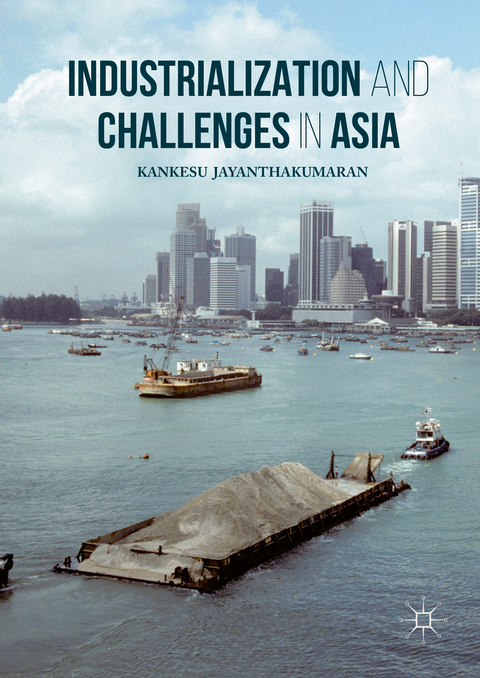
Industrialization and Challenges in Asia
Seiten
2016
|
1st ed. 2016
Springer Verlag, Singapore
978-981-10-0823-8 (ISBN)
Springer Verlag, Singapore
978-981-10-0823-8 (ISBN)
This book provides a much-needed review of Asia’s economic growth and its challenges in the context of post-war industrialization. The major challenge is to bring together a comprehensive picture of Asia’s growth, taking into account the adverse consequences.
This book provides a much-needed review of Asia’s economic growth and its challenges in the context of post-war industrialization. In the early 1990s, the World Bank (1993) recognized eight high-performing Asian economies (HPAEs) (Japan, the Asian tigers, Indonesia, Malaysia and Thailand) and named them the ‘Asian economic miracle’. In the recent past, the term ‘emerging economies’ has been widely used to refer to the high-growth economies, and includes China, India, Mongolia and Vietnam. In this rush towards high growth, the adverse effects of industrialization are widespread, but were unnoticed. The major challenge is to bring together a comprehensive picture of Asia’s growth, taking into account the adverse consequences. Finally, this book examines two challenges for the future of Asia's development: the global financial crisis and urban poverty and inequality.
This book provides a much-needed review of Asia’s economic growth and its challenges in the context of post-war industrialization. In the early 1990s, the World Bank (1993) recognized eight high-performing Asian economies (HPAEs) (Japan, the Asian tigers, Indonesia, Malaysia and Thailand) and named them the ‘Asian economic miracle’. In the recent past, the term ‘emerging economies’ has been widely used to refer to the high-growth economies, and includes China, India, Mongolia and Vietnam. In this rush towards high growth, the adverse effects of industrialization are widespread, but were unnoticed. The major challenge is to bring together a comprehensive picture of Asia’s growth, taking into account the adverse consequences. Finally, this book examines two challenges for the future of Asia's development: the global financial crisis and urban poverty and inequality.
Kankesu Jayanthakumaran is Senior Lecturer in Economics at the University of Wollongong. His research addresses knowledge and statistical gaps in relation to trade integration, industrial growth, poverty reduction, and sustainable environment.
1. Inward Orientation as a developmental strategy.- 2. Outward Orientation as an alternative strategy for development.- 3. Japan and the Asian Tigers.- 4. Regional Trade Agreements (RTA) and the Association of South East Asian Nations (ASEAN).- 5.China: an emerging giant.- 6.India’s growth path.- 7.Asian to global crisis.- 8.Poverty and Urbanization in Asia.
| Erscheinungsdatum | 24.11.2016 |
|---|---|
| Zusatzinfo | 4 Illustrations, color; 33 Illustrations, black and white; XXIV, 265 p. 37 illus., 4 illus. in color. |
| Verlagsort | Singapore |
| Sprache | englisch |
| Maße | 148 x 210 mm |
| Themenwelt | Geisteswissenschaften ► Geschichte ► Regional- / Ländergeschichte |
| Geschichte ► Teilgebiete der Geschichte ► Wirtschaftsgeschichte | |
| Naturwissenschaften ► Biologie ► Ökologie / Naturschutz | |
| Wirtschaft ► Volkswirtschaftslehre | |
| Schlagworte | Developmental studies • East Asia • Industrialization • South Asia • sustainability • trade integration • urbanization |
| ISBN-10 | 981-10-0823-X / 981100823X |
| ISBN-13 | 978-981-10-0823-8 / 9789811008238 |
| Zustand | Neuware |
| Informationen gemäß Produktsicherheitsverordnung (GPSR) | |
| Haben Sie eine Frage zum Produkt? |
Mehr entdecken
aus dem Bereich


aus dem Bereich
wie Tech-Konzerne und Großmächte die Welt unter sich aufteilen
Buch | Hardcover (2025)
C.H.Beck (Verlag)
CHF 39,20
Aufstieg und Fall der Deutschland AG
Buch | Hardcover (2025)
Suhrkamp (Verlag)
CHF 41,95


