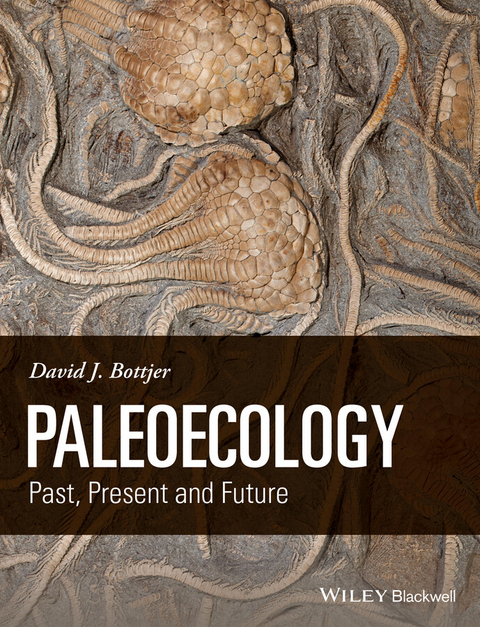
Paleoecology (eBook)
John Wiley & Sons (Verlag)
978-1-118-45581-4 (ISBN)
Paleoecology is a discipline that uses evidence from fossils to provide an understanding of ancient environments and the ecological history of life through geological time. This text covers the fundamental approaches that have provided the foundation for present paleoecological understanding, and outlines new research areas in paleoecology for managing future environmental and ecological change. Topics include the use of actualism in paleoecology, development of paleoecological models for paleoenvironmental reconstruction, taphonomy and exceptional fossil preservation, evolutionary paleoecology and ecological change through time, and conservation paleoecology. Data from studies of invertebrates, vertebrates, plants and microfossils, with added emphasis on bioturbation and microbial sedimentary structures, are discussed. Examples from marine and terrestrial environments are covered, with a particular focus on periods of great ecological change, such as the Precambrian-Cambrian transition and intervals of mass extinction.
Readership: This book is designed for advanced undergraduates and beginning graduate students in the earth and biological sciences, as well as researchers and applied scientists in a range of related disciplines.
David J. Bottjer is Professor of Earth Sciences, Biological Sciences, and Environmental Studies at the University of Southern California. He is a Fellow of The Paleontological Society, the Geological Society of America, and the American Association for the Advancement of Science, and is an Editor-in-Chief for the journal, Palaeogeogaphy, Palaeoclimatology, Palaeoecology. In 2014 he was awarded the Raymond C. Moore Medal for excellence in paleontology by the SEPM Society for Sedimentary Geology.
PALEOECOLOGY PALEOECOLOGYPast, Present and Future Paleoecology is a discipline that uses evidence from fossils to provide an understanding of ancient environments and the ecological history of life through geological time. This text covers the fundamental approaches that have provided the foundation for present paleoecological understanding, and outlines new research areas in paleoecology for managing future environmental and ecological change. Topics include the use of actualism in paleoecology, development of paleoecological models for paleoenvironmental reconstruction, taphonomy and exceptional fossil preservation, evolutionary paleoecology and ecological change through time, and conservation paleoecology. Data from studies of invertebrates, vertebrates, plants and microfossils, with added emphasis on bioturbation and microbial sedimentary structures, are discussed. Examples from marine and terrestrial environments are covered, with a particular focus on periods of great ecological change, such as the Precambrian-Cambrian transition and intervals of mass extinction. Readership: This book is designed for advanced undergraduates and beginning graduate students in the earth and biological sciences, as well as researchers and applied scientists in a range of related disciplines.
DAVID J. BOTTJER is Professor of Earth Sciences, Biological Sciences, and Environmental Studies at the University of Southern California. He is a Fellow of The Paleontological Society, the Geological Society of America, and the American Association for the Advancement of Science, and is an Editor-in-Chief for the journal, Palaeogeogaphy, Palaeoclimatology, Palaeoecology. In 2014 he was awarded the Raymond C. Moore Medal for excellence in paleontology by the SEPM Society for Sedimentary Geology.
Preface vii
1 Overview 1
2 Deep time and actualism in paleoecological reconstruction 10
3 Ecology, paleoecology, and evolutionary paleoecology 17
4 Taphonomy 33
5 Bioturbation and trace fossils 52
6 Microbial structures 64
7 Across the great divide: Precambrian to Phanerozoic paleoecology 76
8 Phanerozoic level-bottom marine environments 95
9 Reefs, shell beds, cold seeps, and hydrothermal vents 114
10 Pelagic ecosystems 128
11 Terrestrial ecosystems 139
12 Ecological change through time 153
13 Ecological consequences of mass extinctions 175
14 Conservation paleoecology 203
Index 217
Color plate pages fall between pp. 1 and 42
Chapter 1
Overview
Introduction
Paleoecology is the study of ancient ecology in its broadest sense. It has been enormously successful in placing the history of life within an ecological context. As part of that understanding, it has served as a vital tool for understanding the occurrence of many natural resources. In all its sophisticated approaches, paleoecology has taught us much about the past history of life and Earth's environments. With this record of demonstrating the response of Earth's biota to past environmental change, paleoecology now stands poised as a vital source of information on how Earth's ecosystems will respond to the current episode of global environmental change.
History of study
The notion that certain objects that one finds in sedimentary rocks were once living organisms is one that humanity struggled with for a long time. Leonardo da Vinci is generally credited with being the first to write down observations on the biological reality of fossils through examination of marine fossils from the Apennine Mountains of Italy. In reality, Leonardo also made some of the first paleoecological interpretations through understanding these fossils as the remains of once living organisms that had not been transported some great distance and hence were not deposited as part of a great flood. The great utility of fossils to geologists was highlighted in the 19th century by the development of the geological timescale, and of course, after publication of “On the Origin of Species” by Darwin, evidence from the fossil record was some of the strongest available then for evolution. For the past 200 years, stratigraphic and paleontologic work has defined the occurrence of the major fossil groups that make up the record, and this general outline can be seen in Fig. 1.1, which shows Paleozoic, Mesozoic, and Cenozoic characteristic marine (ocean) skeletonized fossils.
Figure 1.1 The Phanerozoic timescale with distribution of characteristic skeletonized marine fossils. Occurrence of fossils through the stratigraphic record has largely been determined through mapping efforts around the globe to characterize the surface geology of the continents. These fossil distributions have been continuously refined through the use of fossils to build the relative timescale and definition of Eras, Periods, and other time intervals. Key to classes: An, Anthozoa; Bi, Bivalvia; Ce, Cephalopoda; Cr, Crinoidea; De, Demospongiae; Ec, Echinoidea; Ga, Gastropoda; Gy, Gymnolaemata; In, “Inarticulata” (Linguliformea and Craniformea); Ma, Malacostraca; Mo, Monoplacophora; Os, Osteichthyes; Rh, “Articulata” (Rhynchonelliformea); Se, Stenolaemata; St, Stelleroidea; Tr, Trilobita. From McKinney (2007). Reproduced with permission from Columbia University Press.
Paleoecology as originally practiced is the use of biological information found in sedimentary rocks to help determine ancient paleoenvironments. Phanerozoic sedimentary rocks are found to have in situ marine fossils that we know were deposited in ancient oceans. Devonian and younger sedimentary strata that have remains of plants can be interpreted as deposited in terrestrial environments. For example, Fig. 1.2 shows the distribution within environments of various different fossil groups that have a substantial fossil record. One can see that these data are very valuable for understanding the past and past environments. So this information makes it easy to determine depositional environments of Phanerozoic sedimentary rocks, particularly in combination with physical sedimentary structures and geochemical indicators. Much work on paleoecology has been spurred by the petroleum industry and the need to understand ancient environments from drill cores and cuttings as well as outcrops. This need has led to much activity on microfossils, which can yield many specimens from a small piece of rock. And, through microfossils, information can be gained not only on ancient environments but also for ancient age determinations.
Figure 1.2 Environmental distribution of selected groups of fossils. This information largely comes from studies on the distribution of these organisms in modern environments, but also includes data on facies associations and functional morphology, particularly for the extinct groups. From Jones (2006). Reproduced with permission from Cambridge University Press.
In the 1960s and 1970s, the study of fossil communities, or paleocommunities, blossomed. To many, the results from this research activity seemed to show that animals in the past lived the way they do today. But, as this information has accumulated, it became clear that ecology changes through time, due to both evolution as well as environmental change. The synthesis of this realization has come to be known as evolutionary paleoecology. Evolutionary paleoecology has become a group of research programs that focus on the environmental and ecological context for long-term macroevolutionary change as seen from the fossil record. For example, Fig. 1.3 displays the tiering history for benthic suspension-feeding organisms in shallow marine environments below wave base since their early evolution in the Ediacaran, synthesized in work done with William Ausich. Tiering is the distribution of organisms above and below the seafloor, and this diagram shows how the distribution has changed through time and therefore how organisms have evolved their ability to inhabit three-dimensional space. This diagram is the latest of several showing tiering, and its development in the early 1980s was part of the early history of evolutionary paleoecology.
Figure 1.3 Tiering history among marine soft-substrata suspension-feeding communities from the late Precambrian through the Phanerozoic. Zero on the vertical axis indicates the sediment–water interface; the heaviest lines indicate maximum levels of epifaunal or infaunal tiering; other lines are tier subdivisions. Solid lines represent data, and dotted lines are inferred levels. These characteristic tiering levels were determined for infaunal tiers by examination of the trace fossil record, particularly the characteristic depth of penetration below the seafloor of individual trace fossils. Data on shallow infaunal tiers also came from functional morphology studies of skeletonized body fossils. Paleocommunity and functional morphology studies of epifaunal body fossils comprise the data for epifaunal tiering trends. Tiering data from the late Precambrian is from studies of the Ediacara biota. This tiering history has been updated as more data have become available. From Ausich and Bottjer (2001). Reproduced with permission from John Wiley & Sons.
Paleoecology and the future
Earth's ancient ecology is a fascinating subject for study, but there is more to be gained from this study as a benefit to present society. We are entering a time of widespread environmental change, in large part due to disruption of the carbon cycle (Fig. 1.4) through burning of lithospheric coal and petroleum and subsequent transfer of carbon in the form of carbon dioxide from the lithosphere into the atmosphere. This increase in greenhouse gasses in the atmosphere is causing rapid increased warming of the atmosphere and the ocean (Fig. 1.5). Increased warming of the ocean can lead to reduced ocean circulation which causes decreased oxygen content in ocean water and hence the growth of ocean systems characterized by reduced to no oxygen content, called “dead zones” (Fig. 1.6). Increased levels of atmospheric carbon dioxide cause decreases in the concentration of the carbonate ion in ocean water, termed ocean acidification, which makes it more difficult for many organisms such as corals to produce their calcium carbonate skeletons (Fig. 1.7).
Figure 1.4 Schematic of modern carbon cycle including anthropogenic influence. Combustion of lithospheric carbon such as coal and oil is the modern cause of global warming, and a similar mechanism involving igneous intrusions through sedimentary rocks rich in carbon has been the cause of rapid global warming episodes, or hyperthermals, in the past. From the New York State Department of Environmental Conservation website: http://www.dec.ny.gov/energy/76572.html.
Figure 1.5 Increase in ocean heat content since 1955 shown as a time series of yearly ocean heat content in joules (J) for the 0–700 m layer. Each yearly estimate is plotted at the midpoint of the year, with the reference period from 1957 to 1990. From Levitus et al. (2009). Reproduced with permission from John Wiley & Sons.
Figure 1.6 Location of hypoxic system coastal “dead zones.” Their distribution matches the global human footprint, where the normalized human influence is expressed as a percent, in the Northern Hemisphere. For the Southern Hemisphere, the occurrence of dead zones is only recently being reported. From Diaz and Rosenberg (2008). Reproduced with permission from the American Association for the Advancement of Science.
Figure 1.7 Increase in atmospheric carbon dioxide and its influence on ocean acidification and the resultant affect on development of coral reefs in the past, present, and future. (a) Increased carbon dioxide concentration in the oceans leads to decreased availability of carbonate ions, which are needed by corals to secrete their skeletons made of calcium carbonate. (b) Plot of...
| Erscheint lt. Verlag | 9.2.2016 |
|---|---|
| Sprache | englisch |
| Themenwelt | Geisteswissenschaften ► Archäologie |
| Geschichte ► Allgemeine Geschichte ► Vor- und Frühgeschichte | |
| Naturwissenschaften ► Biologie ► Ökologie / Naturschutz | |
| Naturwissenschaften ► Geowissenschaften ► Mineralogie / Paläontologie | |
| Technik | |
| Schlagworte | Biowissenschaften • earth sciences • evolutionary biology • Evolutionsbiologie • Geowissenschaften • Life Sciences • Paläontologie • Paläontologie, Paläobiologie u. Geobiologie • Paläontologie • Paläontologie, Paläobiologie u. Geobiologie • Paleontology, Paleobiology & Geobiology |
| ISBN-10 | 1-118-45581-9 / 1118455819 |
| ISBN-13 | 978-1-118-45581-4 / 9781118455814 |
| Informationen gemäß Produktsicherheitsverordnung (GPSR) | |
| Haben Sie eine Frage zum Produkt? |
 EPUB (Adobe DRM)
Kopierschutz: Adobe-DRM
Adobe-DRM ist ein Kopierschutz, der das eBook vor Mißbrauch schützen soll. Dabei wird das eBook bereits beim Download auf Ihre persönliche Adobe-ID autorisiert. Lesen können Sie das eBook dann nur auf den Geräten, welche ebenfalls auf Ihre Adobe-ID registriert sind.
Details zum Adobe-DRM
Dateiformat: EPUB (Electronic Publication)
EPUB ist ein offener Standard für eBooks und eignet sich besonders zur Darstellung von Belletristik und Sachbüchern. Der Fließtext wird dynamisch an die Display- und Schriftgröße angepasst. Auch für mobile Lesegeräte ist EPUB daher gut geeignet.
Systemvoraussetzungen:
PC/Mac: Mit einem PC oder Mac können Sie dieses eBook lesen. Sie benötigen eine
eReader: Dieses eBook kann mit (fast) allen eBook-Readern gelesen werden. Mit dem amazon-Kindle ist es aber nicht kompatibel.
Smartphone/Tablet: Egal ob Apple oder Android, dieses eBook können Sie lesen. Sie benötigen eine
Geräteliste und zusätzliche Hinweise
Buying eBooks from abroad
For tax law reasons we can sell eBooks just within Germany and Switzerland. Regrettably we cannot fulfill eBook-orders from other countries.
aus dem Bereich