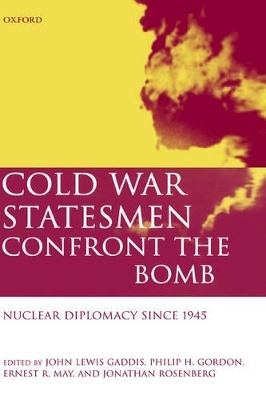
Cold War Statesmen Confront the Bomb
Oxford University Press (Verlag)
978-0-19-829468-9 (ISBN)
Cold War Statesmen Confront the Bomb: Nuclear Diplomacy Since 1945 is a path-breaking work that uses biographical techniques to test one of the most important and widely debated questions in international politics: Did the advent of the nuclear bomb prevent the Third World War?
Many scholars and much conventional wisdom assumes that nuclear deterrence has prevented major power war since the end of the Second World War; this remains a principal tenet of US strategic policy today. Others challenge this assumption, and argue that major war would have been `obsolete' even without the bomb.
This book tests these propositions by examining the careers of ten leading Cold War statesmen--Harry S Truman; John Foster Dulles; Dwight D. Eisenhower; John F. Kennedy; Josef Stalin; Nikita Krushchev; Mao Zedong; Winston Churchill; Charles De Gaulle; and Konrad Adenauer--and asking whether they viewed war, and its acceptability, differently after the advent of the bomb. The book's authors argue almost unanimously that nuclear weapons did have a significant effect on the thinking of these leading statesmen of the nuclear age, but a dissenting epilogue from John Mueller challenges this thesis.
PROFESSOR JOHN GADDIS is Professor of History at Yale DR PHILIP GORDON is Director for European Affairs, National Security Council, Washington PROFESSOR ERNEST MAY is Professor of History at Harvard PROFESSOR JONATHAN ROSENBERG is Assistant Professor of History at Florida Atlantic University
Introduction by Ernest May ; 1. 'War No Longer Has Any Logic Whatever': Dwight D. Eisenhower and the Thermonuclear Revolution ; 2. Longing for International Control, Banking on American Superiority: Harry S Truman's Approach to Nuclear Energy ; 3. Stalin and the Nuclear Age ; 4. John Foster Dulles' Nuclear Schizophrenia ; 5. Bear Any Burden?: John F. Kennedy and Nuclear Weapon ; 6. The Nuclear Education of Nikita Khrushchev ; 7. Before the Bomb and After: Winston Churchill and the Use of Force ; 8. Between 'Paper' and 'Real' Tigers: Mao's View of Nuclear Weapons ; 9. Charles De Gaulle and the Nuclear Revolution ; 10. Konrad Adenauer: Defence Diplomat on the Backstage ; Conclusion. Nuclear Statesmen ; Epilogue
| Erscheint lt. Verlag | 1.4.1999 |
|---|---|
| Verlagsort | Oxford |
| Sprache | englisch |
| Maße | 162 x 242 mm |
| Gewicht | 729 g |
| Themenwelt | Geschichte ► Allgemeine Geschichte ► Zeitgeschichte |
| Sozialwissenschaften ► Politik / Verwaltung ► Staat / Verwaltung | |
| ISBN-10 | 0-19-829468-9 / 0198294689 |
| ISBN-13 | 978-0-19-829468-9 / 9780198294689 |
| Zustand | Neuware |
| Informationen gemäß Produktsicherheitsverordnung (GPSR) | |
| Haben Sie eine Frage zum Produkt? |
aus dem Bereich