


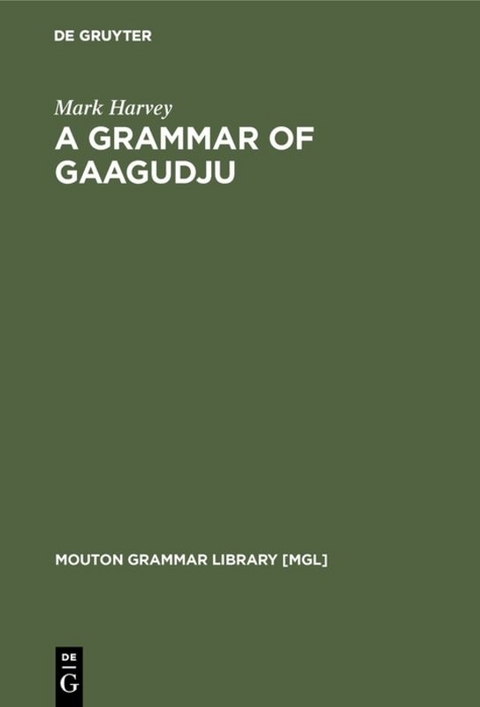
A Grammar of Gaagudju
Seiten
2002
de Gruyter Mouton (Verlag)
9783110172485 (ISBN)
de Gruyter Mouton (Verlag)
9783110172485 (ISBN)
The series builds an extensive collection of high quality descriptions of languages around the world. Each volume offers a comprehensive grammatical description of a single language together with fully analyzed sample texts and, if appropriate, a word list and other relevant information which is available on the language in question. There are no restrictions as to language family or area, and although special attention is paid to hitherto undescribed languages, new and valuable treatments of better known languages are also included. No theoretical model is imposed on the authors; the only criterion is a high standard of scientific quality.
Gaagudju is a previously undescribed and now nearly extinct language of northern Australia. This grammar provides an overall description of the language. Australian languages generally show a high degree of structural similarity to one another. Gaagudju conforms to some of the common Australian patterns, yet diverges significantly from others. Thus while it has a standard Australian phonological inventory, its prosodic systems differ from those of most Australian languages, with stressed and unstressed syllables showing marked differences in realisation. Like many northern languages, it has complex systems of both prefixation and suffixation to nominals and verbs. Prefixation provides information about nominal classification (4 classes), mood, and pronominal cross-reference (Subjects, Objects, and Indirect Objects). Suffixation provides information about case, tense, and aspect. As in many languages, there is a clear distinction between productive and unproductive morphology. Gaagudju differs from most Australian languages in that a considerable amount of its morphology is unproductive, showing complex and irregular allomorphic variation. Gaagudju is like most Australian languages in that it may be described as a free word order language. However, word order is not totally free and strictly ordered phrasal compounding structures are significant (e.g. in the formation of denominal verbs).
Gaagudju is a previously undescribed and now nearly extinct language of northern Australia. This grammar provides an overall description of the language. Australian languages generally show a high degree of structural similarity to one another. Gaagudju conforms to some of the common Australian patterns, yet diverges significantly from others. Thus while it has a standard Australian phonological inventory, its prosodic systems differ from those of most Australian languages, with stressed and unstressed syllables showing marked differences in realisation. Like many northern languages, it has complex systems of both prefixation and suffixation to nominals and verbs. Prefixation provides information about nominal classification (4 classes), mood, and pronominal cross-reference (Subjects, Objects, and Indirect Objects). Suffixation provides information about case, tense, and aspect. As in many languages, there is a clear distinction between productive and unproductive morphology. Gaagudju differs from most Australian languages in that a considerable amount of its morphology is unproductive, showing complex and irregular allomorphic variation. Gaagudju is like most Australian languages in that it may be described as a free word order language. However, word order is not totally free and strictly ordered phrasal compounding structures are significant (e.g. in the formation of denominal verbs).
Mark Harvey is Lecturer at the University of Newcastle, Australia.
>
1 Language owners and speakers
2 Segmental phonology
3 Phonotactics and morphophonology
4 Nominals
5 Verbs
6 Clitics and phrasal compounds
7 Syntax
Appendices
| Erscheint lt. Verlag | 24.9.2002 |
|---|---|
| Reihe/Serie | Mouton Grammar Library [MGL] ; 24 |
| Zusatzinfo | 4 maps |
| Verlagsort | Berlin/Boston |
| Sprache | englisch |
| Maße | 155 x 230 mm |
| Gewicht | 955 g |
| Themenwelt | Geisteswissenschaften ► Sprach- / Literaturwissenschaft ► Literaturwissenschaft |
| Geisteswissenschaften ► Sprach- / Literaturwissenschaft ► Sprachwissenschaft | |
| Schlagworte | A • Aboriginal Australians • Aboriginal Australians, Languages, Grammar • Aspect • Australia • Australian Languages • Australische Sprachen • Autodesk Inventor • classification • Complex • Complex System • Complex Systems • Compound • Fixation • Formation • Gagadu language • Gagadu language, Grammar • grammar • Grammatik • Hardcover, Softcover / Allgemeine und Vergleichende Sprachwissenschaft • HC/Sprachwissenschaft, Literaturwissenschaft/Sonstige Sprachen, Sonstige Literat • HSK26.1 • Information • Inventory • Kakadu-Sprache • Kittel • language • Languages • Morphology • object • Pattern • Patterns • Phonology • Similarity • Stress • Structure • Structures • Subject • Tense • TRANSL.TRAD. • Uebersetzung |
| ISBN-13 | 9783110172485 / 9783110172485 |
| Zustand | Neuware |
| Informationen gemäß Produktsicherheitsverordnung (GPSR) | |
| Haben Sie eine Frage zum Produkt? |
Mehr entdecken
aus dem Bereich



aus dem Bereich
die griechischen Mythen neu erzählt von Sarah Iles Johnston
Buch | Hardcover (2025)
C.H.Beck (Verlag)
CHF 51,90


